

Low-competition keywords are often the primary reason small websites finally start receiving Google traffic.
When you pick a keyword and write a great article. You waited.
Nothing happened.
Sound familiar?
Here is what probably went wrong. You went after a keyword that 500 other websites, many with years of history and thousands of backlinks, are already fighting for.
You never had a chance. Not because your content was bad. But because you brought a bicycle to a Formula 1 race!
This is the common trap most small business site owners fall into. And it costs them months of work with zero results.
The fix is not to write better. The fix is to pick smarter. That is where low competition keywords come in.
Most new site owners make the same mistake. You open an SEO tool, find a keyword with thousands of monthly searches, write a long article, and hope Google ranks it fast. But weeks later, nothing happens.
That is because big keywords usually belong to giant websites with strong domain authority, huge backlink profiles, and deep topical authority. Small sites cannot easily compete against brands that already dominate the SERP.
The smarter move is different.
Instead of chasing massive search volume, you should focus on low competition keywords with clear search intent and real ranking opportunities.
These are usually long-tail keywords that match what users truly search for. They also help Google better understand your topical relevance, semantic SEO signals, and content strategy.
When you build content clusters around related search queries, use proper internal linking, and match user intent correctly, your website becomes easier for Google Search to trust. This is where NLP keywords, contextual relevance, entity-based SEO, and EEAT start working together.
Small niche websites grow faster when they stop trying to beat giant brands at their own game. The real win comes from finding easy-to-rank topics, solving specific problems, and creating content that directly matches search behavior.
That is how small sites start getting organic traffic within weeks instead of waiting years
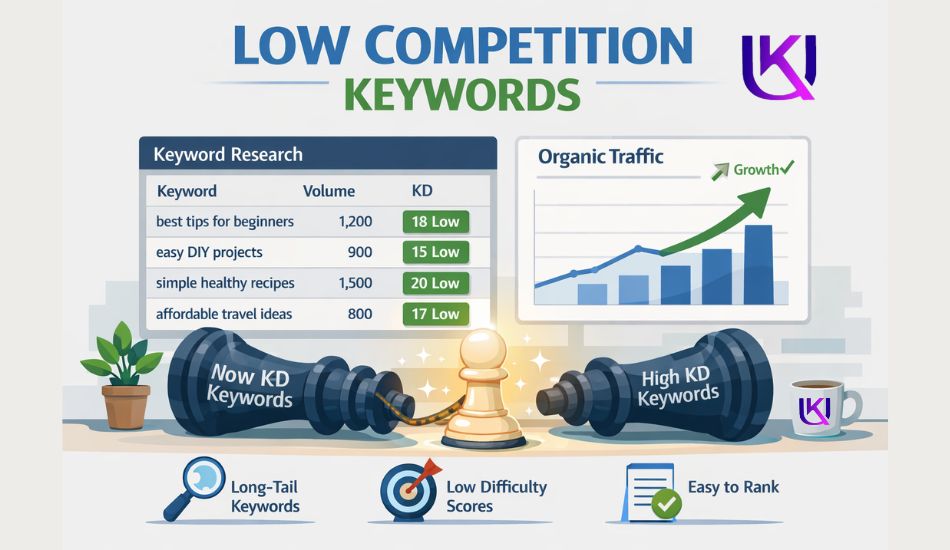
What Are Low Competition Keywords?
Low competition keywords are search phrases that real people type into Google, but big websites are not targeting them hard.
Think of it this way. “Weight loss tips” gets millions of searches. WebMD, Healthline, and Forbes are all fighting for that top spot. You will never beat them.
But “weight loss tips for night shift nurses”? That is a different story. Fewer sites wrote about it. The ones that did might be weak, old, or off-topic. You can walk right in and take that spot.
Low competition keywords are search terms that have relatively few websites targeting them, which makes it easier to achieve higher rankings in search engine results. And here is something that might surprise you.
Content targeting low-competition keywords can reach higher positions in 3–6 months significantly faster than pages optimized for highly competitive terms.
Three to six months. Not three years.

Why Big Keywords Are a Trap for Small Sites?
Big keywords feel exciting. “Best running shoes” gets 150,000 searches a month. You write about it. You imagine the traffic. Then Google buries you on page 8.
But here is the truth: broad, short keywords attract competition from large brands with massive budgets and years of SEO authority. You are not just competing with one site. You are competing with Nike, Runner’s World, and Amazon all at once.
High-volume terms are overcrowded, costly, and can take months, sometimes years, to rank for. Relying on that approach often wastes both time and money.
You have neither time nor a giant budget. So stop playing their game.

The Real Numbers Behind Low Competition Keywords
Before you think this is “settling for less,” read this.
Long-tail low-competition keywords account for 70% of all search traffic. The mass of actual people searching Google are not typing short, vague keywords. They are typing specific questions and phrases.
Because fewer sites target specific long-tail phrases, strong pages often outrank generic competitors faster. Users typing specific phrases usually know what they want and are closer to converting.
So you get traffic faster. And the people who arrive are actually looking for what you offer. That is a double win.

What Makes a Keyword “Low Competition”?
Not every low-search-volume keyword is a good one. You need to look at a few things together.
1. Keyword Difficulty (KD). This is a score most tools give you. For beginners, it is better to target keywords with a very low KD, often in the 0–10 range depending on the tool. The sweet spot many experts identify is a KD under 30 and a monthly search volume under 1,000.
2. Who is already ranking? This one matters a lot. Low competition keywords are search queries where the top-ranking pages are beatable. Look for signs like low-authority sites already ranking on page one, few or weak backlinks to top pages, or thin and outdated content in the top results.
If page one shows forum posts, Reddit threads, or old articles from 2018, that is your green light.
3. Search intent. Does the keyword have a clear meaning? Can you write one focused article that fully answers it? If yes, that is a keeper.

Step-by-step Framework: How to Find Low Competition Keywords?
You do not need to spend hundreds of dollars a month on tools. Start free. Scale later.
Step 1: Start With a Seed Topic
Pick a broad topic you cover. Do not go too narrow yet. If you run a personal finance blog, your seed topic might be “budgeting.” If you write about fitness, it might be “home workouts.”
Think of a broad topic your audience cares about. These broad topics are known as seed keywords; they are the foundation for everything else you will research.
Step 2: Use Google Autocomplete
This is completely free, and most people walk right past it.
Start typing your seed keyword into Google and pause before hitting Enter. Google will show a dropdown of suggestions based on what real people are searching.
Type “budgeting for” and watch what shows up. You might see “budgeting for college students,” “budgeting for a family of four,” or “budgeting for beginners with low income.”
Every one of those is a real keyword idea. People are actually searching for them.
Step 3: Check “People Also Ask”
Scroll down in Google results. You will see a box with questions. These are real queries people type into Google. Each question is a potential blog post idea.
These questions are gold. Often overlooked by bigger sites. They are the exact words your reader is using. Write an article around one of them, and you have a real shot.
Step 4: Check “Related Searches” at the Bottom
Scroll to the bottom of Google and check the related searches section. That is Google telling you: here is what else people are looking for. Every one of those phrases is keyword gold.

Step 5: Look at the SERP
Before you commit to a keyword, look at who is already ranking. Are the top results thin, outdated, poorly structured, or off-intent? If yes, that is a sign you can do better.
If you see big publications like Forbes or The New York Times on page one, skip it. If you see a random blogspot.com from 2016 sitting at #3, that is your open door.
Step 6: Use a Keyword Tool to Confirm
Free tools like Google Keyword Planner, Ahrefs Free Keyword Generator, or Ubersuggest can help you check volume and difficulty. The Ahrefs Free Keyword Generator shows 50 related questions, which are gold for content that satisfies Google’s Helpful Content system.
Look for anything under KD 30 with at least 100–500 monthly searches. That is a realistic, winnable target.

Beginner Guide: What is The Long-Tail Keyword Secret?
Long-tail keywords are the engine behind this whole strategy.
A long-tail keyword is just a longer, more specific phrase. Instead of “shoes,” it is “best walking shoes for flat feet women.” In place of “diet,” it is “what to eat after 40 to lose belly fat.”
A small business can target long-tail keywords like “handmade organic dog toys for large breeds,” which likely has much lower competition than a broader term like “dog toys.”
This strategy lets smaller or more focused businesses compete effectively against larger competitors.
Long-tail keywords are less competitive, which means Google can more easily rank your content even if your domain is brand new.
Long-tail searches also reveal clear intent, and when your content directly answers that intent, Google typically rewards the page with a higher position.
Here is a simple pattern to follow. Take your seed topic. Add a specific modifier:
- Who? “for nurses,” “for seniors,” “for beginners.”
- Where? “in Texas,” “for small apartments.”
- When? “in winter,” “after surgery,” “at night.”
- How much? “under $50,” “on a tight budget.”
- What type? “without equipment,” “without a gym.”
These modifiers turn a crowded keyword into a niche one you can own.

What to Do With Competitors Who Already Rank?
You do not need to ignore your competitors. Study them.
Look at the pages already ranking for your target keyword. Read them. Ask yourself:
- Is this article old or outdated?
- Does it actually answer the question fully?
- Is it confusing or hard to read?
- Does it skip important subtopics?
If you answered yes to any of these, your job is simple. Write something better, clearer, and more complete. That is how a brand-new site beats an older one.
Choosing the right keyword is half the job. The rest is packaging the best answer on the internet.

How to Organize Your Keywords Into a Winning Plan?
Finding keywords is step one. Using them smartly is step two.
Do not just write random articles. Build topic clusters. Low competition keywords play an important role when you build topic clusters around a central theme. You can cover multiple subtopics related to your main keyword and connect them through internal links to increase your authority.
Here is how a simple cluster looks for a personal finance blog:
- Main pillar: How to budget your money (moderately competitive, you build toward this)
- Cluster articles: budgeting tips for college students, how to budget on $2,000 a month, budgeting apps for beginners, how to stop overspending when you’re bored
Each cluster article has low competition. Each one links back to your main pillar. Over time, Google sees your site as an authority on budgeting, and your pillar article starts climbing too.
As you rank for low competition keywords, Google begins to trust your site, enabling you to target higher-volume, more competitive keywords in the future. You are not settling. You are building a staircase.

Low Competition Keywords: The 4-Week Quick-Start Plan
You do not have to figure this out over months. Here is a simple first move.
- Week 1: Pick one seed topic. Use Google Autocomplete and People Also Ask to collect 20 keyword ideas. Write them all down.
- Week 2: Check each keyword’s difficulty using a free tool. Circle the ones with KD under 30 and at least 100 searches per month. Pick your top 5.
- Week 3: Write your first two articles. Each one fully answers one keyword. Keep it clear, specific, and helpful. Link the two articles.
- Week 4: Publish three more articles. Add internal links between your pages, submit them to Google Search Console, and build a few contextual links from relevant communities if available.
That is one solid month of smart SEO work. Most sites start seeing impressions in Google Search Console (GSC) within 4–6 weeks of consistently doing this.

Common Mistakes to Avoid Low Competition Keywords Game Changing
1. Chasing volume over opportunity: A keyword with 50,000 searches and a KD of 80 is useless to you. A keyword with 400 searches and a KD of 8 can bring you to page one. Pick the second one every time.
2. Targeting too many keywords in one article: Keyword overload confuses and dilutes relevance. Focus on a small, tight set per page. One primary keyword. Two or three supporting ones. That is it.
3. Ignoring the SERP: A tool score is just a number. Always look at the actual search results. If high-authority sites dominate page one, trust the SERP over the score.
4. Writing without a plan: Random articles do not build authority. A strong long-tail keyword strategy is one of the most practical ways to grow organic traffic when you do not have a massive domain, a huge backlink profile, or an enterprise SEO budget. Plan your cluster first. Then write.

What Happens When You Finally Stop Chasing Big Keywords?
Everything starts changing when you stop targeting impossible keywords and focus on realistic ranking opportunities instead.
At first, the results may look small. A few impressions. A few clicks. Maybe one article reaches page two of Google Search. But then something important happens. Your content starts getting noticed.
Low competition keywords usually rank faster because fewer websites are fighting for them. That means small sites can begin getting organic traffic much earlier instead of waiting years to compete with giant brands.
The traffic also becomes more qualified. People who search long-tail keywords often know exactly what they want. They stay longer, read more pages, and engage more with your content because it directly matches their search intent.
Over time, your website naturally builds topical authority. Each helpful article strengthens your semantic SEO signals, contextual relevance, and internal linking structure. Google slowly starts understanding your niche and trusting your content more.
This creates a powerful cycle.
Better topical relevance leads to easier rankings. Easier rankings bring more organic traffic. More traffic helps your website gain authority even faster.
You also remove a huge amount of content stress. Instead of constantly worrying about massive keyword difficulty scores and giant competitors, you focus on creating useful content your audience truly needs.
That makes SEO feel more manageable, more strategic, and much more sustainable for small websites.
Your website finally starts getting noticed.

You Do Not Need to Be Big to Win
Small sites usually fail because they chase high-volume keywords with impossible keyword difficulty scores. Bigger brands already own those Google Search results.
Alternatively, fighting giant websites, you should focus on low competition keywords with clear search intent and strong topical relevance. These long-tail keywords help you build topical authority faster.
When you combine semantic SEO, internal linking, NLP keywords, and content clusters, Google better understands your content strategy and user intent.
This creates easier ranking opportunities, higher organic traffic, better click-through rates, and faster growth for niche websites with low domain authority.
Here is the thing nobody tells you when you start a website.
You do not need to beat everyone. You just need to beat the weak spots.
Every niche has ignored corners. Questions nobody answered well. Old articles that stopped being updated. Thin content that technically exists but does not really help anyone.
Those are your openings.
The real secret to getting traction with SEO and getting it faster is to aim for low-competition keywords. These are the specific, often-ignored phrases that your ideal customers are actually typing into Google.
Stop trying to merge onto a gridlocked highway. Find the open back road. Show up where the giants are not paying attention. Write something genuinely helpful. Repeat.
That is how small sites win. Not by fighting harder. By fighting smarter.

Final Thoughts: What Is the Fastest Way to Grow Organic Traffic for Small Sites?
Growing a small website with SEO takes patience. Most sites fail because they try to grow too fast. They chase huge keywords, copy big brands, and expect instant rankings. But Google rewards websites that stay focused, helpful, and consistent over time.
The better strategy is simple. Target low competition keywords that match real user intent. Build content clusters around related topics. Improve your internal linking. Keep adding useful content that solves small but important problems your audience already searches for.
You do not need massive search volume to grow organic traffic. You need smart keyword targeting, strong topical relevance, and a clear content strategy that builds authority slowly.
Every helpful article adds another signal of trust. Every long-tail keyword creates another ranking opportunity. Over time, Google starts understanding your niche, your expertise, and your website structure much better.
That is how small sites slowly build topical authority without a huge backlink profile or enterprise SEO budget.
Small sites do not win by being bigger. They win by being smarter.
Most relevant article: What Is SEO and How Does It Really Work in 2026?

FAQs: How Do Small Websites Find Easy-to-Rank Keywords?
1. What is a low competition keyword?
It is a search phrase that real people type into Google, but for which few strong websites are competing. They are usually longer, more specific phrases. They are easier to rank for, especially for new or small sites.
2. How do I know if a keyword is truly low competition?
Check the keyword difficulty score in a tool like Ahrefs, Ubersuggest, or Google Keyword Planner. Aim for a KD under 30. Then look at the actual search results to confirm that the ranking pages are weak, old, or off-topic.
3. Can I find low competition keywords for free?
Yes. Google Autocomplete, People Also Ask, Related Searches at the bottom of results, and Google Keyword Planner are all free. They give you real data straight from Google itself.
4. How long does it take to rank for low competition keywords?
Most pages targeting low-competition keywords with good content can reach the first page within 3–6 months. Some rank in as little as a few weeks if the competition is especially weak.
5. Do low competition keywords get enough traffic to matter?
Yes. A single low-competition keyword might bring 50–300 visitors a month. When you build 20–30 articles around similar keywords, that adds up fast. And because the traffic is targeted, it converts better than broad, high-volume traffic.
6. Should I stop using high competition keywords forever?
No. Start with low competition keywords to build trust and authority with Google. Once your site grows, start blending in harder keywords on pillar pages. Think of it as a staircase, not a ceiling.