

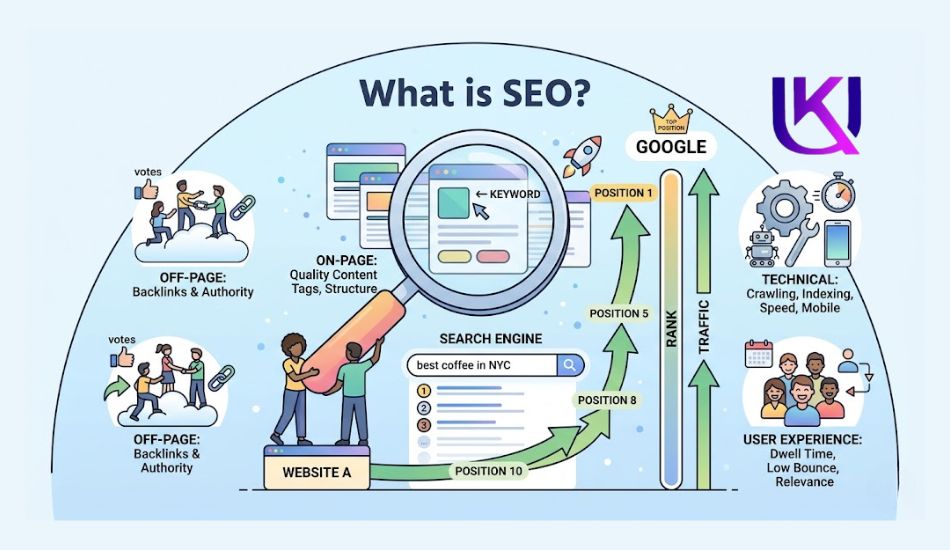
What is SEO? Mean is SEO short for Search Engine Optimization, is the process of improving your online site. It appears higher in search results when people look for topics related to your business or interests on Google, Bing, and other search engines.
Think of the internet as a giant library, and search engines as librarians. SEO is how you make sure the librarian knows exactly what your book is about so they can recommend it to the right people.
If your website is live but no one finds it, you are not alone. Many site owners post pages, products, or blogs and still get little traffic from Google, Bing, or Yahoo.
Search Engine Optimization (SEO) is the smart process of improving your personal or business website so it can appear higher in search results and bring more organic traffic.
It helps search engines crawl your pages, understand your content, index your site, and rank it for the right searches based on search intent.
Good SEO solves real problems. If your webpages are slow, hard to use on mobile, missing keywords, or weak in trust, they often stay hidden. That is where on-page, off-page, and technical SEO help.
- On-page SEO improves title tags, meta descriptions, header tags, internal linking, image alt text, URL structure, and content quality.
- Off-page SEO builds authority through backlinks, brand mentions, social signals, referring domains, and stronger domain authority.
- Technical SEO improves page speed, Core Web Vitals, mobile-friendly design, HTTPS security, XML sitemaps, robots.txt files, canonical tags, schema markup, structured data, and broken link fixes.
Many beginners and businesses use tools like Google Search Console, Google Analytics, Semrush, and Moz to check rankings, fix errors, and find new keyword research opportunities.
If you want more visibility, more clicks, and better results without always paying for ads, SEO is one of the best long-term solutions.
What Is SEO? Meaning in Simple Words for Beginners?
SEO stands for Search Engine Optimization. It means improving your website so search engines like Google, Bing, Yahoo, and even YouTube can understand your pages and show them to the right people.
The main goal is simple: help your site rank higher in search results and bring more organic traffic, which means unpaid visitors who found you through search.
Today, SEO is also about trust. Search engines look for E-E-A-T:
- Experience,
- Expertise,
- Authoritativeness
- Trustworthiness.
If you give clear answers, useful content, and a good user experience, your website has a better chance of growing.
Think of SEO as making your website easier to trust, easier to use, and easier to find. Search engines use bots to crawl pages, read content, follow internal linking, and place useful pages into their index.
They compare pages using ranking signals like relevance, content quality, user experience, mobile-friendly design, page speed, Core Web Vitals, and trust signals such as E-E-A-T.
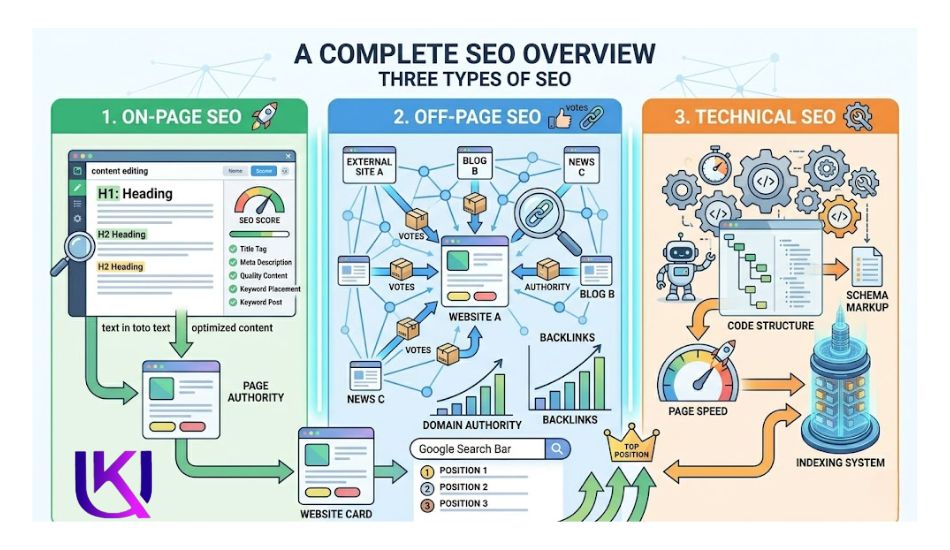
SEO is usually divided into three main parts.
- On-page SEO focuses on title tags, meta descriptions, header tags, keyword research, image alt text, URL structure, readability, and content quality.
- Off-page SEO builds authority through backlinks, referring domains, brand mentions, and social signals.
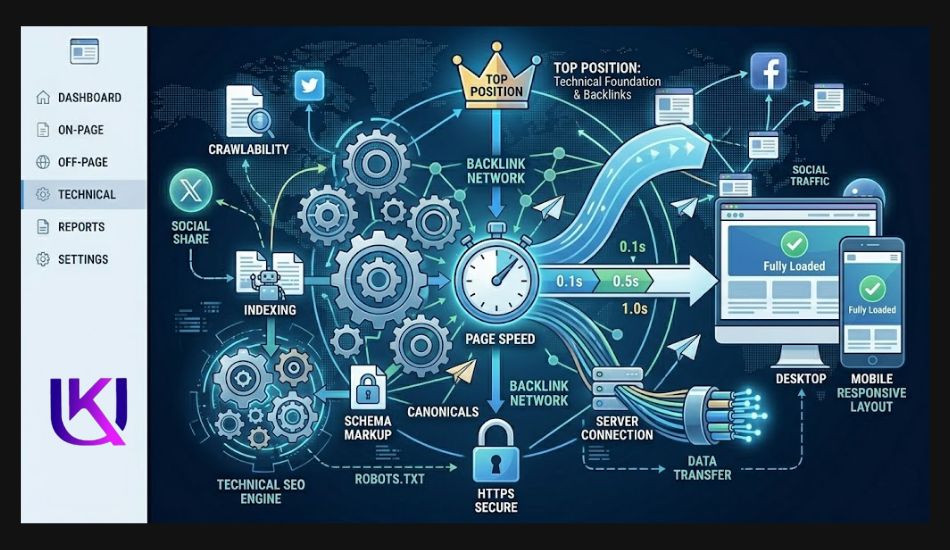
- Technical SEO improves crawlability, indexing, XML sitemaps, robots.txt, canonical tags, HTTPS, schema markup, structured data, and fixing broken links.
When these parts work together, your website becomes stronger in search results. That means more visibility, better rankings, and visitors who are already searching for what you offer.
Many personal and business website owners use Google Search Console, Google Analytics, and other relevant tools like Semrush, Ahrefs, and Moz to track progress, find problems, and grow traffic over time.

What Is SEO? How Many Search Engines in the Global and How They Work?
There are over 1,500 search engines globally, ranging from major general-purpose platforms to specialized niche tools. While hundreds exist, the market is dominated by a few players, with Google holding over 90% market share as of early 2026, followed by Bing, Yandex, Yahoo!, and DuckDuckGo.
Key Search Engines & Market Share (2025-2026)
- Google: Approx 89-90% market share, dominant globally.
- Microsoft Bing: Approx 4.1% market share, growing in desktop search.
- Yandex: More than 1.3-2.5% market share, dominant in Russia.
- Yahoo!: Now approx 1.3-1.48% market share, powered by Bing.
- DuckDuckGo: Approx 0.75-0.8% market share, focused on privacy.
- Baidu: Leading search engine in China.
Types of Search Engines
- General: Google, Bing, Yahoo!, Baidu, Yandex.
- Privacy-Focused: DuckDuckGo, StartPage, Searx.
- Academic or Specialized: Google Scholar, PubMed, Wolfram Alpha.
- Alternative/Eco-Friendly: Ecosia, Swisscows, Mojeek.
While many niche or specialized engines exist, most alternative search engines often rely on indices from major providers like Bing.
What is SEO? Meaning, Types, and How It Works?
Search engines use “bots” (often called crawlers or spiders) to scan the internet. They look at your website and gather information to put it into an index. When someone types a query, the search engine looks through that index to find the most relevant, high-quality answers.
The Three Pillars of SEO
To get the “librarian” to notice you, you need to focus on three main areas:
- On-Page SEO: This is what you do on your website. It includes writing high-quality content, using the right keywords, and making sure your titles and descriptions are clear.
- Off-Page SEO: This is about your website’s reputation. If other reputable websites link to yours (called “backlinks”), search engines see your site as an authority. It’s like getting a “vote of confidence” from the rest of the web.
- Technical SEO: This is the “behind-the-scenes” stuff. Is your site fast? Does it work well on mobile phones? Is it easy for search bots to read? If your site is a mess technically, search engines will avoid it.
2. Why is it important?
Most people never click past the first page of Google. In fact, the top few results get the vast majority of the traffic.
- Free Traffic: Unlike ads, you don’t pay every time someone clicks on an organic search result.
- Trust: Users generally trust organic results more than paid advertisements.
- Sustainability: Good SEO can bring visitors to your site for years, whereas an ad stops working the second you stop paying for it.
3. SEO Checklist for Beginners
If you are just starting, focus on these four steps:
| What is SEO Step? | What is SEO Action? |
| Keywords | Find out what terms people actually type into Google to find you. |
| Quality Content | Write articles or pages that actually answer the user’s question better than anyone else. |
| Mobile-Friendly | Ensure your site looks great and loads quickly on a smartphone. |
| User Experience | Make it easy for people to navigate your site without getting lost or frustrated. |
SEO isn’t about “tricking” Google; it’s about providing the best possible experience and information to the person searching. If you help the user, the search engine will eventually help you.
How SEO Works to Get More Website Traffic?
Search Engine Optimization works by helping search engines discover, understand, and trust your website. When someone searches on Google, Bing, or Yahoo, the search engine tries to show the best answer first. If your website is clear, fast, useful, and relevant, it has a better chance of ranking higher and bringing more organic traffic.
1. Step One is Crawling: Search engine bots visit your pages, read your text, follow internal linking, and check files like robots.txt and XML sitemaps. This helps them find new pages and updated content. If your site has broken links, slow speed, or poor structure, crawling can become harder.
2. Second Step is Indexing: After crawling, search engines store your page in their index. This is like a giant library of websites. If your content is thin, duplicated, or confusing, some pages may not get indexed well. Clear headings, high-quality content, image alt text, and a clean URL structure can help.
3. The Third Step is Ranking: Search engines compare many pages and use ranking signals to choose the best result. These signals include keyword relevance, search intent, mobile-friendly design, page speed, Core Web Vitals, HTTPS security, backlinks, referring domains, brand mentions, and trust signals like E-E-A-T. Good on-page, off-page, and technical SEO all support better rankings.
SEO is not an instant game-changing strategy like One Night Standing Revolution Success!
It often takes time, testing, and updates. Many website owners use Google Search Console to see indexing issues, Google Analytics to track visitors, and tools like Semrush or Moz for keyword research and audits. When you improve what users need and remove what blocks performance, SEO starts working in your favor.
Why SEO Matters: Is SEO Dead or Still Powerful in 2026?
If your website is hard to find, people may never know your business exists. That is why Search Engine Optimization matters. SEO helps your pages appear in search results on Google, Bing, Yahoo, and even YouTube. When your site ranks higher, more people can find you at the exact moment they need help, products, or answers.
One of the biggest benefits is more organic traffic. These visitors come from unpaid search clicks, so you do not need to rely only on ads. White-hat SEO can keep bringing traffic month after month. This makes it a strong long-term growth strategy for blogs, local businesses, online stores, and service websites.
SEO also brings better visitors. By conducting keyword research and understanding search intent, you can attract people who are already looking for what you offer. If someone searches for a solution you provide, that visitor is more likely to read, sign up, call, or buy. This means higher-quality traffic, not just random clicks.
Another reason SEO matters is trust. Many users believe top-ranking pages are more reliable. Search engines also look at NLP (Natural Language Processing) at E-E-A-T signals like experience, expertise, authoritativeness, and trustworthiness.
If your site has helpful content, clear titles, fast page speed, HTTPS security, mobile-friendly design, and strong backlinks, it can earn more trust from both users and search engines.
SEO also helps you stay competitive. If your competitors invest in on-page SEO, off-page SEO, and technical SEO while you do nothing, they may win the traffic first.
Tools like Google Search Console, Google Analytics, Semrush, and Moz can help you track growth, find gaps, and improve rankings over time. In simple words, SEO matters because it helps the right people find you before they find someone else.
What Are the Main Types of SEO and How Do They Work?
Search Engine Optimization is not one single task. It has different parts that work together to help your website rank better on Google, Bing, and other search engines. If one part is weak, your results may suffer. The main types of SEO are on-page SEO, off-page SEO, technical SEO, and local SEO.

1. What Is SEO and How Can On-Page SEO Bring Free Traffic?
On-page SEO focuses on everything inside your website pages. It helps search engines understand what each page is about and helps users enjoy reading it.
This includes title tags, meta descriptions, header tags, keyword research, search intent matching, content quality, readability, image alt text, internal linking, and clean URL structure. Good on-page SEO makes your content useful and easy to scan.
2. How Does Google Use Off-Page SEO to Rank Websites?
Off-page SEO happens outside your website. It builds trust and authority. The biggest factor is backlinks, which are links from other websites pointing to your pages. Search engines may see quality backlinks as signs that your content is helpful. Off-page SEO also includes brand mentions, social signals, referring domains, and growing domain authority over time.
3. Why Is Technical SEO Important for Growing a Website or Business?
Technical SEO improves how your website performs behind the scenes. It helps search engines crawl, index, and rank your pages more easily.
Important parts include page speed, Core Web Vitals, mobile-friendly design, HTTPS security, XML sitemaps, robots.txt, canonical tags, schema markup, structured data, fixing broken links, and improving crawlability.
4. Local SEO: Branding Your GBP Easy Searching Visitors
Local SEO helps businesses appear in local searches, such as “near me” or city-based keywords. It is useful for shops, doctors, restaurants, agencies, and service providers. Local SEO often includes map visibility, customer reviews, local content, and a well-managed business profile on Google platforms like GBP (Google Business Profile).
Why These Types Matter Ranking Factors?
The best results usually come when all SEO types work together. Strong content without technical SEO may stay hidden.
Best technical setup without backlinks may rank slowly. When you balance every part, you create a stronger website that can attract more organic traffic and better rankings. Many people use Google Search Console, Google Analytics, Semrush, and Moz to improve each area.

7 Basic Things to Do SEO for Beginners: How Does SEO Work for Business Boost Ranking?
Starting Search Engine Optimization can feel confusing at first, but you do not need to do everything at once. The best way is to begin with simple steps that help both users and search engines like Google and Bing understand your website. Small improvements done well can grow into strong results over time.
1. Start With Keyword Research
Find the words people already search for. This is called keyword research. Look for terms related to your topic, product, or service. Focus on phrases that match search intent.
For example, a user searching “how to grow tomatoes” wants a guide, while someone searching “buy tomato seeds” wants to shop.
Tools like Semrush, Moz, and Google Search Console can help you discover useful keywords.
2. Create Helpful Content Management
Write pages that solve real problems. Give clear answers, easy steps, and useful examples. Because Unique content is King, so strong content quality matters more than writing many weak pages. Use headings, short paragraphs, and natural keywords. Make sure each page has one clear topic.
3. Improve On-Page SEO
Help search engines understand each page by improving:
- Title tags
- Meta descriptions
- Header tags
- URL structure
- Image alt text
- Internal linking
- Readability
These small changes can improve clicks and rankings.
4. Fix Technical SEO Basics
Your website should be easy to crawl and fast to use. Check:
- Mobile-friendly design
- Page speed
- Core Web Vitals
- HTTPS security
- XML sitemaps
- Robots.txt
- Broken links
- Canonical tags
Good technical SEO removes barriers that stop growth.
5. Build Trust and Authority
Search engines value websites that people trust. You can build authority with quality backlinks, brand mentions, useful resources, and honest content. Show NLP and E-E-A-T by sharing real experience, expertise, and trustworthy information.
6. Track Results and Keep Improving
SEO is not one-time work. Watch what grows and what needs fixing. Use Google Analytics to track visitors and Google Search Console to monitor clicks, indexing, and search results.
7. Beginner Tip for What Is SEO Game-changing?
Do not chase shortcuts. Focus on helping users, improving your pages, and staying consistent. Even basic SEO can bring more organic traffic when done the right way.
What are SEO Tools: How They Help You Grow?
When you start learning Search Engine Optimization, using tools makes your work easier and faster. They help you understand what is working, what is not working, and what users are searching on Google and other platforms like Bing.
1. Keyword Research Tools
Keyword tools help you find what people are searching for. They show search volume, competition, and related ideas. This helps you choose the right topics based on search intent, so your content matches real user needs.
Popular paid tools:
- Semrush
- Moz
- Ahrefs
Free SEO Tools:
Many other techniques, as an SEO Expert, can realize their expertise through the method used.
2. Website Performance Tools
These tools show how your website is performing in search results. You can see clicks, impressions, indexing status, and errors. This helps you fix problems early and improve visibility.
Key tools:
- Google Search Console
- Google Analytics
3. Content Optimization Tools
These tools help you improve your pages for better rankings. They suggest keywords, content structure, readability, and SEO score improvements. This helps you create stronger on-page SEO content.
4. SEO Audit Tools
Audit tools check your full website and find issues like:
- Broken links
- Slow pages
- Missing tags
- Technical errors
- Crawl issues
This improves your technical SEO and helps search engines understand your site better.
5. Why SEO Tools Matter
Without tools, SEO becomes guesswork. With tools, you can:
- Understand your audience
- Fix website problems
- Track ranking growth
- Improve content quality
- Increase organic traffic
6. Simple Idea: What are SEO Tips
The best SEO strategy is not only writing content. It is also checking data, fixing errors, and improving step by step. Tools make this process clear and measurable, so you can grow your website with confidence.
Common Mistakes SEO You Should Avoid
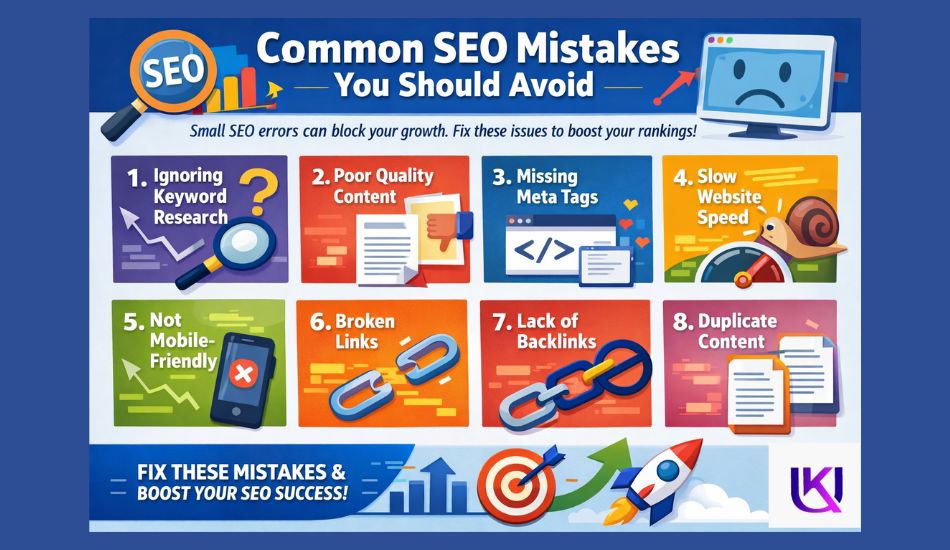
Many beginners in Search Engine Optimization put in the right effort but still do not get results on Google or Bing. The reason is simple, and small mistakes can block your growth, even if your content is good. If you fix these issues early, your website can grow faster in organic traffic and rankings.
1. Writing Without Search Intent
One big mistake is writing content without understanding search intent. If users want a simple answer, but you write long and confusing content, they will leave. Always match what people actually search and what they expect to learn.
2. Keyword Stuffing
Some people repeat keywords too much. This makes the content unnatural and hard to read. Search engines now understand meaning, so focus on natural writing instead of repeating the same word again and again.
3. Ignoring On-Page SEO
Missing basic on-page SEO like title tags, meta descriptions, header tags, internal linking, and image alt text can reduce your ranking chances. Even good content may not perform well without proper structure.
4. Weak Technical SEO
If your site is slow, not mobile-friendly, or hard to crawl, search engines may not rank it well. Problems like broken links, missing XML sitemaps, or poor Core Web Vitals can hurt your technical SEO performance.
5. No Backlinks or Authority
Without backlinks or brand mentions, search engines may not trust your site. Strong off-page SEO helps build authority and improve ranking signals over time.
6. Copying Content
Copying content from other websites does not help. Search engines prefer original, helpful, and experience-based NLP (natural language processing) content that follows E-E-A-T principles (experience, expertise, authoritativeness, trustworthiness).
7. Not Using SEO Tools
Many beginners skip tools and guess everything. But tools like Google Search Console, Google Analytics, Semrush, and Moz help you find problems and improve faster.
However, Most SEO expertise and beginners’ mistakes happen when people focus only on writing and ignore structure, intent, and data. If you avoid these errors and focus on user needs, your website can grow much more easily in search results.
Can You Do SEO Yourself Without Any Experience?
Yes, you can do Search Engine Optimization by yourself, even if you are a beginner. You do not need to be a developer or expert to start. Many websites grow just by learning the basics and applying them step by step on platforms like Google and Bing.
The main idea is simple: help your website match what people are searching for and make it easy for search engines to understand your pages.
1. Start Small and Learn Basic SEO
You can begin with simple tasks:
- Write helpful content based on search intent
- Add clear titles and headings (on-page SEO)
- Use keywords naturally, not too many times
- Add internal links between your pages
Even small improvements can help your organic traffic grow over time.
2. Use Free Tools to Guide You
You do not need expensive tools at the beginning. You can use:
- Google Search Console to see how your site appears in search
- Google Analytics to understand visitor behavior
- Semrush or Moz for keyword ideas and SEO checks
These tools show what is working and what needs improvement.
3. Focus on Content First
Search engines care most about helpful content. If your page solves a real problem, people stay longer, and rankings improve. This builds trust signals like E-E-A-T (experience, expertise, authoritativeness, trustworthiness).
4. Improve Step by Step
SEO is not fast. You improve little by little:
- Fix technical issues
- Update old content
- Add new pages
- Build backlinks slowly
- Track progress
This is part of technical SEO and off-page SEO growth.
Simple Truth: Yes, you can do SEO yourself, but success depends on consistency. If you keep learning, testing, and improving your content for real users, your website can grow without needing paid ads.

How to Do SEO for Beginners: A Simple Step-by-Step Plan
If you are new to Search Engine Optimization, the best way to start is not to do everything at once. You grow step by step by improving your website for users and search engines like Google and Bing. The goal is simple: get more organic traffic by matching what people search and what your page offers.
1. Understand What People Search (Keyword Research)
Start by finding real search terms people use. This is called keyword research. Focus on search intent what the user really wants.
Example:
- What is SEO? wants to learn
- SEO tools want tools
- SEO services want to hire
Use tools like Semrush and Moz to find ideas.
2. Create Helpful Content
Now write content that solves the user’s problem in a simple way. Keep it:
- Clear
- Short sentences
- Easy to read
- Focused on one topic
This is where on-page SEO starts. You naturally use keywords in titles, headings, and explanations without forcing them.
3. Optimize Your Pages (On-Page SEO)
Improve each page with:
- Strong title tags
- Clear meta descriptions
- Proper header structure (H1, H2, H3)
- Internal linking
- Image alt text
- Clean URL
This helps search engines understand your page better.
4. Fix Technical Problems (Technical SEO)
Your site should load fast and work on mobile. Check:
- Page speed
- Mobile-friendly design
- HTTPS security
- XML sitemap
- Robots.txt
- Broken links
- Core Web Vitals
These help search engines crawl and index your site easily.
5. Build Trust (Off-Page SEO)
To rank higher, your website needs trust. You can build it with:
- Backlinks from other sites
- Brand mentions
- Helpful content that others share
This improves authority over time.
6. Track Results and Improve
Use:
- Google Search Console to see search performance
- Google Analytics to track visitors
These tools show what is working and what needs fixing.
Simple Ending Idea: SEO is not about doing everything fast. It is about small improvements done again and again. If you keep your content helpful, your site clean, and your focus on users, your rankings will slowly grow on search engines like Google.

Is SEO Dead or Still Growing in 2026?
Many beginners think that Search Engine Optimization is dying, but the reality is different. SEO is not dead; it is changing and becoming smarter. Search engines like Google and Bing are now more focused on user needs, content quality, and trust instead of simple keyword tricks.
1. SEO Is Still Growing, Not Ending
People still search billions of times every day. As long as users search, SEO will exist. What has changed is how search engines decide rankings. Now they prefer helpful content, real experience, and better answers instead of low-quality pages.
This means strong organic traffic still depends on SEO, but the methods are more advanced.
2. SEO Is Now About User Intent, Not Just Keywords
Old SEO focused only on keywords. Modern SEO focuses on search intent. Search engines try to understand:
- What the user really wants
- What problem are they solving
- What answer is most helpful
So content that truly helps users perform better than content that just repeats keywords.
3. AI and SEO Are Working Together
AI systems are changing how search works, but they are not replacing SEO. Instead, SEO is becoming more focused on:
- High-quality content
- Clear structure
- Trusted sources
- Real experience (E-E-A-T)
Search engines still rely on signals from websites, so SEO is still very important.
4. Technical SEO and Speed Matter More Now
Modern websites must load fast, work on mobile, and follow clean structure rules. Strong technical SEO, like page speed, Core Web Vitals, HTTPS security, XML sitemaps, and structured data, helps websites stay competitive.
5. SEO Is More Competitive, Not Dead
More websites are created every day. That means ranking is harder, not impossible. To succeed, you need:
- Better content
- Strong on-page SEO
- Quality backlinks (off-page SEO)
- Good user experience
- Trust signals (E-E-A-T)
Tools like Google Search Console, Google Analytics, Semrush, and Moz help track this competition.
SEO is not dead in 2026. It is evolving into a smarter system focused on real users, better answers, and trust. If you keep improving your content and follow modern SEO practices, you can still grow strong visibility on search engines.

What Is SEO Service and Career Opportunities?
Search Engine Optimization is not only a skill for website growth, but it is also a real career path. Many businesses depend on search traffic from Google and Bing, so they need people who can improve rankings, traffic, and visibility.
1. SEO Specialist
An SEO specialist works to improve website rankings. You focus on keyword research, on-page SEO, off-page SEO, and technical SEO. Your goal is simple: bring more organic traffic and improve search performance.
2. Content SEO Writer
This role focuses on writing helpful content that matches search intent. You create blogs, landing pages, and guides that are easy to read and optimized for search engines. Good content writers understand how to use keywords naturally and build topic depth.
3. Technical SEO Expert
This job is more technical. You work on website speed, Core Web Vitals, mobile optimization, XML sitemaps, robots.txt, structured data, and indexing issues. You make sure search engines can crawl and understand the website properly.
4. SEO Analyst
An SEO analyst studies data using tools like Google Analytics and Google Search Console. You track traffic, rankings, clicks, and user behavior to improve strategies.
5. SEO Manager or Consultant
This role is more advanced. You manage full SEO strategies for businesses or clients. You guide teams, plan campaigns, and improve overall performance using tools like Semrush and Moz.
6. Freelance SEO Expert
Many people work independently. You can help websites, blogs, or local businesses improve rankings and earn income from SEO services without working in a company.
Why SEO Career Is Growing?
SEO is growing because every business wants visibility online. As long as people search on platforms like Google, SEO jobs will stay important. It is a skill that mixes content, strategy, and technical knowledge, making it useful for long-term career growth.

Quick SEO Checklist: Beginner-Friendly Summary
If you are learning Search Engine Optimization, this checklist helps you quickly check if your website is ready to rank on Google and Bing. It keeps everything simple, so you don’t miss the important parts of SEO.
| Area | What You Should Do | Why It Matters |
| Content Basics | One topic per page, match search intent, easy reading, natural keywords | Helps users get quick answers and improves rankings |
| On-Page SEO | Title tag, meta description, H1–H3 structure, internal links, image alt text, clean URLs | Helps search engines understand your page |
| Technical SEO | Fast speed, mobile-friendly design, HTTPS, XML sitemap, robots.txt, fix broken links, Core Web Vitals | Makes your site easy to crawl and index |
| Off-Page SEO | Backlinks, brand mentions, social sharing, and authority building | Builds trust and improves ranking strength |
| SEO Tools | Google Search Console, Google Analytics, Semrush, Moz | Helps track performance, keywords, and errors |
Simple Idea: What is SEO Matrix
If your content is helpful, your site is fast, and your SEO setup is clean, you already have a strong foundation. SEO is not about doing everything perfectly; it is about improving step by step and staying consistent.

Conclusion: What Is SEO and Why Is It Important for Your Website?
Search Engine Optimization is a long-term way to help your website grow on search engines like Google and Bing. It is not only about ranking higher, but also about helping real users find the right answers at the right time.
If your website is not getting traffic, SEO gives you a clear path forward. You improve your content, fix technical issues, build trust, and match search intent so people can easily find you. Over time, this brings more organic traffic, better visibility, and a stronger online presence.
SEO works best when you focus on:
- Helpful and clear content
- Strong on-page SEO
- Clean technical SEO setup
- Trust and authority building (off-page SEO)
- Continuous improvement using tools like Google Search Console, Google Analytics, Semrush, and Moz
In simple words, SEO is not a one-time task. It is a continuous process of improving your website, so it becomes more useful, more trusted, and more visible. If you stay consistent and focus on users first, search engines will slowly reward your efforts with better rankings and steady growth.
FAQs: Is SEO Really Worth It for Beginners in 2026?
1. What is SEO, and how does it work?
Search Engine Optimization is the process of improving your website so it can appear higher on search engines like Google and Bing. It works by helping search engines crawl, index, and rank your pages based on relevance, quality, and user experience.
2. Can you do SEO by yourself?
Yes, you can. Many beginners start SEO on their own using basic steps like keyword research, writing helpful content, improving on-page SEO, and fixing simple technical issues. Tools like Google Search Console and Google Analytics make it easier to track progress.
3. How to do SEO for beginners?
If you complete all these steps, your website becomes easier for search engines like Google and Bing to understand, rank, and show in search results. Start with finding keywords based on search intent. Writing helpful, simple content and adding proper titles and headings. Improving website speed, mobile design, and building basic backlinks
4. What are the 4 types of SEO?
The main types are: On-page SEO, Off-page SEO, Technical SEO, and Local SEO. Each type helps improve different parts of your website.
5. Is SEO difficult to learn?
SEO is not difficult, but it takes time. You need practice, patience, and consistency. Once you understand the basics, it becomes easier to improve your website step by step.
6. What is the SEO job salary?
SEO salary depends on experience, skill, and location. Beginners may start small, but experienced SEO professionals and consultants can earn much higher by managing websites, clients, or agencies.
7. What are the best SEO tools?
Some popular tools include: Semrush, Moz, Ahrefs, Google Search Console, and Google Analytics.
8. Is SEO dead or still useful?
SEO is not dead. It is still very important in 2026. It is evolving with a better focus on user experience, content quality, and trust signals. Websites that follow good SEO practices still grow strong traffic over time.