

Personal Brand SEO Freelancer beginner’s guide. Success starts when people can quickly see who you are, what you know, and why they should trust you.
In 2026, being good at SEO is not always enough. Many SEO freelancers have the right skills, but they still struggle to get noticed, build a strong reputation, or win better clients.
Your personal brand can help solve that problem.
When someone finds your name on Google Search, your personal website, LinkedIn, or another online platform, they should see real proof of your work. Your portfolio, SEO case studies, useful content, client results, and social proof can show your real-world experience.
Your SEO knowledge can show expertise. Your published work and industry presence can build authoritativeness. Honest information and clear proof can create trust.
This is also where Google E-E-A-T matters. You do not need to call yourself the best SEO expert. Instead, you can show what you have actually done. Share the SEO problems you faced. Explain how you used tools such as Google Search Console. Show what worked, what didn’t, and the results you achieved.
A strong personal brand also needs a clear niche and a clear audience. You may focus on local SEO, technical SEO, content SEO, link building, or another area. Then, through content marketing and useful ideas, you can build thought leadership around that topic.
The goal is simple: if the right person needs an SEO freelancer, your online presence should help them understand why you may be the right person to hire.
In this guide, you will learn a personal brand SEO freelancer beginner’s guide step by step, from finding your Search Engine Optimization (SEO) niche and creating a professional website to sharing useful content, building trust, showing real results, and growing your online reputation.

Why Personal Branding Matters for SEO Freelancers in 2026?
You may know how to find keywords, fix technical SEO problems, or grow organic traffic. But there is one big problem.
1. Potential clients may not know who you are.
There are many SEO freelancers online. Many people offer the same services. So, when a business owner searches for an SEO expert, they need a reason to choose you.
This is where your personal brand helps.
Your personal brand shows people more than your services. It shows your experience, your skills, your work, and the way you solve problems.
For example, a client may search your name on Google. They may find your website, LinkedIn profile, SEO articles, portfolio, and case studies. They can then see real examples of your work.
That can make a big difference.
2. A Strong Personal Brand Helps You Build Trust
SEO is not always easy for clients to understand. They may not know how keyword research, backlinks, technical SEO, or content strategy works.
So, before they hire you, they often look for proof.
You can give them that proof through:
- Real SEO case studies
- Your personal website
- A clear SEO portfolio
- Helpful LinkedIn content
- Client testimonials
- Before-and-after results
- Articles based on your real experience
- Clear information about your SEO services
You do not need to look famous.
You need to look real, helpful, and trustworthy.
3. Real Example: How UK Deb Uses a Personal Website for Personal Branding
Your personal website can become the center of your online brand.
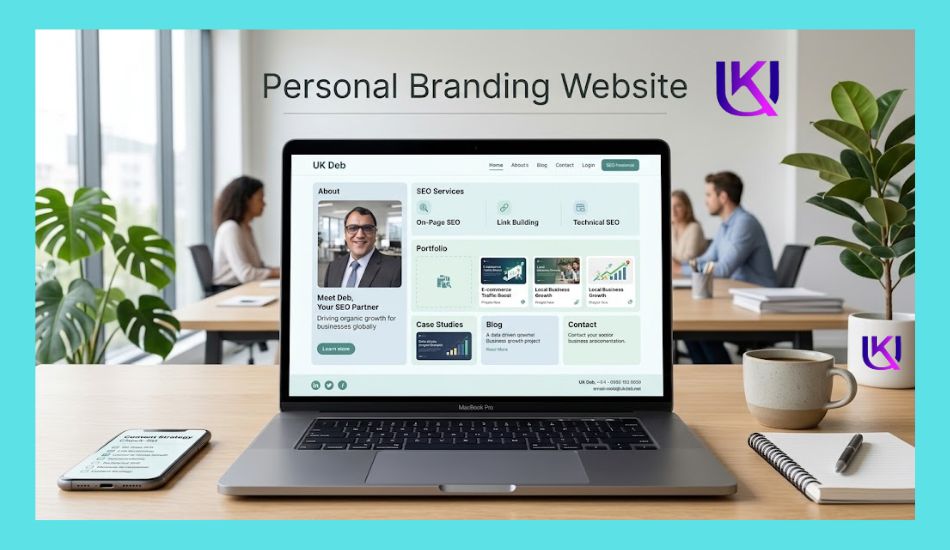
For example, the UK Deb personal website brings several important trust signals into one place. The site clearly explains the professional role as an SEO specialist and web builder. It also presents services, work experience, live projects, blog content, and ways for potential clients to get in touch.
This is a useful example of personal branding because a visitor does not need to guess what the person does.
They can quickly see:
- The SEO and digital marketing services offered
- Experience and professional skills
- Live websites and projects
- A portfolio of work
- Educational SEO and WordPress content
- Professional profiles on freelance platforms
- A LinkedIn presence
- A clear way to book a consultation
The portfolio also shows several live projects across different website types and topics. This gives visitors something more useful than a simple claim such as, “I am an SEO expert.” They can see examples of actual work connected to the person’s professional brand.
This supports an important part of E-E-A-T.
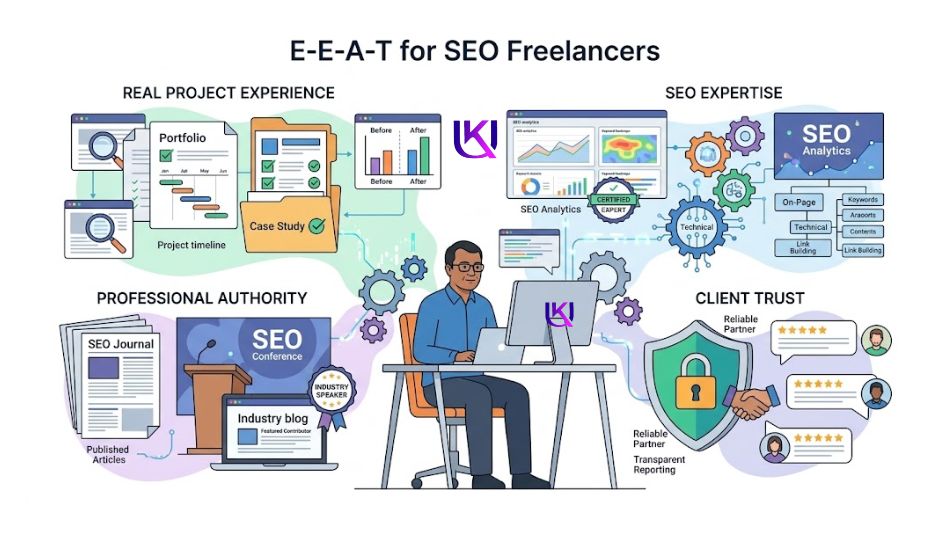
Your experience becomes easier to see through real projects. Your expertise appears through helpful content and services. Your authoritativeness can grow as you build a consistent presence across your website and professional platforms. And your trustworthiness improves when people can find clear information about you and your work.
4. Your Name Can Become a Search Result
A good personal brand can also help you own more of your name in Google Search.
When someone searches for your name “ukdeb”, they may find your website and professional profiles. They may also find your published content and mentions on trusted websites.
Over time, this can help build your online reputation.
Think about the UKDeb example. The personal website works as a central place that connects the professional identity with services, portfolio projects, blog content, and external professional profiles. That gives visitors a clearer picture of the person behind the SEO service.
This is important for both people and businesses. A client may feel safer hiring you when they can find clear and consistent information about you online.
5. Personal Branding Can Bring Better SEO Clients
Without a strong brand, you may spend most of your time looking for clients.
You may send cold emails. You may apply for freelance jobs. You may compete mainly on price.
A strong personal brand can change this.
When you regularly share useful SEO knowledge and show real work, some people may find you before you contact them. They may visit your website, read your content, review your portfolio, and learn about your services.
They may already know what you do.
That means your personal brand can work as a long-term marketing asset.
You are not only selling SEO services.
You are building proof of who you are, what you can do, and why the right client should trust you.
The next step is to find your personal brand position, so people can quickly understand what type of SEO freelancer you are and who you help.
Define What You Want to Be Known For as an SEO Freelancer
Before you build your personal brand, you need to answer one simple question:
1. What do you want people to remember you for?
You may offer many SEO services. But if your website says you do everything, people may not understand what makes you different.
A clear personal brand gives people a simple answer.
For example, you may want to be known for:
- Technical SEO
- Local SEO
- SEO content strategy
- Keyword research
- Link building
- WordPress SEO
- AI Search Optimization
- AEO and GEO
- SEO audits
You do not need to choose only one skill forever. But you should have a clear area where you want to build stronger expertise and authority.
2. Build Your Brand Around Your Real Skills
Your personal brand should match the work you can actually do.
Do not choose a niche only because it is popular.
For example, if you have real experience with WordPress websites, SEO content, website audits, and digital marketing, these can become important parts of your professional brand.
This is better than calling yourself an expert in every area of SEO.
A simple positioning statement can help:
I help [type of people] solve [specific problems] through [your main skill].
For example:
I help businesses improve their online visibility through SEO, content strategy, and website optimization.
You can make this statement more specific as your experience grows.
3. Use Your Personal Branding Website as Your Home Base
Your personal branding website should bring your professional identity together in one place.
For example, your website, UK Deb, can work as the main home of your personal brand. Instead of sending potential clients to different places to learn about you, you can guide them to one website where they can understand your work.
Your branding website can connect:
- Your personal story
- Your SEO services
- Your skills and experience
- Your portfolio
- SEO case studies
- Blog articles
- Client proof
- Professional profiles
- Contact and consultation options
This creates a clear journey for your visitors.
Someone may first find one of your articles through Google Search. They may then visit your author profile or homepage. From there, they can explore your services, portfolio, and other proof of your work.
That is how a personal website can support your brand.
4. Example: Building the UK Deb Brand
Your UK Deb website can help people connect your name with your professional work.
When you publish useful SEO articles under your name, your content can build topic relevance around your skills. When you add portfolio projects, you show real work. When you explain your services, visitors understand how you can help them.
Over time, these pieces can work together.
For example:
UK Deb → SEO Content → Professional Experience → Portfolio → Services → Client Trust
This creates a stronger brand than having only a social media profile or a freelance marketplace account.
Your website becomes the place you control.
Social media platforms can change. Freelance platforms can change their rules. Your personal website gives you a long-term place to build your name and reputation.
Generic Freelance Profile vs. Strong Personal Brand
Here is the difference, side by side.
| Feature | Generic Freelance Profile | Strong Personal Brand |
| Positioning | “SEO expert, all industries” | One clear niche and result |
| Proof | Star ratings only | Number-based case studies |
| Bio | One line, no credentials | Full bio with Person schema |
| Visibility | One platform, random posts | 2-3 platforms, steady posts |
| Mentions | None outside your profile | Guest posts, quotes, podcasts |
| AI Search | Invisible to AI answers | Named in AI-generated summaries |
5. Keep Your Brand Message Consistent
Your website, LinkedIn profile, portfolio, and other professional pages should tell a similar story.
You do not need to use the same words everywhere.
But people should understand the same basic message.
For example, if your website presents you as an SEO and digital marketing professional, your LinkedIn profile should support that identity. Your portfolio should show work connected to those skills. Your content should also cover topics where you want to build authority.
This consistency can make your brand easier to understand and remember.
The goal is simple:
When someone sees your name, your website, or your content, they should quickly understand who you are, what you do, and how you can help.
The next step is to build your personal brand website properly, including the pages and trust signals that can turn visitors into potential clients.
Build a Personal Branding Website That Shows Your Real SEO Experience
Your personal website is one of the most important parts of your Personal Brand SEO Freelancer strategy.
Social media can help people discover you. Freelance platforms can help you find jobs. But your website is the place where you can fully control your story.
It can show who you are, what you do, and what you have achieved.
For an SEO freelancer, this is also a chance to practice what you offer to clients.
If you say you understand SEO, your own website can become part of your proof.
1. Make Your Homepage Explain Who You Are
A new visitor should not feel confused when they land on your website.
Within a few seconds, they should understand:
- Who you are
- What you do
- Who you help
- What services you offer
- What they should do next
For example, your homepage can introduce you as an SEO professional and clearly connect your name with your main services.
Your UK Deb branding website can act as the central place for this. A visitor can learn about your professional identity and then move to other important parts of your website.
Your homepage should give them a reason to continue.
2. Create an About Page With a Real Story
Your About page should not only list your job titles.
Use it to explain your professional journey.
Tell visitors:
- How you started working in SEO
- What you have learned
- What type of work you do
- What problems you enjoy solving
- What skills you have developed
- What makes your approach different
You do not need to create a perfect success story.
A real story is often more useful.
For E-E-A-T, real experience matters. Your professional journey can help visitors understand the person behind the website.
3. Show Your Work in a Portfolio
One of the strongest parts of personal branding is proof.
Anyone can say, “I am an SEO expert.”
But your portfolio can show your work.
On your UK Deb website, your portfolio can connect your personal brand with real projects. This gives potential clients a chance to see the type of websites, SEO work, content, or digital projects connected with your experience.
For each project, try to explain:
- What the project was
- What problem needed to be solved
- What work you did
- What SEO strategy you used
- What tools you used
- What happened after the work
Keep it honest.
Do not claim results that you cannot prove.
4. Add Case Studies When You Have Real Results
A portfolio shows your projects. A case study goes deeper.
A good SEO case study can follow a simple path: Problem → Strategy → Work → Result → Lesson
For example:
A website had low organic visibility. You reviewed the site’s technical problems, keyword targets, and content gaps. You created a clear SEO plan and improved important pages. After tracking the work, you recorded the changes and explained what you learned.
You do not always need to share private client data.
You can remove sensitive details and still explain your process.
The important thing is to show your real experience.
5. Use Your Blog to Build Topic Authority
Your blog can help people understand what you know.
Write about the SEO topics connected to the brand you want to build.
For example, the UK Deb website can publish helpful content about:
- SEO strategy
- Keyword research
- Technical SEO
- WordPress SEO
- Link building
- Content marketing
- Local SEO
- AI Search Optimization
- AEO and GEO
Do not publish content only to fill your blog.
Each article should answer a real question.
Your content should help a beginner, business owner, or potential client solve a problem.
Over time, your articles can build a stronger connection between your name and your areas of expertise.
6. Add Clear Trust Signals
Trust signals help visitors feel safer.
Your website can include:
- Your real name or professional name
- A clear professional photo
- An author bio
- Your experience
- Portfolio projects
- Case studies
- Client testimonials
- Professional social profiles
- Contact information
- Clear service pages
- Updated content
These details can support the trust side of your personal brand.
7. Think of Your Website as Your Digital Office
Your personal branding website does more than display information.
It can work like your digital office.
People can find you through Google Search, LinkedIn, referrals, or your content. Then they can visit your website to learn more.
A simple journey may look like this:
Google Search or LinkedIn → Your Content → UK Deb Website → Portfolio or Case Study → Services → Contact.
That is why your website should not feel like a simple online business card.
It should help visitors move from “Who is this person?” to “I understand what this person can do for me.”
Once your website foundation is ready, the next important step is to create content that helps people discover your name and see your real SEO knowledge.

Create SEO Content That Builds Your Personal Brand
Unique content is always the king of digital marketing game-changing. Your website gives people a place to learn about you. Your content gives them a reason to come back.
If you want to build a strong Personal Brand SEO Freelancer presence, you need more than a service page. You need useful content that shows how you think, what you know, and how you solve SEO problems.
This is where SEO content, content marketing, and thought leadership work together.
1. Write About Problems Your Audience Actually Has
Do not start by asking, “What keyword should I rank for?”
Start with: “What problem is my reader trying to solve?”
For example, a small business owner may search:
- Why is my website not ranking?
- How much does SEO cost?
- How do I find the right keywords?
- What is a backlink?
- How long does SEO take?
- How do I improve my Google rankings?
- Do I need an SEO audit?
- How can I get more local customers from Google?
These questions give you a chance to help people before they become clients.
Your content should answer the question clearly. Then explain what the reader should do next.
2. Show Your Experience, Not Just SEO Definitions
You can find basic SEO definitions on thousands of websites.
Your personal brand becomes stronger when you add your own experience.
For example, instead of writing only: “An SEO audit checks a website for SEO problems.”
You can explain what you look for during an audit.
You might discuss:
- Indexing problems
- Technical errors
- Poor page structure
- Search intent
- Keyword targeting
- Internal links
- Content gaps
- Backlink quality
- Page speed
- Google Search Console data
Then explain how you decide which problems should be fixed first.
That gives the reader something more useful than a textbook definition.
3. Use Your UK Deb Website as Your Content Hub
Your UK Deb website can connect your articles with your professional brand.
For example, imagine you publish an article called “What Is an SEO Audit and Do You Really Need One?”
A reader finds the article through Google.
They read your explanation.
Then they see your author information, other SEO articles, portfolio, and SEO services.
Now the reader has learned something from you and has also seen evidence of your professional work.
That creates a natural path: Helpful Article → Your Name → Your Experience → Your Website → Your Services
This is much stronger than trying to sell your service in every paragraph.
4. Build Content Around Topic Clusters
You should also avoid writing random SEO articles.
Build groups of related content.
For example, if you want to build authority around SEO audits, you could create:
Main topic:
SEO Audit Guide
Supporting topics:
- What is an SEO audit?
- How to perform an SEO audit
- Technical SEO audit checklist
- On-page SEO audit
- Content audit vs SEO audit
- Common SEO audit mistakes
- How to use Google Search Console for an SEO audit
These pages can link to each other.
This helps readers find related information. It also gives search engines clearer context about the topics you cover.
5. Add Your Own Data and Examples
Your content becomes more valuable when you can show evidence.
You can use:
- Search Console screenshots
- Ranking examples
- Traffic changes
- Before-and-after page examples
- Keyword research examples
- Technical SEO fixes
- Content updates
- Real project lessons
Always protect private client information.
If you cannot share client data, you can use your own website as a practical example where appropriate.
For instance, your UK Deb website can become a living example of how you structure a professional SEO and digital marketing site. You can explain the changes you make, why you make them, and what you learn from the process.
That makes your content more personal.
6. Write for People First
Semantic SEO does not mean filling an article with related keywords.
It means covering the topic properly.
If you write about personal branding for SEO freelancers, readers may also need information about:
- Personal websites
- SEO portfolios
- Case studies
- Author profiles
- Social proof
- E-E-A-T
- Online reputation
- Niche selection
- Client trust
- Content marketing
- Thought leadership
Cover these topics when they genuinely help the reader.
You do not need to force every related term into one article.
7. Turn Your Experience Into Thought Leadership
Thought leadership does not mean using big words.
It means sharing useful ideas based on what you have learned.
For example, you could write:
“Here is the SEO mistake I see new freelancers make when choosing keywords.”
Or:
“I tested this content approach on my own website. Here is what I learned.”
This type of content gives your audience a reason to remember you.
You are no longer just another person publishing SEO definitions.
You are sharing your view, your process, and your lessons.
That is how your content can slowly turn your name into a professional brand.
Next, you can take that content beyond your website and use LinkedIn and other professional platforms to make your expertise easier for the right audience to discover.

Use LinkedIn to Make Your SEO Expertise Visible
Your personal website is your home base. LinkedIn can help more people discover you.
For an SEO freelancer, LinkedIn is useful because potential clients, marketers, founders, and other professionals already use the platform to find people they may want to work with.
But simply creating a LinkedIn profile is not enough.
You need to make your profile support the same personal brand as your website.
1. Make Your LinkedIn Profile Match Your Brand
Your profile should quickly answer three questions:
- Who are you?
- What do you do?
- How can you help?
Your headline, About section, profile photo, skills, work history, and featured content should all support the same message.
For example, if your website presents you as an SEO and digital marketing professional, your LinkedIn profile should not make you look like a completely different professional.
Keep your main message consistent.
Your name should become connected with the SEO topics you want to be known for.
2. Share What You Are Learning: Personal Brand SEO Freelancer beginner’s guide
You do not need to post every day.
You need to share something useful.
You can turn your SEO work into simple LinkedIn posts.
For example:
- A technical SEO problem you found
- A keyword research lesson
- A content strategy that worked
- A Google Search Console insight
- An SEO mistake you made
- A website improvement you tested
- A case study from your own work
- A useful SEO tip for business owners
You can also turn one detailed article from your UK Deb website into several smaller LinkedIn posts.
For example, one SEO article could become:
- Post 1: The problem
- Post 2: What you found
- Post 3: How you fixed it
- Post 4: What you learned
- Post 5: Link to the full article
This gives your website and LinkedIn profile a clear connection.
3. Do Not Make Every Post a Sales Pitch
A common personal branding mistake is turning every post into an advertisement.
You do not need to say:
“Hire me for SEO.”
in every post.
Instead, teach something.
If your post helps someone understand a difficult SEO problem, that person may remember your name later.
A simple rule works well:
Teach first. Sell when there is a clear reason.
Your service pages can handle the selling. Your social content can build familiarity and trust.
4. Use Your Own SEO Work as Content
Your own website gives you a useful source of content.
For example, when you make a meaningful change to your UK Deb website, you can explain:
- What you changed
- Why you changed it
- What problem you wanted to solve
- What SEO principle you used
- What you learned afterward
You are not simply telling people that you understand SEO.
You are showing them how you apply it.
That difference matters.
5. Build Connections, Not Just Followers
A personal brand is not a follower-count contest.
One relevant connection can be more useful than hundreds of random followers.
Connect with people who match your professional goals, such as:
- Small business owners
- Startup founders
- Marketing managers
- Web developers
- Content teams
- Other SEO professionals
- Agency owners
- Freelance professionals
When you engage with their posts, add something useful.
Ask a good question. Share a practical point. Give a useful example.
Do not spam your service link.
6. Create a Recognizable Content Pattern
You can make your personal brand easier to remember by using a few repeatable content themes.
For example, your LinkedIn content could focus on four areas:
| Content Theme | What You Can Share |
| SEO Education | Simple SEO lessons and explanations |
| Real Experience | Problems, tests, mistakes, and lessons |
| Case Studies | SEO work, results, and processes |
| Digital Marketing | Broader marketing ideas connected to SEO |
This creates consistency without making every post sound the same.
Over time, people may start to associate your name with these topics.
7. Connect LinkedIn Back to Your Website
Your LinkedIn profile should lead people to your main website.
Your website can then provide deeper proof.
The journey can look like this: LinkedIn Post → Profile → UK Deb Website → Article → Portfolio → Case Study → Service
This creates a connected personal brand instead of separate online profiles.
The same approach can work with other platforms too. The goal is not to be everywhere. The goal is to make your professional identity clear wherever people discover you.
Next, you can strengthen that identity with real proof, case studies, testimonials, and measurable SEO results– the evidence that turns expertise into trust.

Show Real Proof of Your SEO Skills
You can call yourself an SEO freelancer. But your audience needs more than a title.
They want to know: Can you actually do the work?
This is where proof becomes one of the strongest parts of your personal brand. Your experience becomes more believable when you show what you have done, how you did it, and what you learned.
1. Turn Your SEO Work Into Case Studies
A case study does not need to be long or complicated.
You can use a simple format: Problem → Research → Action → Result → Lesson
For example, if you worked on a website with poor organic visibility, explain the problem first.
Then show:
- What you found
- Which SEO issues mattered most
- What keywords you targeted
- What content changes you made
- What technical fixes you applied
- How you tracked progress
- What changed after the work
- What you learned
This gives potential clients a clear picture of your process.
2. Use Your Own Website as a Living Case Study
You do not always need a client project to demonstrate your SEO skills.
Your own website can become part of your personal branding proof.
For example, UK Deb can serve as a real-world example of how you build and improve your own professional online presence.
You can document changes to the website and explain why you made them.
You might show how you:
- Structure service pages
- Build topic clusters
- Improve internal links
- Create SEO-focused content
- Optimize page titles and descriptions
- Improve website usability
- Build topical authority
- Use Google Search Console
- Test different content approaches
- Connect content with your services
The important part is to explain the reason behind the work.
That turns your website from a simple portfolio into evidence of your SEO thinking.
3. Show Results, But Keep Them Honest
Numbers can make a case study stronger.
You may show:
- Organic clicks
- Impressions
- Keyword positions
- Indexed pages
- Organic traffic
- Leads
- Conversion changes
For example, if a page moves from page three to page one, you can explain what you changed and how you tracked the improvement.
But do not promise that one SEO action caused every result.
SEO has many moving parts. Google updates, competition, seasonality, website changes, and content quality can all affect performance.
Good personal branding is built on honest evidence, not impressive-looking claims.
4. Testimonials Add Another Layer of Trust
A client testimonial can answer a question that your own website cannot answer:
What was it like to work with you?
A useful testimonial can mention:
- The problem
- Your communication
- Your process
- Your SEO knowledge
- The result
- The client’s overall experience
Ask clients for permission before publishing their name, company, logo, or results.
If you cannot publish a testimonial, you can still build authority through your portfolio, published work, professional profiles, and your own SEO experiments.
5. Use E-E-A-T as a Practical Guide
You do not need to write about E-E-A-T in every article.
Instead, use its ideas when building your brand.
- Experience: Show work you have actually done.
- Expertise: Explain SEO topics clearly and accurately.
- Authoritativeness: Build a consistent presence through your website, content, professional profiles, and industry contributions.
- Trust: Be transparent about your work, results, limitations, and identity.
Your UK Deb website can bring many of these signals together. Your content shows what you know. Your portfolio shows what you have worked on. Your services explain what you offer. Your professional profiles help people verify your identity and experience.
6. Create an Evidence Page
As your personal brand grows, you can also create a dedicated page for your proof.
You could call it:
SEO Case Studies
or
My SEO Work
or
Results & Projects
Place your strongest examples there.
This gives a potential client one clear place to review your experience before contacting you.
Your personal brand becomes much stronger when you stop asking people to simply believe your claims and start giving them useful evidence to review.
Next, build a simple content and publishing system so your website and social profiles keep showing your expertise without requiring you to create everything from scratch each time.
Build a Consistent Content System for Your Personal Brand
You do not need to publish content every day to build a strong SEO personal brand.
What you need is a system you can follow.
If you publish one article today and disappear for three months, people may forget you. But when you keep sharing useful SEO knowledge, your name becomes easier to recognize.
Your UK Deb website can be the main content hub. Then you can reuse each useful idea across LinkedIn and other platforms.
1. Start With One Main Topic
Choose a topic that matches the SEO services you want to be known for.
For example, you could focus on:
- SEO for small businesses
- Technical SEO
- WordPress SEO
- SEO content strategy
- Local SEO
- AI Search Optimization
- AEO and GEO
- Link building
Do not try to cover every SEO topic at once.
Start with an area where you have real knowledge and experience.
2. Create One Strong Article First
Your website should hold the full version of your idea.
For example, you could publish a detailed guide on your UK Deb website about how to get freelance SEO clients.
The article can answer the main question and cover related questions that a reader may have.
Then add your own experience.
Explain what you have seen, what you tested, and what you learned.
This gives the article more value than a basic list of SEO tips.
3. Turn One Article Into Several Posts
You do not need to create completely new content for every platform.
One good article can give you many smaller ideas.
For example:
Website article:
How to Get Your First SEO Client
LinkedIn post:
5 mistakes new SEO freelancers make when looking for clients
Short post:
Why your SEO portfolio matters more than a long list of skills
Case study post:
What I learned from building my own SEO portfolio
Question post:
What is the hardest part of getting your first SEO client?
Each post can point people back to your main website when the full article is useful.
3. Keep Your Publishing Schedule Simple
Choose a schedule you can maintain.
For example:
| Content | Simple Schedule |
| Website article | 1–2 times per month |
| LinkedIn posts | 2–3 times per week |
| Case study | 1 per month |
| Portfolio update | When you complete meaningful work |
| Professional profile update | When your services or experience change |
You can publish more if you have the time.
But consistency is more important than volume.
4. Keep Your Personal Voice
Your personal brand should sound like you.
Do not make every article sound like a textbook.
Explain SEO as if you were helping a business owner who has never worked in SEO before.
Use simple examples.
Share your own lessons.
Say when something did not work.
Explain why you changed your approach.
This can make your content easier to trust because readers can see the person behind the advice.
5. Update Older Content
Your content system should not only focus on new articles.
Go back to useful older content and check:
- Is the information still correct?
- Are the examples still useful?
- Are the links working?
- Does the article match search intent?
- Can you add your latest experience?
- Can you improve the structure?
- Are there new questions your readers need answered?
Your UK Deb website can become stronger as you improve existing content instead of constantly starting from zero.
6. Track What Your Audience Finds Useful
Use tools such as Google Search Console to see how your website performs in Google Search.
Look for pages that receive impressions but few clicks.
Check which search queries bring people to your content.
Look for pages that are gaining visibility.
Then use what you learn to improve your content plan.
This creates a useful cycle: Publish → Measure → Learn → Improve → Publish Again
You are not guessing what your audience wants. You are using real search data and your own experience to make better content decisions.
7. Build a Brand People Can Recognize
Over time, your content should create a clear connection:
Your Name → SEO Knowledge → Real Experience → Useful Content → Proof → Trust
That is the real goal of a personal brand.
You do not need millions of followers.
You need the right people to remember you when they need the skills you offer.
Next, strengthen that recognition by building social proof and professional authority outside your own website.

Build Authority Beyond Your Own Website
Your website is the center of your personal brand, but your brand should not live in only one place.
When people see your name across trusted websites, professional networks, communities, and industry platforms, they can better understand that you are an active SEO professional.
This can strengthen your online reputation and support the authority side of E-E-A-T.
1. Build a Consistent Professional Identity
Use the same core information across your professional profiles.
Your:
- Name
- Professional title
- Main SEO skills
- Website
- Profile photo
- Short bio
- Work history
- Areas of expertise
should tell a similar story.
For example, if UK Deb presents you as an SEO and digital marketing professional, your LinkedIn profile and other professional profiles should support that same identity.
You do not need to copy the same bio everywhere.
The goal is consistency.
Someone who finds you on Google should be able to connect your website, profile, content, and professional work without confusion.
2. Earn Mentions Instead of Chasing Links
A backlink can be useful for SEO.
But for personal branding, the context around the mention also matters.
You can build your professional reputation by:
- Writing guest articles
- Giving expert comments
- Joining SEO discussions
- Appearing on podcasts
- Speaking at online events
- Contributing to industry publications
- Answering relevant questions
- Sharing useful research
- Collaborating with other professionals
Do not do these activities only to get a backlink.
Focus on being useful.
A relevant mention from a trusted source can introduce your name to people who have never seen your website before.
3. Share Your Knowledge With Other Professionals
You can also build authority by helping other people.
For example, if you understand technical SEO, you could explain a difficult issue to a web developer.
If you understand SEO content, you could share a simple content planning method with a small business owner.
If you understand local SEO, you could explain how a business can improve its local search presence.
You are not trying to prove that you know everything.
You are showing that you can explain useful ideas clearly.
That is an important part of professional authority.
4. Create a Strong Digital Footprint
Your digital footprint is the collection of information people can find about you online.
For an SEO freelancer, this may include: Your website → LinkedIn → Portfolio → Articles → Case studies → Professional profiles → Industry mentions
Try to make these sources agree about who you are and what you do.
Your UK Deb website can act as the main reference point. Your other profiles can help people discover it and verify your professional identity.
5. Avoid Fake Authority
Personal branding becomes weak when you try to look more experienced than you really are.
Avoid claims such as:
- “Best SEO expert in the world”
- “Guaranteed Google rankings”
- “I can rank any website”
- “Guaranteed page-one results”
- “Google-approved SEO expert”
Unless you have clear evidence and the claim is accurate.
Instead, show your work.
Explain your process.
Share real lessons.
Use real numbers when you can prove them.
A smaller but honest claim is often more powerful than a huge claim without evidence.
6. Build Relationships in Your Industry
Authority does not grow from publishing alone.
Talk with other SEO professionals.
Connect with web developers, content writers, designers, marketers, and business owners.
Share their useful work when it helps your audience.
Leave thoughtful comments.
Collaborate on projects.
These relationships can lead to referrals, partnerships, interviews, guest opportunities, and new clients.
Your goal is not to become known by everyone.
Your goal is to become known by the right people for the right reasons.
7. Make Your Brand Easy to Verify
When someone hears your name, they should be able to find reliable information about you.
Your website should connect your professional identity with your:
- Experience
- Services
- Portfolio
- Case studies
- Content
- Professional profiles
- Contact information
This makes your brand easier to verify.
And verification matters because a potential client is not only asking, “Does this person know SEO?”
They are also asking:
“Can I trust this person with my website and business?”
The next part is to turn that trust into a clear client journey, so your personal brand does not only build visibility but also helps generate quality SEO leads.
Turn Your Personal Brand Into a Client-Getting System
Building a personal brand is not only about getting more views.
You want the right people to see your work, trust your skills, and know how to contact you.
Your personal brand should make that journey easy.
A potential client may discover you through Google Search. Another may find you on LinkedIn. Someone else may get your name from a referral.
Wherever they find you, they should have a clear next step.
1. Create a Simple Client Journey
A good client journey can look like this:
Google Search → Helpful Content → Personal Website → Portfolio → Case Study → SEO Service → Contact
Or:
LinkedIn → Your Profile → UK Deb Website → Your Work → Service Page → Consultation
This is why every part of your online presence should work together.
Your article attracts attention.
Your portfolio shows your work.
Your case study provides proof.
Your service page explains how you can help.
Your contact page gives the visitor a way to take action.
2. Make Your Service Pages Useful
Do not make your service pages simple sales pages.
A good SEO service page should explain the problem you solve.
For example, if you offer an SEO audit, explain:
- What an SEO audit checks
- Who needs one
- What problems you look for
- What the client receives
- How your process works
- What happens after the audit
You can then link to a related article or case study.
This helps the visitor learn before making a decision.
3. Use Your Content to Support Your Services
Your blog and service pages should connect naturally.
For example, if you publish an article about technical SEO, you can link to your technical SEO service when it genuinely helps the reader.
If you publish an article about local SEO, you can connect it with your local SEO service.
Do not add links only because you want more internal links.
Add them because the reader may need the next piece of information.
This creates a better user journey and helps search engines understand how your pages relate to each other.
4. Give Visitors a Clear Reason to Contact You
Your website should not make people guess what to do.
Use simple calls to action such as:
- Request an SEO audit
- Discuss your SEO project
- Book a consultation
- Ask about SEO services
- View my SEO portfolio
Your CTA should match the page.
Someone reading a beginner SEO guide may not be ready to hire you. A visitor reading your SEO service page may be much closer to taking action.
Respect that difference.
5. Do Not Chase Every Lead
A strong personal brand can help you attract more people.
But more leads do not always mean better leads.
Your website should make your ideal client clear.
Think about:
- Business size
- Industry
- Location
- SEO needs
- Budget
- Type of project
- Problems you solve best
This can help you attract clients who fit your skills.
It can also reduce conversations with people who only want the cheapest SEO service.
6. Use Your UK Deb Website as the Brand-to-Client Example
Your UK Deb website can connect the personal branding side with the business side.
A visitor can discover your SEO content, learn about your professional skills, explore your portfolio, review your services, and then contact you.
That is the basic model you want for your own personal brand.
Your website should answer three questions before a visitor leaves:
- Who are you?
- Can you solve my problem?
- How can I work with you?
If your website answers those questions clearly, your personal brand has a better chance of turning attention into real business opportunities.
7. Measure More Than Website Traffic
Do not judge your personal brand only by pageviews or followers.
Track useful signals such as:
- Organic impressions
- Organic clicks
- Branded searches
- Website visitors
- Portfolio views
- Service page visits
- Consultation requests
- Referral traffic
- LinkedIn profile visits
- Qualified leads
You may find that a small increase in relevant visitors brings better results than a large increase in random traffic.
That is a healthier way to measure personal branding.
Your goal is not simply to become visible. Your goal is to become visible to people who need what you offer.
Next, you can build a simple 90-day personal branding plan that turns these ideas into weekly actions you can actually follow.
90-Day Personal Branding Plan for SEO Freelancers
You do not need to build your personal brand in one week.
Give yourself 90 days.
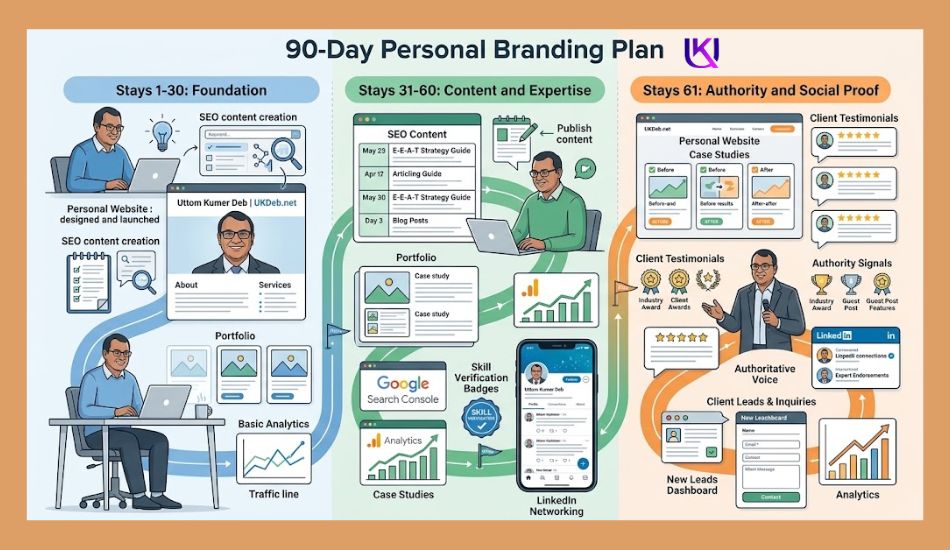
Use this time to make your online identity clear, publish useful content, show your work, and build trust. Small actions each week can create a strong base for your SEO career.
1. Days 1–30: Build Your Brand Foundation
Start by making your professional identity clear.
Review your UK Deb website and your main professional profiles.
Make sure visitors can quickly understand:
- Who you are
- What SEO work you do
- Who you help
- What makes your approach useful
- How they can contact you
Then improve your main website pages.
Focus on your:
- Homepage
- About page
- Services pages
- Portfolio
- Case studies
- Contact page
- Author bio
Add real information about your experience.
Do not try to make everything perfect.
Make it clear first.
2. Days 31–60: Publish and Show Your Expertise
Now start building your content presence.
Choose a few SEO topics that match your skills and services.
For example: SEO content + WordPress SEO + Technical SEO + Digital Marketing
Create useful articles for your website.
Then turn each article into smaller LinkedIn posts.
For every topic, try to add something from your own experience.
You can share:
- A lesson
- A mistake
- A test
- A process
- A case study
- A useful example
- A result
- A simple SEO explanation
This gives your content a personal angle.
You are not simply repeating information found on other websites.
You are showing what you know and how you use it.
3. Days 61–90: Build Authority and Social Proof
During the final 30 days, focus more on proof and relationships.
Update your portfolio.
Add strong case studies.
Ask suitable clients for testimonials.
Improve your LinkedIn profile.
Connect with people in your target market.
Look for useful opportunities to contribute to SEO discussions, websites, podcasts, interviews, or professional communities.
At the same time, review your website data.
Use Google Search Console to see which pages and search queries are gaining attention.
Ask yourself:
- Which topics are getting impressions?
- Which pages get clicks?
- Which content attracts the right visitors?
- Which pages need improvement?
- Are people finding my name?
- Are visitors reaching my service pages?
- Am I getting qualified inquiries?
Use these answers to plan your next 90 days.
4. A Simple Weekly Routine: Personal Brand SEO Freelancer beginner’s guide
You can keep your personal branding work simple.
| Day | Action |
| Monday | Research one SEO topic |
| Tuesday | Work on an article or case study |
| Wednesday | Publish or improve website content |
| Thursday | Share a useful LinkedIn post |
| Friday | Engage with relevant professionals |
| Weekend | Review results and plan the next week |
You do not have to follow this exact schedule.
The important part is to keep moving.
Even a few focused hours each week can help you build a stronger professional presence.
5. Your 90-Day Goal
After 90 days, you should have more than a social media profile.
You should have a connected personal brand system:
Your Name → Personal Website → SEO Content → Portfolio → Case Studies → Professional Profiles → Services → Client Contact.
Your UK Deb website can be the center of this system.
Your content brings people in.
Your portfolio shows your experience.
Your case studies provide evidence.
Your professional profiles help people discover you.
Your service pages show how they can work with you.
And your consistent activity keeps your brand visible.
6. Do Not Expect Overnight Results
Personal branding takes time.
You may publish an article and get very little traffic at first.
You may post on LinkedIn and receive only a few reactions.
That does not mean the work has failed.
You are building recognition.
One useful article can bring a visitor months later. One case study can help win a client. One LinkedIn connection can lead to a referral.
Think long term.
You are building an asset that can keep working even when you are not actively looking for clients.
The next step is to review the common personal branding mistakes that can weaken your authority, trust, and SEO visibility.
Common Personal Branding Mistakes SEO Freelancers Should Avoid
Building your personal brand takes time. But a few mistakes can slow you down or make your brand look less trustworthy.
- You do not need a perfect brand.
- You need a clear and honest one.
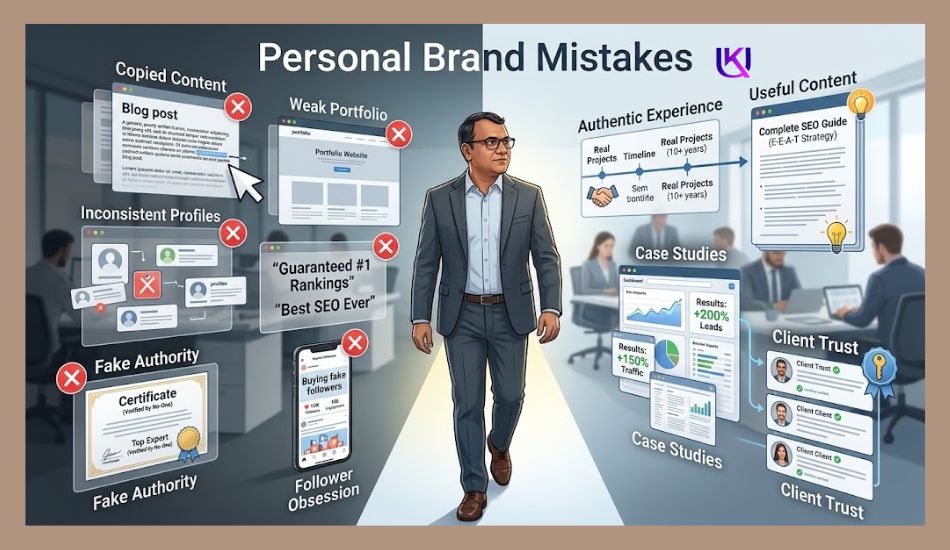
1. Trying to Be an Expert in Everything
SEO has many parts.
You may know technical SEO, content SEO, local SEO, link building, WordPress, AI search, and digital marketing.
- But you do not need to present yourself as the expert in all of them.
- Choose the areas where you have real experience.
- Then build your content and portfolio around those areas.
- A clear position is easier for people to remember.
2. Copying Other SEO Experts
You can study successful SEO professionals.
But do not copy their voice, content, or personal story.
Your own experience is your advantage.
For example, your work on the UK Deb website gives you real examples that another SEO freelancer does not have.
Use those experiences.
Explain what you tested, what you changed, what you learned, and what you would do differently next time.
That makes your brand more personal.
3. Making Big Claims Without Proof
Avoid claims such as:
- “I guarantee page-one rankings.”
- “I can rank every website.”
- “I am the world’s best SEO expert.”
- “My method always works.”
These statements can damage trust when you cannot support them.
Instead, show evidence.
Use real case studies, portfolio projects, screenshots, data, testimonials, and clear explanations of your process.
Let your work support your claims.
4. Publishing Content With No Personal Experience
Generic SEO content is easy to find.
If your article only repeats information that readers can find everywhere, it gives them little reason to remember you.
Add your own experience when it is relevant.
For example:
- What did you test?
- What happened?
- What did you learn?
- What would you change now?
These simple questions can make your content more useful.
5. Ignoring Your Website
Some freelancers focus heavily on LinkedIn but have a weak personal website.
That can become a problem.
Your website is where you can give people a deeper view of your work.
Your UK Deb website can connect your professional identity, services, portfolio, content, and contact options in one place.
- Keep it updated.
- Remove outdated information.
- Add new projects.
- Improve important pages.
- Make sure visitors can easily understand what you offer.
6. Focusing Only on Followers
A large follower count looks impressive.
But followers do not automatically become clients.
One relevant business owner who trusts your work can be more valuable than hundreds of unrelated followers.
Focus on:
- Relevant connections
- Useful conversations
- Website visitors
- Portfolio views
- Qualified leads
- Referrals
- Client relationships
Build an audience that fits your goals.
7. Using AI Without Adding Your Own Knowledge
AI tools can help you research, organize, and draft content.
But your personal brand should still sound like you.
- Do not publish content that simply repeats AI-generated information.
- Check the facts.
- Add your own examples.
- Share your experience.
- Explain your reasoning.
- Edit the final piece so it reflects your real professional knowledge.
Your personal brand becomes stronger when readers can see a real person behind the content.
8. Forgetting to Update Your Brand
Your skills will change.
Your services may change.
Your best projects will change.
Your website should change with you.
Review your brand every few months.
Update your:
- Homepage
- About page
- LinkedIn profile
- Portfolio
- Case studies
- Service pages
- Author bio
Remove services you no longer offer.
Add skills you now use.
Publish your latest work.
Your personal brand should show where you are now, not where you were two years ago.
9. The Biggest Mistake: Building a Brand Without a Purpose
Do not build a personal brand simply because everyone says you should.
Know what you want it to achieve.
You may want to:
- Get better SEO clients
- Build industry authority
- Increase freelance income
- Attract consulting work
- Grow your digital marketing business
- Become known for a specific SEO skill
- Create long-term career opportunities
Your goal should guide your content, website, networking, and marketing.
A strong personal brand is not about looking important. It is about making your real expertise easy to find, understand, and trust.
Once you avoid these mistakes, you can focus on measuring whether your personal brand is actually growing and bringing the right people to your business.

How to Measure Your SEO Personal Brand Growth
Personal branding can feel hard to measure.
You may get more views or followers, but that does not always mean your brand is growing in the right direction.
As an SEO freelancer, you should look at signals that show whether people are discovering you, trusting your work, and taking action.
1. Track Branded Searches
One useful signal is how often people search for your name or brand.
For example, someone may search for:
- Your name + SEO
- Your name + SEO freelancer
- Your name + digital marketing
- Your brand name
- Your website name
You can use Google Search Console to study the search queries that bring people to your website.
If more people begin finding your website through searches connected to your name, that can be a useful sign that your professional identity is becoming more visible.
2. Watch Your Organic Visibility
Your personal brand and SEO work should support each other.
Track:
- Search impressions
- Organic clicks
- Keyword positions
- Organic traffic
- Top-performing pages
- New pages gaining visibility
Look for patterns.
Maybe your technical SEO articles are getting more impressions. Maybe your SEO pricing content is bringing business owners to your website. Maybe your personal branding content is starting to rank for long-tail searches.
These signals can help you decide what to publish next.
3. Track Your Website Actions
Traffic is only part of the story.
You should also check what visitors do after they arrive.
For example: Article → Portfolio → Service Page → Contact
If people read your content but never explore your services, your internal links or calls to action may need work.
If visitors reach your service pages but do not contact you, you may need stronger proof, clearer offers, or better explanations.
Your goal is not simply to get visitors.
Your goal is to help the right visitors take the next useful step.
4. Measure LinkedIn and Social Growth
You can also track your professional social activity.
Look at:
- Profile views
- Relevant connections
- Post engagement
- Website clicks
- Direct messages
- Referral visits
- Conversations with potential clients
Do not judge every post by likes.
A post with 20 likes may be more valuable than one with 200 likes if the smaller post reaches business owners who need your SEO services.
5. Track Qualified Leads
This is one of the most important measurements. Ask where each new lead came from.
For example:
| Lead Source | What to Track |
| Google Search | Organic leads |
| Profile or post leads | |
| Referral | Who referred you |
| Website | Contact form inquiries |
| Portfolio | Project-related inquiries |
| Content | Leads from specific articles |
After a few months, you may see which channels bring the best opportunities.
Then you can spend more time on those channels.
6. Review Your Brand Every 90 Days
Every three months, review your personal brand.
Ask yourself:
- What topics am I becoming known for?
- Which pages attract the right visitors?
- Which articles perform best?
- Which posts create useful conversations?
- Have I added new proof to my portfolio?
- Do my website and LinkedIn profile still match?
- Am I attracting the type of clients I want?
- What should I stop doing?
- What should I do more often?
Your answers can shape your next 90-day plan.
7. Use Your Own Website as Your Long-Term Brand Asset
Your UK Deb website can continue to grow with your experience.
- Each new project can add to your portfolio.
- Each useful lesson can become an article.
- Each case study can become proof.
- Each article can support your topical authority.
- Each professional connection can create another path back to your website.
That creates a simple long-term cycle: Do the work → Document the work → Share the lesson → Build trust → Attract the right people
This is a better way to think about personal branding than chasing followers alone.
Your brand grows when your name, expertise, experience, content, and proof become easier for the right audience to find and understand.
The final step is to turn everything into a simple personal branding strategy you can keep using throughout 2026 and beyond.

Build Your Personal Brand for the Long Term
Your personal brand is not a one-time SEO project.
You build it every time you publish something useful, complete a project, share a lesson, help someone, or show proof of your work.
That is why you should think beyond the next client.
Think about what you want your name to mean one, three, or five years from now.
1. Let Your Experience Lead Your Brand
Your skills will grow as you work with more websites and clients.
Your personal brand should grow with them.
If you start with general SEO services, you may later become known for technical SEO, SEO content, WordPress SEO, local SEO, or AI search.
- You do not need to decide everything today.
- Let your real work help shape your position.
Your experience gives you new topics to write about. Your projects give you new case studies. Your results give you new proof.
This creates a natural connection between your work and your brand.
2. Keep Improving Your Website
Your personal website should never feel finished.
Keep adding useful proof as your experience grows.
For example, your UK Deb website can continue to evolve with:
- New portfolio projects
- Fresh case studies
- Updated service pages
- New SEO articles
- Better author information
- New professional achievements
- Updated contact options
Your website should show your current level of expertise.
If someone visits it six months from now, they should still see an active professional brand.
3. Build Around Your Own Name
A personal brand becomes stronger when your professional identity is clear.
Your website, social profiles, portfolio, and published content should connect back to you.
This does not mean you need to promote yourself in every sentence.
Instead, let your work create the connection.
A reader finds your article.
- They see your name.
- They visit your website.
- They read your case study.
- They see your portfolio.
- They learn about your services.
That repeated exposure helps people remember you.
4. Keep Helping Your Audience
The strongest personal brands do not stop being useful after they get attention.
- Keep answering questions.
- Keep sharing lessons.
- Keep explaining difficult SEO topics in simple language.
- Keep documenting what you learn.
Your audience will change over time, too. A beginner may become a business owner. A reader may become a client. A LinkedIn connection may refer someone to you.
You cannot predict every opportunity.
But you can keep creating useful reasons for people to remember you.
5. Think of Personal Branding as Compounding
- Your first article may get very little attention.
- Your first case study may have only a few readers.
- Your first LinkedIn post may receive almost no engagement.
That is normal.
You are building a library of proof.
After months of consistent work, someone may find your website through one article and then discover ten more useful resources.
- They may see your portfolio.
- They may read your case study.
- They may look at your professional profile.
- Now they are not judging you from one page.
- They are seeing the larger picture.
That is the power of consistent personal branding.
6. Your 2026 Personal Brand Formula
You can keep the whole strategy simple:
Clear Position + Personal Website + Useful Content + Real Experience + Case Studies + Professional Visibility + Social Proof + Consistency = Stronger Personal Brand.
Your UK Deb website can sit at the center of this system.
Your website gives your brand a home.
Your content shows what you know.
Your portfolio shows what you have done.
Your case studies show how you solve problems.
Your professional profiles help people discover you.
Your results and testimonials give people more reasons to trust you.
And your consistency keeps the brand alive.
You do not need to become famous to build a successful SEO personal brand.
You need to become known, useful, and trusted by the people you want to work with.
That is the real goal of building a personal brand as an SEO freelancer in 2026.
Conclusion: Your Personal Website Is Not Only a Portfolio; It Is Proof Branding!
Building a Personal Brand SEO freelancer in the future is not about becoming famous.
A personal brand SEO freelancer beginner’s guide is about becoming easy to find, easy to understand, and easy to trust.
You can start with a clear professional position. Then build your personal website as your online home. Use your portfolio and case studies to show real experience. Publish useful SEO content to demonstrate your knowledge. Use LinkedIn and other professional platforms to reach more people.
Your UK Deb website can be a good example of how these pieces can work together. Your website can connect your professional identity with your SEO services, portfolio, content, and digital marketing work. Each new project or useful article can add another piece of proof to your brand.
Keep E-E-A-T in mind as you build:
- Show your Experience.
- Share your Expertise.
- Build Authoritativeness.
- Protect Trust.
You do not need to claim that you are the best SEO freelancer.
- Let your work show what you can do.
- Let your content explain what you know.
- Let your case studies show how you solve problems.
- Let your website make it easy for the right clients to learn more about you.
Most importantly, stay consistent.
Your first article may not bring a client. Your first LinkedIn post may not get much attention. Your first case study may have only a few readers.
Keep going with personal brand SEO freelancer beginner’s guide.
Every useful piece of content, every real project, and every professional connection can add to your reputation.
Build the brand today that you want clients to trust tomorrow.
Your next practical move is simple: review your website, choose the SEO topics you want to be known for, and create your first 90-day personal branding plan around them.
Relevant article: The First-Client SEO Playbook: How Beginners Can Start Getting Paid.
FAQs: Build the Brand Today That Future SEO Clients Will Trust Tomorrow.

1. How long does it take to build a personal brand as an SEO freelancer?
There is no fixed timeline. You may start seeing early signs within a few months, but a strong personal brand usually takes longer. Your results depend on your content, experience, online visibility, networking, and how consistently you show your work. Focus on steady progress instead of trying to become known overnight.
2. Do I need a personal website to build an SEO freelancer brand?
You can start without one, but a personal website gives you much more control. You can use it to show your SEO services, Portfolio, Case studies, Experience, Articles, Testimonials, Professional background, and contact details.
For example, UK Deb can work as a central home for your professional identity, SEO content, services, and portfolio. Your social profiles can help people discover you, while your website gives them a deeper place to learn about your work.
3. What should I post as an SEO freelancer?
Post content that helps your target audience solve real problems. You can share SEO lessons, case studies, website audits, keyword research ideas, technical SEO fixes, content strategies, mistakes, experiments, and lessons from your own work.
You do not need to post only SEO news. Your own experience can become some of your most useful content.
4. Is LinkedIn important for an SEO freelancer’s personal brand?
Yes, LinkedIn can be useful for professional visibility. You can use it to share your SEO knowledge, connect with potential clients, meet other professionals, and send people to your website.
But do not depend on LinkedIn alone. Your personal website, portfolio, content, case studies, and professional network should work together.
5. How does E-E-A-T help an SEO freelancer?
E-E-A-T stands for Experience, Expertise, Authoritativeness, and Trustworthiness.
You can use these ideas as a practical guide for building your online presence. Show real experience through projects and case studies.
Explain topics you understand. Build authority through useful content and professional contributions. Build trust by being clear and honest about your work. Do not treat E-E-A-T as a badge you can simply add to a website. Show it through your work.
6. Should I choose a specific SEO niche?
A clear niche can make your personal brand easier to understand. You might focus on technical SEO, local SEO, WordPress SEO, content SEO, link building, or another area. You do not have to stay in one niche forever. Start with the area where you have useful knowledge and real experience. You can expand as your skills and goals change.
7. Can my own website become an SEO case study?
Yes. Your own website can be a useful place to document your SEO work. You can explain changes you make, why you made them, what you tested, and what you learned. For a personal brand such as UK Deb, this can help connect your name with real SEO work instead of relying only on claims about your skills.
8. How often should I publish content?
You do not need to publish every day. A realistic schedule is better. For example, you could publish one or two strong website articles each month and share useful LinkedIn posts several times a week. Quality, relevance, and consistency matter more than publishing a large amount of weak content.
9. How can I get clients through personal branding?
Create a clear path from discovery to action. A potential client might find your article on Google, visit your website, review your portfolio, read a case study, explore your SEO service, and then contact you. You can also build relationships through LinkedIn, referrals, professional communities, guest contributions, and industry networking. The key is to make your expertise easy to discover and your next step easy to understand.
10. What is the biggest personal branding mistake SEO freelancers make?
One of the biggest mistakes is trying to look like an expert instead of showing real expertise. You do not need huge claims or thousands of followers. Show your work. Explain your process. Share real lessons. Use honest results. Keep your website updated. Over time, these small signals can create a much stronger professional reputation.
11. Can AI help me build my SEO personal brand?
Yes, AI tools can help with research, ideas, outlines, content organization, and other parts of your workflow. But your personal brand should not become a collection of generic AI-written content. Add your own experience, examples, opinions, data, and lessons. Your professional knowledge is what makes the content yours.
12. What should I do first to build my SEO personal brand?
Start with your foundation. Make your personal website clear. Define what you want to be known for. Create a strong portfolio. Add real case studies. Improve your professional profiles. Then start publishing useful content around your main SEO topics. From there, keep measuring what works and improve your brand every 90 days.
Start with one strong website, one clear message, and real proof of your SEO work. Then build from there.
1 thought on “How to Build a Personal Brand as an SEO Freelancer in 2026: Beginner’s Guide?”
Pingback: Google Algorithm Updates: SEO Guide for Rankings & AI Search