

Get Freelance SEO Clients even if you have never worked with a paying client before. Many new SEO experts feel stuck because they do not know where to start.
You learned SEO (Search Engine Optimization). You can read a Search Console report without blinking. You can spot a broken title tag from across the room. But your inbox is still empty. No client has messaged you yet.
Here is the part nobody tells you upfront. Learning SEO is the easy half. Selling it is the hard half.
However, getting your first client is not a matter of luck. It comes down to doing a few things in the right order. This guide walks you through each one, step by step.
You may have learned keyword research, on-page SEO, technical SEO, and link building, but finding someone who will trust you is the hardest step. You do not need years of experience or a big agency to win your first project.
The best way to get your first SEO client is to build trust before you sell your SEO services. A simple portfolio website, one helpful SEO case study, a free SEO audit, and an active LinkedIn profile can show your skills.
You can also use tools like Google Search Console, Google Analytics, Ahrefs, or Semrush to explain real website problems and simple fixes. When you reach out to small businesses with helpful advice rather than a sales pitch, they are more likely to reply.
Where to find freelance SEO clients, how to contact them, what to say, how to set your pricing, and how to turn your first happy client into many more. So, you will have a clear plan you can follow, even if you are starting from zero.

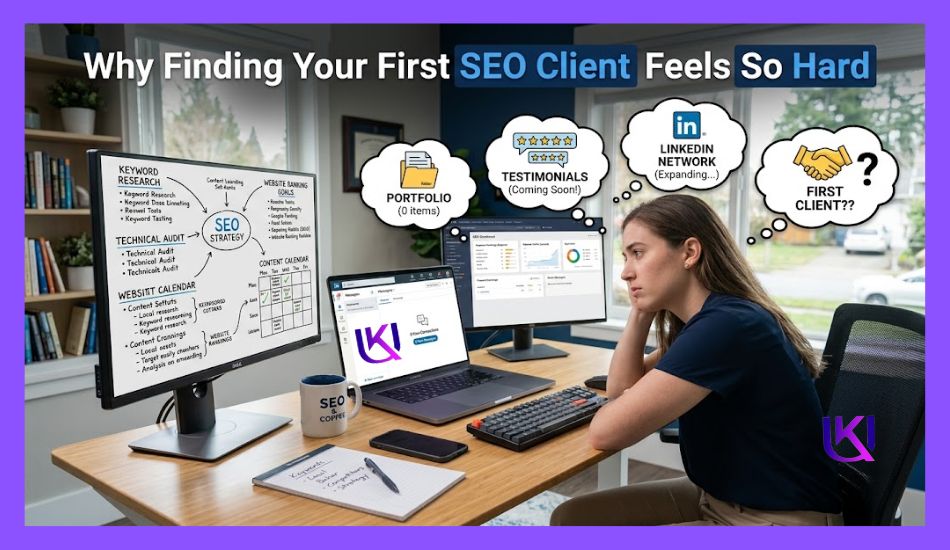
Why Does Finding Your First SEO Client Feel So Hard?
Getting your first SEO client is often the hardest part of becoming a freelancer. It is not because there are no businesses that need SEO. It is because new freelancers often do not know how to earn trust.
Many small business owners want more website traffic, better Google rankings, and more leads. But before they hire you, they want to know one thing:
“Can this person really help my business?”
If you cannot answer that question with proof, many potential clients will keep looking.
Every successful SEO freelancer started in the same place. You do not need dozens of clients to get started. You only need to show that you understand SEO, can solve real problems, and care about helping businesses grow.
By knowing what stops beginners and what clients expect, you can avoid common mistakes and stand out from other new freelancers.
Common Beginner Fears Get Freelance SEO Clients
Most new SEO freelancers worry about the same things. These fears are normal, but they should not stop you from getting started.
| Beginner Fear | Reality |
| I have no clients. | Every freelancer starts with zero clients. |
| I have no experience. | Practice projects and personal websites count as experience. |
| I am not an SEO expert yet. | Many clients need someone who can solve simple SEO problems well. |
| I do not know what to charge. | Start with fair pricing and increase your rates as you gain results. |
| Bigger agencies will win every client. | Many small businesses prefer working with one dedicated freelancer. |
| Clients will ask for proof. | A portfolio, SEO audit, or case study can build trust, even if it is from your own website. |
Instead of waiting until you feel “ready,” focus on improving your skills and showing your work. Each project you complete makes it easier to win the next client.
1. What Clients Actually Look For: Get Freelance SEO Clients
Many beginners think clients only care about years of experience. In reality, most business owners want someone who understands their goals and communicates clearly.
Here is what many clients value before hiring an SEO freelancer:
| What Clients Want | Why It Matters |
| A simple SEO portfolio | Shows your skills with real examples. |
| SEO case studies | Proves you can improve website performance. |
| A website or LinkedIn profile | Builds credibility and makes you easy to trust. |
| Basic SEO knowledge | Shows you understand keyword research, on-page SEO, technical SEO, and content optimization. |
| Clear communication | Helps clients understand your plan without confusing terms. |
| Honest expectations | Builds long-term trust by avoiding unrealistic promises. |
| A helpful SEO audit | Shows problems and offers useful solutions before asking for a sale. |
Clients are not just hiring SEO services. They are hiring someone they believe will help their business grow. If you focus on solving problems, explaining your ideas clearly, and showing real value, you will have a much better chance of landing your first freelance SEO client.

How to Build Trust Before You Start Looking for Clients?
Before you send cold emails or apply for freelance jobs, build trust. Most business owners will check your work before they reply. If they cannot find proof of your skills, they may choose someone else.
You do not need years of experience to earn trust. A few strong examples of your work can make a big difference. Show what you know, explain your process, and let your work speak for you.
The goal is simple: make it easy for a potential client to see that you understand SEO and can help their business.
1. Create a Simple SEO Portfolio
Your SEO portfolio is one of your strongest marketing tools. It does not need to be large. It only needs to show your skills with clear examples.
Include:
- SEO audits you completed
- Keyword research examples
- On-page SEO improvements
- Content optimization samples
- Technical SEO fixes
- Website traffic or ranking improvements
- Practice projects if you do not have client work yet
Keep each project short. Explain the problem, what you did, and the result.
Example Portfolio Format
| Section | What to Include |
| Project | Website or practice project |
| Goal | What needed improvement |
| SEO Work | Keyword research, on-page SEO, technical SEO, content updates |
| Result | Ranking, traffic, or performance improvement |
| Tools Used | Google Search Console, Google Analytics, Ahrefs, Semrush |
Even one well-written case study is better than an empty portfolio.
2. Build Your Personal Website
A personal website helps people learn about you and your SEO services. It also gives you a place to show your work and rank for SEO-related keywords.
Your website should include:
- Home page
- About page
- SEO services page
- Portfolio or case studies
- Blog
- Contact page
Use your website to show your SEO skills. Optimize each page with clear titles, helpful content, internal links, and a fast loading speed.
If your own website ranks well, it becomes proof that your SEO strategy works.
3. Write SEO Case Studies
A case study shows how you solved a problem. It gives clients real evidence instead of promises.
A simple SEO case study should answer these questions:
- What was the problem?
- What SEO work did you complete?
- Which tools did you use?
- What changed after your work?
If you do not have paying clients yet, create a case study using your own website or a practice project. Explain the process and share the results honestly.
Clients want to see how you think and solve problems.
4. Optimize Your LinkedIn Profile
Many business owners search LinkedIn before hiring a freelancer. A complete profile can help you appear more professional.
Update these sections:
- Professional profile photo
- SEO-focused headline
- About section
- Skills
- Portfolio links
- Case studies
- Recommendations
- Contact information
Share useful SEO tips, website audits, and project updates. Helpful posts can attract business owners who need SEO services.
A strong LinkedIn profile, combined with a portfolio and personal website, gives potential clients more reasons to trust you before the first conversation.

Learn the SEO Skills Clients Will Pay For
You do not need to know every part of SEO before getting your first client. Most small businesses want someone who can fix common SEO problems and help them get more organic traffic.
Focus on learning the skills that bring real results. When you can explain these skills in simple words and show your work, clients are more likely to hire you.
1. Keyword Research
Keyword research helps you find what people search for on Google. It is the first step in every SEO strategy.
Learn how to:
- Find keywords with buying intent
- Choose low-competition keywords
- Understand search intent
- Find long-tail keywords
- Group related keywords into one topic
Useful tools include:
A good keyword strategy helps businesses reach the right audience.
2. On-Page SEO
On-page SEO improves the pages on a website so search engines and users can understand them better.
Learn how to optimize:
- Title tags
- Meta descriptions
- Heading tags (H1, H2, H3)
- URL structure
- Internal links
- Image alt text
- Content readability
- Keyword placement
Your goal is to make every page useful, clear, and easy to navigate.
3. Technical SEO
Technical SEO makes sure a website is easy for search engines to crawl, index, and rank.
Learn the basics of:
- Website speed
- Mobile-friendly design
- XML sitemap
- Robots.txt
- HTTPS security
- Broken links
- Crawl errors
- Core Web Vitals
You can find many technical issues using Google Search Console and free SEO audit tools.
4. Content Optimization
Publishing content is not enough. It must answer the user’s question better than other pages.
Learn how to:
- Match search intent
- Improve existing pages
- Add helpful headings
- Answer common questions
- Use related keywords naturally
- Write clear calls to action
Well-optimized content can increase rankings and keep visitors on the page longer.
5. Link Building
Link building helps increase a website’s authority by earning links from other trusted websites.
Start with beginner-friendly methods such as:
- Guest posting
- Resource page outreach
- Business directories
- Local citations
- Digital PR
- Broken link building
Focus on earning relevant, high-quality backlinks instead of collecting large numbers of low-quality links.
Get Freelance SEO Clients And Skills Clients Expect
| SEO Skill | Why Clients Pay for It |
| Keyword Research | Helps target the right audience |
| On-Page SEO | Improves page relevance and rankings |
| Technical SEO | Fixes website issues that hurt performance |
| Content Optimization | Increases traffic and user engagement |
| Link Building | Builds website authority and trust |
| SEO Audit | Finds problems and opportunities |
| Google Search Console | Tracks search performance and indexing |
| Google Analytics | Measures traffic and user behavior |
You do not need to master every SEO skill on day one. Start with the basics, practice on your own website, and keep improving. As your skills grow, it becomes easier to win clients and charge higher rates.

Where to Find Your First Freelance SEO Clients
Your first SEO client can come from many places. The key is to be active where business owners look for help. Do not wait for clients to find you. Reach out, share your work, and start conversations.
Use more than one method. This gives you more chances to find clients and build your freelance business.
1. LinkedIn: Professional Platform to Get Freelance SEO Clients
LinkedIn is one of the best places to connect with business owners, founders, and marketing managers.
To get noticed:
- Complete your LinkedIn profile.
- Add your SEO portfolio and website.
- Share SEO tips and case studies.
- Comment on posts from business owners.
- Send personalized connection requests.
- Message people after building a connection.
Avoid sending the same message to everyone. Personal messages get better responses.
2. Upwork
Upwork helps beginners find freelance SEO projects from clients around the world.
To improve your chances:
- Write a clear profile.
- List your SEO skills.
- Add portfolio samples.
- Apply for jobs that match your experience.
- Send custom proposals instead of copy-and-paste messages.
Start with smaller projects to build reviews and gain experience.
3. Fiverr
Fiverr lets you create SEO service listings that clients can buy directly.
Your SEO gig should explain:
- What service you offer
- What the client will receive
- How long the work will take
- Why they should choose you
Use simple language and include examples of your work whenever possible.
4. Freelancer Platforms
Besides Upwork and Fiverr, you can also find projects on other freelance websites.
Some popular platforms include:
- Freelancer
- PeoplePerHour
- Guru
- Toptal (for experienced freelancers)
Complete your profile before applying for jobs. Clients often compare profiles before making a decision.
5. Local Businesses
Many local businesses need SEO but have never hired an SEO freelancer.
Look for businesses with:
- Poor Google rankings
- Slow websites
- Missing meta titles
- No blog content
- Weak local SEO
Offer a free SEO audit and explain one or two problems you found. Keep your advice helpful instead of making a sales pitch.
6. Facebook Groups
Many business owners ask for SEO help in Facebook groups.
Join groups related to:
- Small businesses
- Startups
- Local business owners
- Digital marketing
- WordPress
- E-commerce
Answer questions and share useful advice. People are more likely to contact someone who helps without asking for a sale.
7. Networking Events
Online and local networking events can help you meet business owners.
Attend:
- Small business meetups
- Marketing events
- Chamber of Commerce meetings
- Startup events
- Online webinars
Introduce yourself, ask questions, and listen to business owners’ challenges before talking about your services.
8. Referrals: No SEO Clients? Build Trust First, Then Start Selling
Referrals are one of the easiest ways to get new clients.
After finishing a project:
- Ask for a testimonial.
- Request an introduction to another business owner.
- Stay in touch with past clients.
- Thank people who refer new clients.
Happy clients often know other business owners who need SEO.

Best Places to Find Your First SEO Client
| Platform | Best For | Cost |
| Building relationships with business owners | Free | |
| Upwork | Freelance projects | Free to join |
| Fiverr | Selling SEO services | Free to join |
| Freelancer | Project bidding | Free to join |
| Local Businesses | Long-term clients | Free |
| Facebook Groups | Community networking | Free |
| Networking Events | Personal connections | Free or low cost |
| Referrals | High-trust leads | Free |
You do not need to use every platform. Pick two or three, stay active every week, and focus on building relationships. Consistent outreach and helpful communication will bring more opportunities than sending hundreds of generic messages.

How to Reach Out Without Sounding Spammy?
Finding potential clients is only the first step. The next step is starting a conversation. Many freelancers lose opportunities because they send the same message to everyone.
A good outreach message is short, personal, and helpful. Show that you looked at the business before contacting them. Point out one issue and explain how you can help.
Focus on solving a problem, not selling a service.
1. Cold Email
Cold email works well when you contact businesses that could benefit from SEO.
Keep your email simple.
A good cold email should include:
- The person’s name
- One thing you noticed about their website
- One SEO issue
- A simple suggestion
- A clear call to action
Example Structure
| Section | What to Write |
| Greeting | Use the person’s name if possible. |
| Opening | Mention something about their business. |
| Observation | Point out one SEO issue. |
| Solution | Explain how you can help. |
| Call to Action | Ask if they would like a free SEO audit or a short call. |
Avoid long emails. Most business owners only spend a few seconds reading the first message.
2. Cold DM
Many business owners are active on LinkedIn and other social platforms.
A cold direct message should feel like the start of a conversation, not a sales pitch.
Keep it short:
- Introduce yourself.
- Mention something about their business.
- Share one helpful tip.
- Ask if they are open to chatting.
Do not send large paragraphs or multiple follow-up messages on the same day.
3. Personalized Outreach
Personalization increases the chance of getting a reply.
Before sending a message:
- Visit the business website.
- Read the About page.
- Check their blog.
- Look at their Google search results.
- Find one SEO improvement you can mention.
When your message shows that you did your research, it stands out from generic outreach.
4. Follow-Up Strategy
Many clients do not reply to the first message. That does not always mean they are not interested.
A simple follow-up can remind them about your offer.
Good follow-up tips:
- Wait 4 to 7 days before sending another message.
- Keep the follow-up short.
- Add one more helpful idea or observation.
- Stop after two or three follow-ups if there is no response.
Being polite and professional leaves a better impression than sending repeated messages.
Outreach Best Practices Get Freelance SEO Clients
| Do | Avoid |
| Personalize every message | Sending the same message to everyone |
| Mention one real website issue | Making vague claims |
| Keep messages short | Writing long paragraphs |
| Offer helpful advice | Pushing for a sale immediately |
| Include one clear call to action | Asking too many questions |
| Follow up politely | Sending repeated messages every day |
Good outreach is about building trust. A helpful message that solves a small problem is more likely to start a conversation than a message that only talks about your SEO services.

Offer Something Valuable First
Most business owners receive sales messages every week. If your first message only asks for work, it may be ignored.
Instead, offer something useful before asking for a sale. When people see value first, they are more likely to trust you and continue the conversation.
A small amount of free help can lead to a paid SEO project.
1. Free SEO Audit
A free SEO audit is one of the best ways to show your skills. It helps the business owner understand what is working and what needs improvement.
Keep the audit short and easy to understand.
Check things like:
- Missing title tags
- Weak meta descriptions
- Broken links
- Slow page speed
- Mobile usability
- Indexing issues
- Missing image alt text
- Internal linking opportunities
Do not list every problem. Focus on the most important issues and explain how they affect search rankings and organic traffic.
2. Website Review
A website review gives business owners quick feedback without overwhelming them.
Look for common problems such as:
- Confusing navigation
- Slow loading pages
- Poor content structure
- Missing calls to action
- Outdated blog content
- Weak homepage messaging
Explain each issue in simple language and suggest a practical improvement.
3. Keyword Opportunity Report
Many businesses rank for only a few keywords or target the wrong ones.
Create a simple keyword opportunity report that includes:
- Relevant keywords
- Search intent
- Long-tail keyword ideas
- Content gaps
- Competitor opportunities
You can also recommend new blog topics or service pages that could bring more organic traffic.
A short report with useful insights shows that you understand keyword research and content strategy.

What You Can Offer First
| Free Resource | Value for the Client |
| SEO Audit | Finds important SEO problems |
| Website Review | Shows ways to improve user experience |
| Keyword Opportunity Report | Identifies keywords that can bring more traffic |
| Competitor Overview | Shows how competitors perform in search results |
| Content Suggestions | Helps plan new pages and blog posts |
| Local SEO Review | Finds ways to improve local search visibility |
Offering value first helps you stand out from other freelancers. It also gives potential clients a reason to trust your advice before they invest in your SEO services.

How to Price Your First SEO Service?
Setting your first SEO price can feel difficult. Charge too little, and clients may question your quality. Charge too much, and beginners may struggle to get their first project.
Start with a fair price based on your skills, the work involved, and the value you provide. As you gain experience, testimonials, and case studies, you can increase your rates.
Choose a pricing model that is simple for both you and your client to understand.
1. Hourly Pricing
Hourly pricing works well for small SEO tasks or one-time consulting.
It is a good option for:
- SEO audits
- Keyword research
- Content optimization
- Technical SEO fixes
- SEO consultations
Track your time carefully and explain what work is included.
| Pros | Cons |
| Easy to calculate | Income depends on hours worked |
| Good for short projects | Clients may focus on time instead of results |
| Flexible for changing tasks |
2. Project Pricing
Project pricing means charging one fixed price for the entire job.
This works well for services such as:
- Full SEO audit
- On-page SEO
- Website optimization
- Local SEO setup
- SEO content optimization
Before giving a price, understand the project scope and explain exactly what is included.
| Pros | Cons |
| Clients know the total cost | Scope changes can reduce your profit |
| Easier to manage expectations | Requires a clear agreement before starting |
| Rewards efficient work |
3. Monthly Retainers
Many businesses need ongoing SEO. A monthly retainer provides regular SEO work for a fixed monthly fee.
A retainer may include:
- Keyword tracking
- Content optimization
- Technical SEO monitoring
- Link building
- Monthly SEO reports
- Google Search Console reviews
This model creates steady income and helps build long-term client relationships.
| Pros | Cons |
| Predictable monthly income | Requires regular communication |
| Ongoing work with the same client | Clients expect consistent progress |
| Better long-term SEO results |
4. Avoid Charging Too Little
Many beginners lower their prices to win clients. This often creates problems.
Very low prices can:
- Reduce trust
- Attract difficult clients
- Make your services seem low quality
- Leave little time to do good work
Instead of competing on price, compete on value.
Show your portfolio, explain your process, and focus on helping the client solve real business problems.
Compare SEO Pricing Models
| Pricing Model | Best For | Advantages | Things to Consider |
| Hourly | Small tasks and consulting | Flexible and simple | Income depends on hours worked |
| Project-Based | One-time SEO projects | Clear pricing for clients | Define the project scope carefully |
| Monthly Retainer | Ongoing SEO services | Steady income and long-term clients | Requires regular reporting and communication |
Your first price does not have to be perfect. Start with a pricing model that matches your experience and the client’s needs. As you complete more projects and deliver results, you can confidently increase your rates.

Turn Your First Client Into More Clients
Getting your first SEO client is a big step. Keeping that client happy is even more important. One successful project can lead to repeat work, referrals, and new opportunities.
Focus on doing great work and building a strong relationship. A satisfied client can become your best source of new business.
1. Deliver Results
Clients stay with freelancers who solve problems and show progress.
Set clear goals at the start of the project and keep the client updated.
Track important SEO metrics such as:
- Organic traffic
- Keyword rankings
- Website impressions
- Click-through rate (CTR)
- Indexed pages
- Leads or conversions
Use tools like Google Search Console and Google Analytics to measure performance.
If results take time, explain what has been completed and what comes next.
2. Ask for Testimonials
A testimonial helps future clients trust you.
When the project is complete, or the client is happy with your work, ask for a short review.
A good testimonial should mention:
- The problem
- The SEO work you completed
- The result
- The client’s experience working with you
Add testimonials to your website, LinkedIn profile, and portfolio.
3. Request Referrals
Happy clients often know other business owners.
After delivering good results, ask if they know anyone who needs SEO help.
Keep your request simple and polite.
For example:
“If you know another business that could benefit from SEO, I would appreciate an introduction.”
One referral can lead to several new clients over time.
4. Create a Case Study
Turn every successful project into a case study.
Include:
- Client’s goal
- Website challenges
- SEO strategy
- Tools used
- Results
- Key lessons
Use charts or screenshots if you have permission.
Case studies give potential clients proof that your SEO process works.
Simple Client Growth Plan: No Clients Yet? Here’s How to Land Your First Freelance SEO Client.
| Step | Action | Benefit |
| 1 | Deliver quality SEO work | Builds trust |
| 2 | Share regular progress reports | Keeps clients informed |
| 3 | Ask for a testimonial | Increases credibility |
| 4 | Request referrals | Brings new leads |
| 5 | Publish a case study | Strengthens your portfolio |
Your first client should not be the end of your journey. Treat every project as a chance to build trust, improve your portfolio, and create opportunities for more freelance SEO clients.

Common Mistakes That Stop SEO Freelancers From Getting Clients
Many beginners think they need more skills before they can get clients. In many cases, small mistakes are the real problem.
Avoid these mistakes to improve your chances of getting hired.
1. Waiting Until You Feel Ready
Many freelancers spend months learning but never start looking for clients.
You do not need to know everything about SEO. Learn the basics, practice on your own website, and start offering your services.
You will continue learning with every project.
2. Having No Portfolio
Clients want proof that you can do the work.
If you do not have client projects, create your own.
You can:
- Optimize your personal website
- Build a sample website
- Write SEO case studies
- Complete practice SEO audits
A small portfolio is much better than no portfolio.
3. Sending Generic Messages
Many freelancers copy the same message and send it to hundreds of businesses.
Most of these messages are ignored.
Instead:
- Research the business.
- Mention one SEO issue.
- Explain how you can help.
- Keep your message short.
Personalized outreach gets better results.
4. Promising Fast Rankings
No one can guarantee first-page rankings or overnight results.
Making unrealistic promises can damage your reputation.
Instead, explain:
- What SEO work you will do
- How progress will be measured
- That SEO takes time
Honest communication builds trust.
5. Charging Extremely Low Prices
Very low prices may attract clients, but they can also make your services look less valuable.
Price your services fairly.
Focus on:
- Quality work
- Clear communication
- Real results
Clients often remember value more than the lowest price.
6. Ignoring Communication
Clients want updates, even when rankings have not changed yet.
Keep them informed by:
- Sending progress reports
- Explaining completed work
- Answering questions quickly
- Setting clear expectations
Good communication helps build long-term relationships.
7. Giving Up Too Soon
Many freelancers stop after sending a few emails or proposals.
Getting your first client takes time.
Stay consistent by:
- Applying for freelance jobs every week
- Sending personalized outreach
- Improving your portfolio
- Publishing helpful SEO content
- Growing your LinkedIn network
Consistency often matters more than perfection.
Mistakes to Avoid Getting Freelance SEO Clients
| Mistake | Better Approach |
| Waiting until you feel like an expert | Start with basic SEO services and keep learning |
| No portfolio | Create practice projects and case studies |
| Generic outreach | Personalize every message |
| Promising guaranteed rankings | Set realistic expectations |
| Charging too little | Price your work based on value |
| Poor communication | Send regular updates and reports |
| Quitting after a few rejections | Stay consistent with outreach and learning |
Every successful SEO freelancer has faced rejection. Learn from each conversation, improve your approach, and keep moving forward. The more businesses you help, the easier it becomes to attract new freelance SEO clients.
30-Day Action Plan to Land Your First SEO Client
You do not need a perfect plan. You need consistent action. Follow these steps over the next 30 days to build your skills, grow your visibility, and find your first freelance SEO client.
Week 1: Build Your Foundation
Focus on creating a professional online presence.
Tasks:
- Create or update your personal website.
- Optimize your LinkedIn profile.
- Choose the SEO services you want to offer.
- Create one SEO case study.
- Build a simple portfolio page.
- Set up Google Search Console and Google Analytics on your website.
Goal: Build trust before contacting clients.
Week 2: Create Helpful Content
Show your knowledge by sharing useful SEO advice.
Tasks:
- Write one SEO blog post.
- Share three LinkedIn posts.
- Publish one website SEO audit.
- Create a keyword research sample.
- Add another project to your portfolio.
Goal: Give potential clients proof of your skills.
Week 3: Start Client Outreach
Begin contacting businesses that may need SEO help.
Tasks:
- Send 5–10 personalized cold emails each day.
- Connect with business owners on LinkedIn.
- Apply for suitable jobs on Upwork and Fiverr.
- Offer a free SEO audit to local businesses.
- Join online business and marketing communities.
Goal: Start conversations with potential clients.
Week 4: Follow Up and Improve
Most clients will not reply to the first message. Keep improving and following up.
Tasks:
- Follow up with previous contacts.
- Update your portfolio with new work.
- Improve your outreach messages.
- Ask for feedback from anyone who replied.
- Continue publishing helpful SEO content.
Goal: Turn conversations into paying clients.

30-Day Checklist: Get Freelance SEO Clients
| Week | Main Focus | Key Tasks |
| Week 1 | Build Trust | Website, LinkedIn, portfolio, case study |
| Week 2 | Show Your Skills | Blog posts, SEO samples, LinkedIn content |
| Week 3 | Find Clients | Cold emails, LinkedIn outreach, freelance platforms |
| Week 4 | Improve Results | Follow up, update portfolio, refine outreach |
You may not get your first client in 30 days, but you will build a strong foundation. If you keep improving your skills, sharing your work, and reaching out to businesses every week, your chances of landing your first freelance SEO client will continue to grow.
Conclusion: Your First SEO Client Is Closer Than You Think: A Beginner’s Guide.
Getting your first freelance SEO client is not about being the most experienced expert. It is about showing that you can solve real problems and help businesses grow.
Start by building a simple portfolio, creating a personal website, and sharing your SEO knowledge. Learn the core skills, offer value before asking for a sale, and reach out to businesses with personalized messages. Every conversation, project, and case study helps you build trust and improve your reputation.
Do not expect instant results. Freelance SEO takes time, consistency, and continuous learning. Keep improving your skills, update your portfolio, and stay active on platforms where your ideal clients spend time.
If you follow the steps in this guide, you will have a clear path to get freelance SEO clients, build lasting relationships, and grow a successful freelance SEO business.
Ready to find your first SEO client? Start today by creating your portfolio, reaching out to one business, and taking the first step toward your freelance SEO career.
Helpful article: Rank on Page One in 90 Days: The Step-by-Step SEO Playbook.

FAQs: From Zero to Your First SEO Client: A Simple Freelance Roadmap.
1. How can I get my first freelance SEO client with no experience?
Start by building your own website and optimizing it for search engines. Create a few SEO case studies using practice projects or your own site. Then, offer a free SEO audit to small businesses and share helpful SEO content on LinkedIn. These steps help you build trust before asking for paid work.
2. Where can I find freelance SEO clients?
You can find clients on LinkedIn, Upwork, Fiverr, Freelancer, Facebook groups, local business directories, networking events, and through referrals. Using several channels gives you more opportunities to connect with business owners.
3. Do I need a website to get SEO clients?
No, but having a personal website helps. It gives you a place to show your portfolio, case studies, testimonials, and SEO services. A website also helps potential clients learn more about your skills.
4. How much should I charge for my first SEO project?
Charge a fair price based on the work involved and your experience. Avoid setting very low prices just to win clients. As you complete more projects and build a stronger portfolio, you can gradually increase your rates.
5. Should I offer free SEO audits?
Yes. A short SEO audit can demonstrate your expertise and help business owners understand their website’s issues. Keep it focused on the most important issues and explain how you would fix them.
6. Which SEO skills should I learn first?
Beginner SEO skills include keyword research, On-page SEO, Technical SEO, Content optimization, Basic link building, Google Search Console (GSC), and Google Analytics. These skills cover the needs of many small businesses.
7. How long does it take to get your first SEO client?
There is no fixed timeline. Some freelancers find a client within a few weeks, while others take a few months. Consistent outreach, a strong portfolio, and helpful content can improve your chances.
8. Is LinkedIn better than Upwork for finding SEO clients?
Both can work well. LinkedIn helps you build long-term relationships with business owners, while Upwork gives you access to businesses actively looking for SEO freelancers. Many successful freelancers use both.
9. What should I include in an SEO portfolio?
Your portfolio should include SEO case studies, Website audits, Keyword research samples, On-page SEO examples, Technical SEO improvements, Traffic or ranking results, and testimonials, if available.
10. What is the biggest mistake new SEO freelancers make?
One of the biggest mistakes is waiting too long to start. Many beginners keep learning but never show their work or contact potential clients. Building a portfolio, reaching out consistently, and improving with each project is a better way to grow your freelance SEO business.