
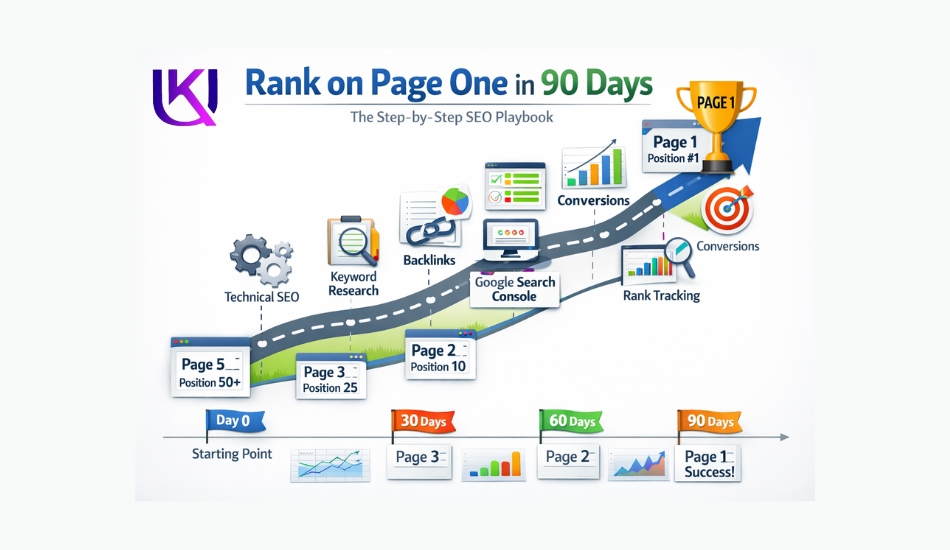
Rank Page One 90 Days sounds like a bold promise. You want to rank on page one of Google. You want it fast. And you’ve probably heard people say 90 days is the magic window.
The truth? It depends on what you do in those 90 days. This playbook gives you an exact, month-by-month plan to make it happen.
You won’t find vague advice here. You’ll find real steps, in the right order, built around how Google actually works in 2025.
If you have been publishing content, updating your website, and still cannot break into Google’s first page, you are not alone.
Many business owners invest time and money into SEO but focus on the wrong things. They chase high-volume keywords, ignore technical problems, and publish content that does not match search intent.
The good news is that reaching page one within 90 days is possible for many websites when you follow a focused strategy.
Trying to compete for the hardest keywords, you need to target low-competition long-tail keywords, improve your site’s technical SEO, strengthen your topical authority, and create content that answers exactly what your audience is searching for.
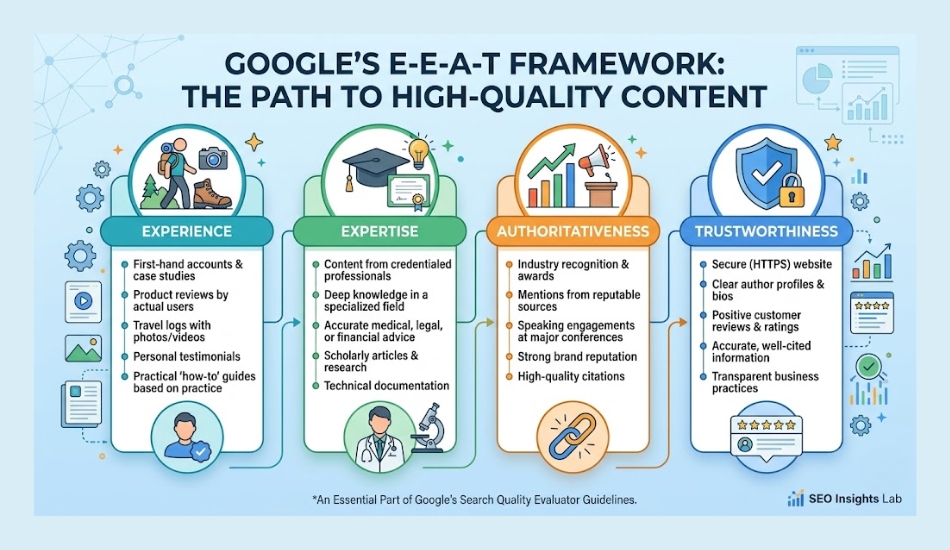
Google now relies heavily on signals such as Experience, Expertise, Authoritativeness, and Trustworthiness (E-E-A-T).
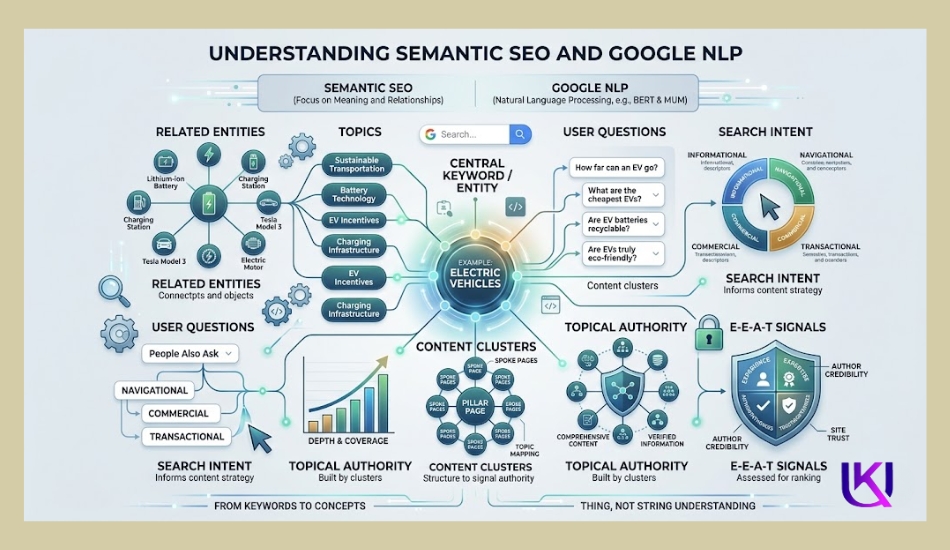
It also uses Natural Language Processing (NLP) and Semantic SEO to understand the meaning behind a search query, not just the words on the page.
This means your content must cover related topics, entities, user questions, and search intent naturally.
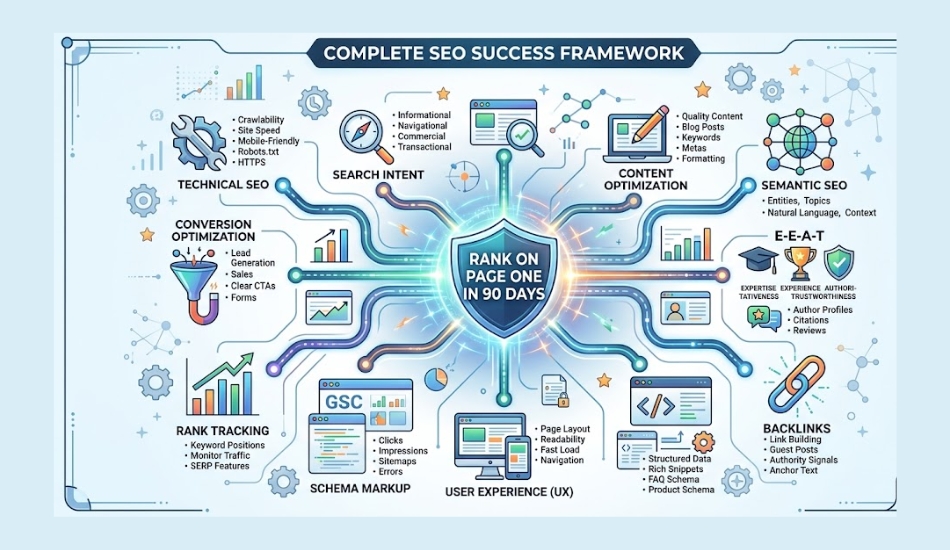
In this 90-day playbook, you will learn how to fix crawling and indexing issues with Google Search Console, improve page speed and mobile usability, optimize pages already ranking in positions 11–20, build relevant backlinks, implement schema markup, track keyword movement with tools like Semrush and Ahrefs, and turn growing organic traffic into real leads and sales.
If your goal is to gain more visibility, generate qualified traffic, and create a predictable SEO growth system, this step-by-step roadmap will show you where to focus first, what to avoid, and how to build momentum month after month.
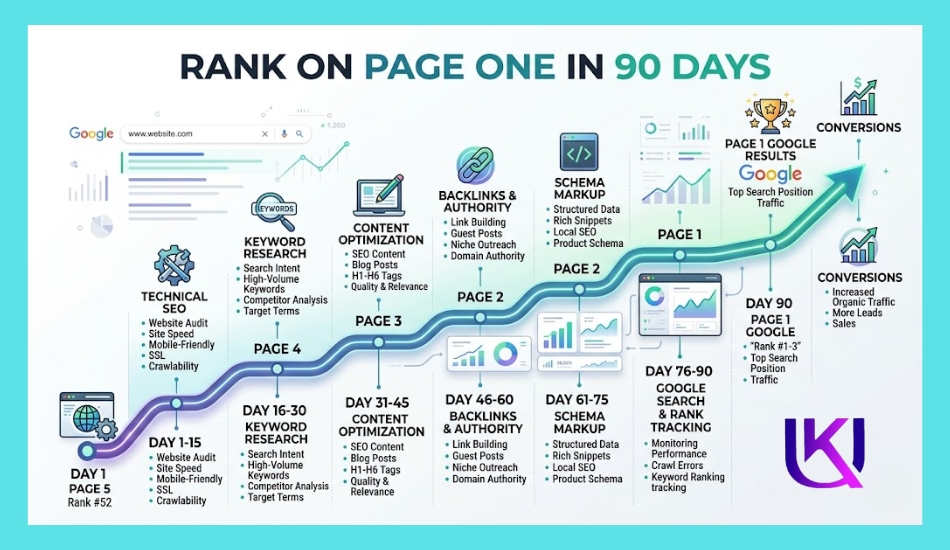
Rank Page One 90 Days: A Practical SEO Playbook That Actually Works
First, Let’s Set Honest Expectations
90-day rankings are possible. But not for every business or every keyword. Here’s what you need to know before you start:
- New domains (under 6 months old) need more time. Google doesn’t trust new sites right away.
- Ultra-competitive keywords like best credit card or SEO services take much longer without paid ads.
- Local and niche markets are where 90-day wins happen most often.
If you’re targeting the right keywords and your site already has some history, you can absolutely rank on page one within 90 days. Let’s go.
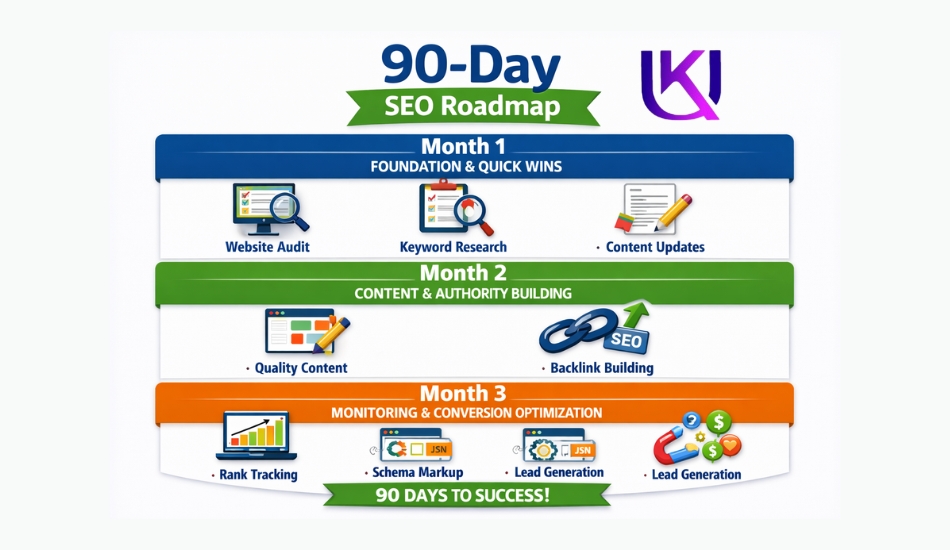
| Month 1: Build Your Foundation & Grab Quick Wins Days 1–30 | Fix what’s broken. Optimize what already works. |
Most businesses skip this step. They jump straight into writing new content or building backlinks. That’s a mistake. Google can’t rank pages it can’t crawl. And it won’t rank pages that give users a bad experience.
Month 1 is about fixing the roof before painting the walls.
Step 1: Run a Full Technical SEO Audit
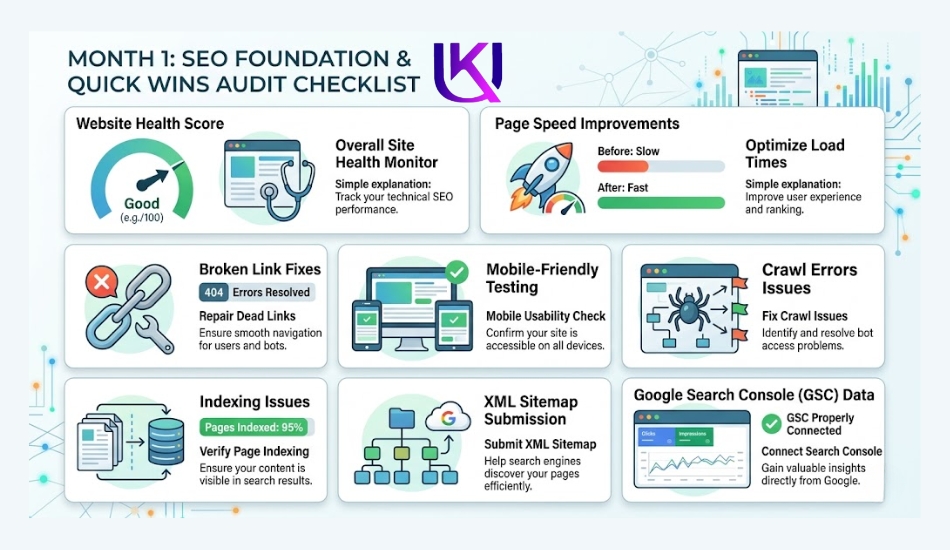
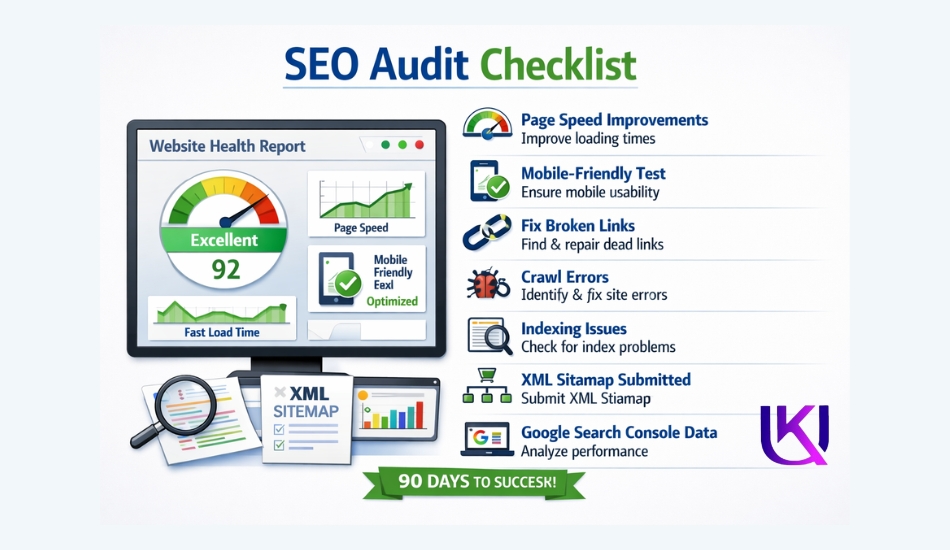
Your website might be blocking Google without you knowing it. Crawl errors, slow load times, and broken links all hurt your rankings. Here’s what to check first:
- Page speed: Use Google PageSpeed Insights. Your page should load in under 3 seconds on mobile. Slow pages lose rankings and lose visitors.
- Mobile responsiveness: Over 60% of Google searches happen on phones. If your site looks broken on mobile, you’re losing rankings every single day.
- Broken links: Use Google Search Console (it’s free) to find 404 errors. Fix them or redirect them.
- Indexing issues: Go to Google Search Console > Coverage. See which pages Google can’t index. Submit your sitemap if you haven’t already.
- Duplicate content: If you have the same content on multiple URLs, Google gets confused about which one to rank.
| Fast Action Item |
| Quick win: Open Google Search Console right now. |
| Go to ‘Coverage’ to see pages with errors. |
| Fix the top 5 issues first. This alone can move rankings within weeks. |
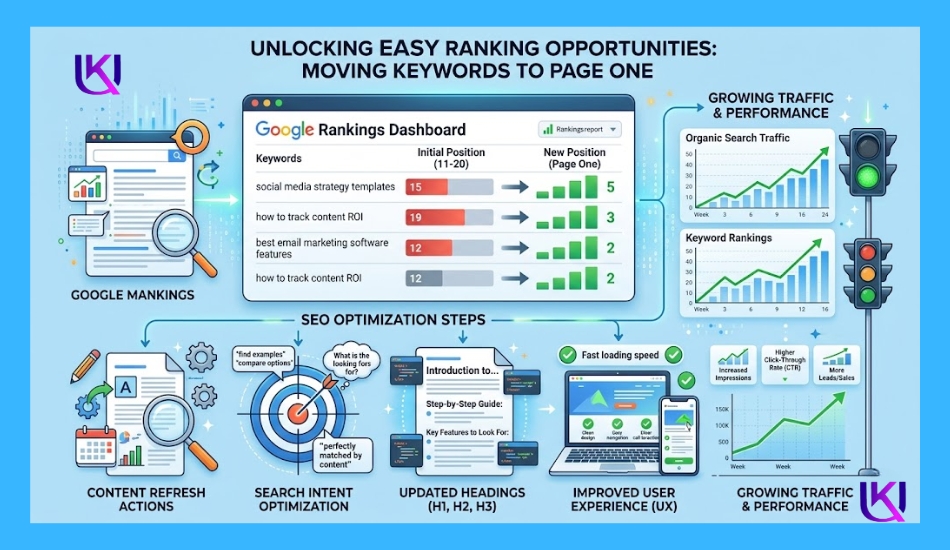
Step 2: Optimize Your ‘Almost There’ Pages
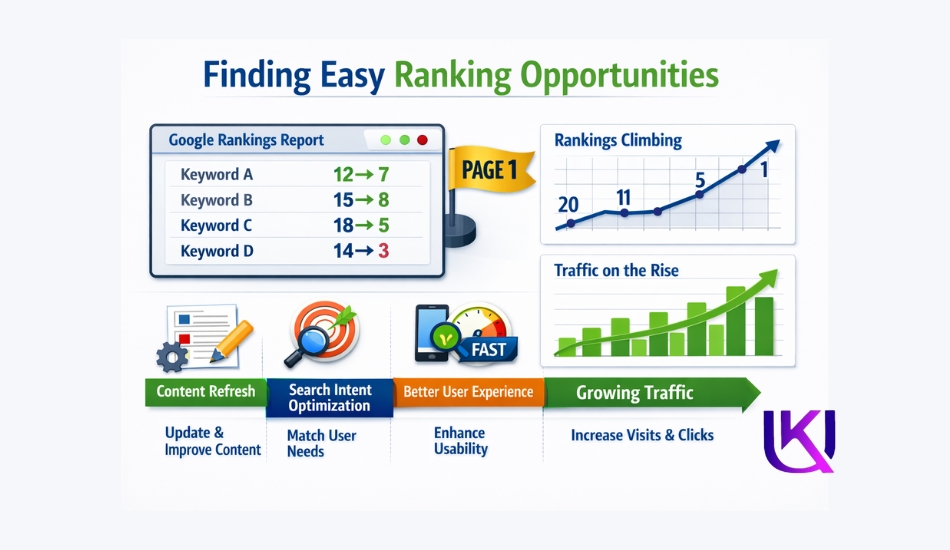
This is one of the fastest ways to rank on page one in 90 days. Look for pages on your site that rank in positions 11 to 20 on Google. These pages are one step away from page one. A little push gets them there.
Here’s how to find them and fix them:
- Find them: In Google Search Console, go to Search Results > Queries. Filter by position 11–20.
- Update the content: Add more useful information. Answer questions users actually search for. Make the page longer and more helpful.
- Fix the title tag: Your page title should include your target keyword. Make it clear and specific.
- Improve the meta description: Write a short, punchy summary that makes people want to click.
- Add internal links: Link from other pages on your site to this page. It sends ranking signals to Google.
A page sitting at position 13 can jump to position 4 or 5 with the right updates. That’s happened to many businesses in less than 30 days.
Step 3: Set Up or Optimize Your Google Business Profile
If you serve local customers in a city, a region, or a specific area, your Google Business Profile (GBP) is a ranking goldmine. It shows your business in the local map pack, which appears right at the top of Google search results.
- Verify your listing if you haven’t done it yet. Go to business.google.com.
- Fill in every field: Hours, phone number, website, services, and categories.
- Add photos: Businesses with photos get 42% more requests for directions on Google.
- Write a keyword-rich description that explains what you do and where you serve customers.
- Collect reviews: Ask your happy customers to leave a review. Even 10 genuine reviews can push you above competitors with none.
| Month 2: Build Content & Earn Authority Days 31–60 | Target the right keywords. Get real backlinks. |
Your foundation is solid. Now it’s time to create content that targets the keywords your ideal customers search for and to build the authority Google needs to trust you.
Step 4: Find the Right Keywords (Not Just the Big Ones)
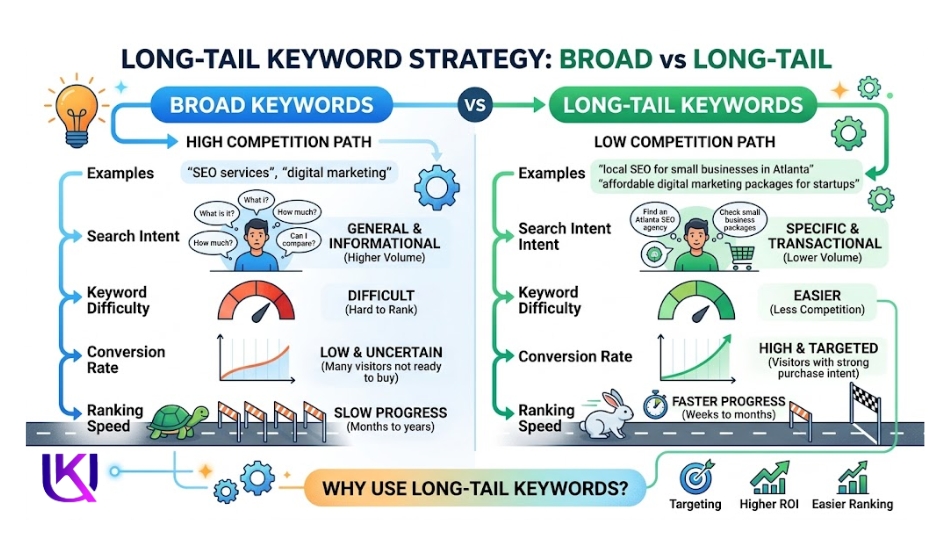
Here’s where most businesses go wrong. They target broad keywords like “digital marketing” or “best shoes” right away. Those keywords are dominated by huge websites with years of authority. You can’t beat them yet.
Instead, go long-tail. Long-tail keywords are longer, more specific phrases. They have less competition and higher buyer intent.
| Right Keywords | Real Example |
| Wrong target early on | digital marketing agency |
| Better target | digital marketing agency for small restaurants in Austin. |
| The second one has | |
| Fewer people search | But those people are ready to buy. |
| Niche Keyword | That’s exactly who you want to reach. |
How to find good long-tail keywords:
- Use Google’s autocomplete: Type your main topic into Google and note what it suggests. These are real searches people make.
- Check ‘People Also Ask’ boxes: These are questions Google shows on page one. Write content that answers them directly.
- Use a keyword tool: Semrush, Ahrefs, or even the free Ubersuggest tool. Filter for keywords with a difficulty score under 30.
- Look at your competitors: See what keywords drive traffic to their top pages. Find gaps where you can win.
Step 5: Write Content That Actually Ranks
Once you have your keywords, write content around them. But here’s the key: don’t write for Google. Write for the person typing that search query. Google’s job is to give that person exactly what they’re looking for.
Here’s how to write content that ranks in 2025:
- Match the search intent: If someone searches ‘how to fix a leaking pipe,’ they want a how-to guide — not a product page selling pipes. Give them what they expect.
- Cover the topic fully: Google favors content that answers a question completely. Include related subtopics, FAQs, and real examples.
- Use headers wisely: Break your content into clear sections with H2 and H3 headings. Each heading should reflect a question or subtopic your reader cares about.
- Keep sentences short: Write as you talk. Short sentences are easier to read and more likely to earn featured snippets on Google.
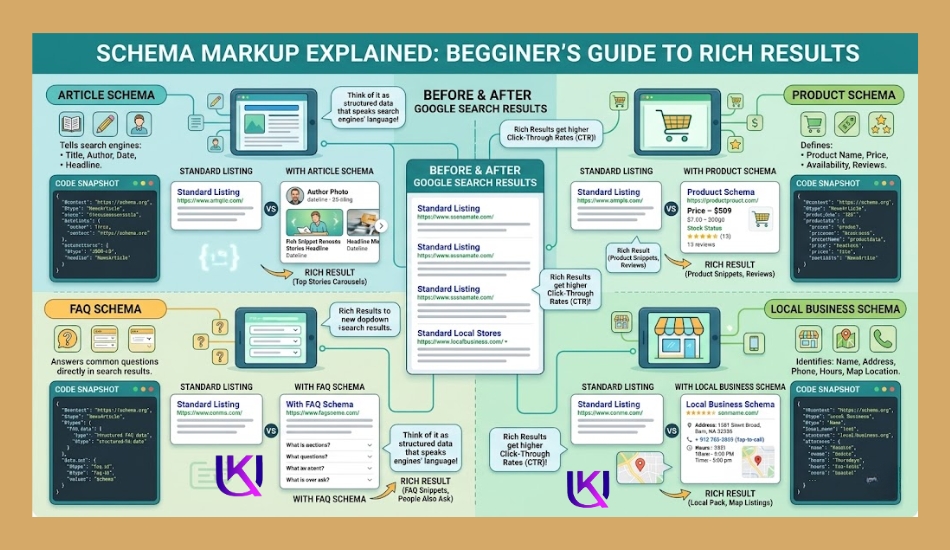
- Add schema markup: Schema helps Google understand your content. For a local business, add the Local Business schema. For articles, add Article schema. For products, add Product schema. A developer or plugin like Yoast SEO can handle this.
Step 6: Build Backlinks That Actually Count
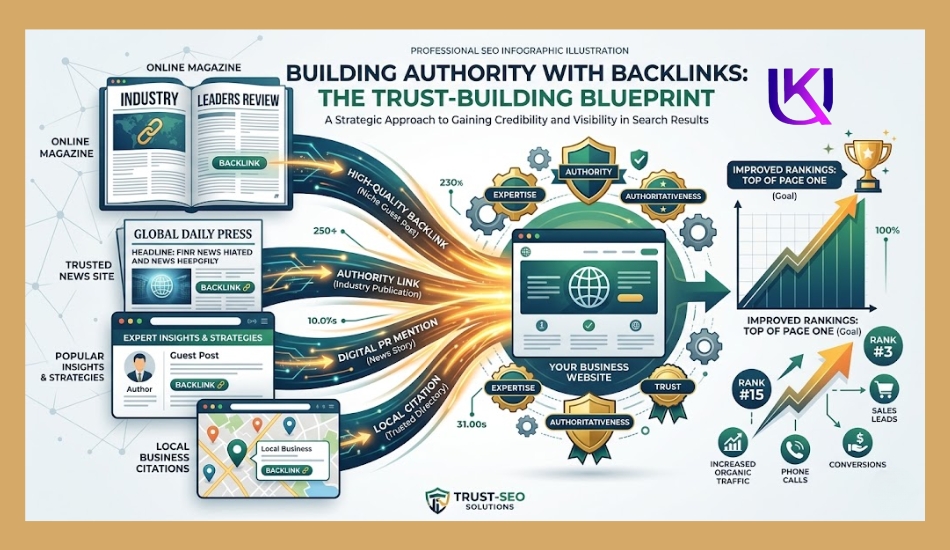
Backlinks are links from other websites pointing to yours. Google treats them like votes of trust. The more quality votes you have, the higher you rank. But quality beats quantity every time. One link from a respected industry site is worth more than 100 links from random directories.
Here are three proven ways to earn real backlinks in Month 2:
- Digital PR: Create something newsworthy, a study, a data report, or a local story, and reach out to journalists or bloggers who cover your industry.
- Guest posting: Write a helpful article for another business’s blog in your niche. They publish it, and you get a link back to your site.
- Local citations: If you serve a local area, get listed in local directories, such as Yelp, the Chamber of Commerce, and local news sites. These are trusted signals for local rankings.
| Month 3: Monitor, Refine & Convert Days 61–90 | Track what’s working. Fix what isn’t. Turn traffic into revenue. |
You’ve done the work. Now you need to measure it, adjust what isn’t working, and make sure that all the new traffic you’re earning actually turns into business.
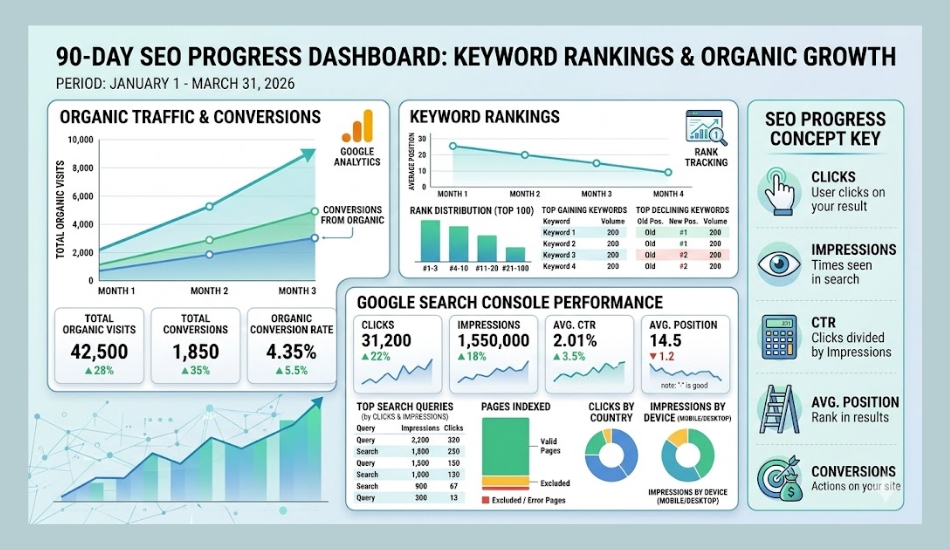
Step 7: Track Your Keyword Rankings Every Week
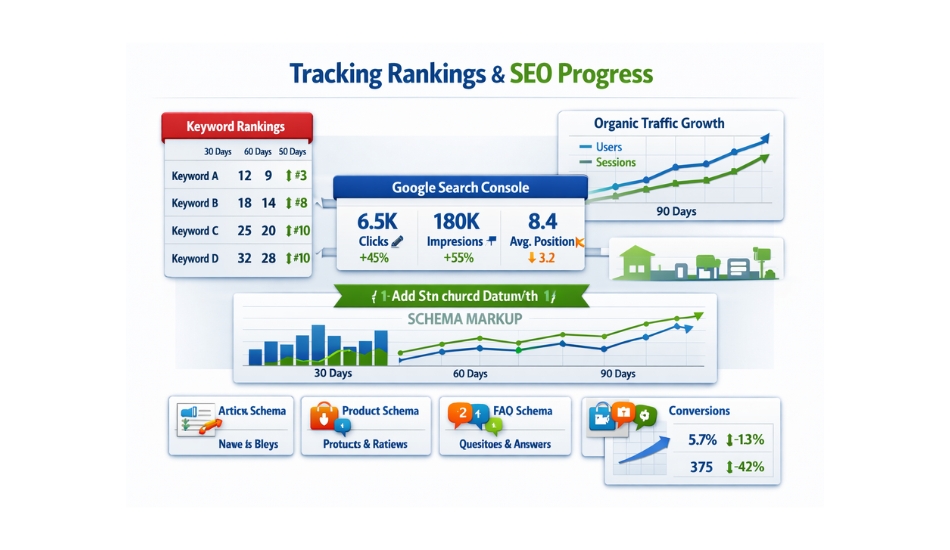
If you don’t track, you’re guessing. Set up weekly rank tracking for every keyword you targeted in Month 2. You want to see movement, even small jumps from position 28 to 21, which means your strategy is working.
- Use Semrush or Ahrefs for detailed rank tracking. Both offer project dashboards that let you monitor 20 or 30 keywords at once.
- Check Google Search Console weekly. Look at your top queries, impressions, and click-through rates. If a page has lots of impressions but few clicks, your title tag or meta description needs work.
- Compare week over week. Don’t panic at small drops. Focus on the 30-day trend, not single-day changes.
Step 8: Use Behavior Data to Improve Pages
Rankings tell you where you are. Behavior data tells you why people leave. Install Google Analytics 4 if you haven’t. Then look at these two things:
- Bounce rate: If 80% or more of visitors leave right away without clicking anything, your page isn’t matching what they expected to find. Rewrite the intro. Make the content clearer.
- Time on page: If people spend less than 30 seconds on a page you’ve optimized for a competitive keyword, that’s a red flag. Add more depth, images, or video to keep them reading.
Use what you find to update pages. Google notices when people engage more with your content; it’s a strong ranking signal.
Step 9: Turn Your Traffic Into Leads or Sales
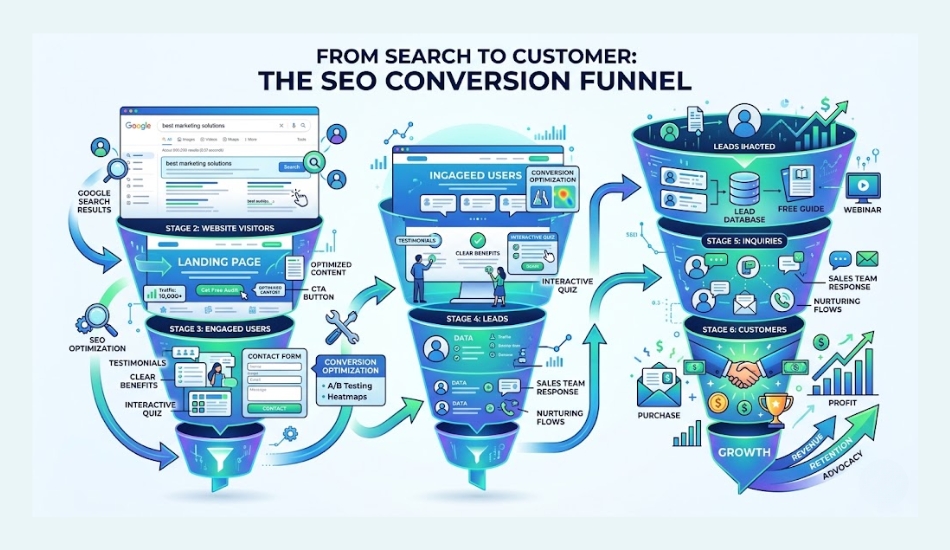
Here’s something most SEO guides skip entirely. What’s the point of ranking on page one if your visitors leave without doing anything?
Conversion optimization makes sure your rankings pay off. For every page you’re ranking or close to ranking, check these things:
- Clear call-to-action (CTA): Every page should have one clear next step. Get a Free Quote. Book a Call. Download the Guide. Don’t make visitors guess what to do next.
- CTA placement: Your CTA should appear above the fold, visible without scrolling, and again at the bottom of the page.
- Trust signals: Add client logos, testimonials, reviews, or certifications near your CTA. People need to trust you before they contact you.
- Mobile CTA: Make sure your CTA button is big enough to tap easily on a phone. Small buttons cost you leads.
What Will Kill Your 90-Day Progress?
Some tactics look good on the surface. But they slow you down or get you penalized by Google. Avoid these:
- Buying links: Google penalizes paid link schemes. If a site offers you 50 links for $99, walk away.
- Ignoring mobile: Half your traffic is on mobile. If your site doesn’t work well on phones, you lose rankings.
- Targeting only broad keywords: You’ll wait 12 months or more and still not rank. Start with specific, lower-competition terms.
- Publishing thin content: A 300-word blog post won’t rank for anything competitive. Aim for depth, not word count padding.
- Skipping technical fixes: Great content on a broken site doesn’t rank. Fix the foundation first.
The Tools You Need for This Playbook
| Tool | Purpose | Cost |
| Google Search Console (GSC) | Find indexing issues, track impressions | Free |
| Google Analytics 4 | Track behavior and conversions | Free |
| PageSpeed Insights | Check load speed | Free |
| Semrush | Keyword research, rank tracking | Paid |
| Ahrefs | Backlink analysis, keyword research | Paid |
| Ubersuggest | Beginner keyword research | Free / Low cost |
| Yoast SEO | On-page optimization & schema (WordPress) | Free / Paid |
Conclusion: Your 90 Days Start Today
Page one rankings don’t happen by accident. They happen because someone made a plan and followed through month by month, step by step.
You now have the exact blueprint. Month 1 fixes your foundation. Month 2 builds your content and authority. Month 3 measures, refines, and converts.
The businesses that rank on page one aren’t smarter than you. They just started earlier and stayed consistent. Today is your day one.
| Your Next Move Right Now 90-Day SEO Blueprint to Reach Google’s First Page |
| Start with Month 1, Step 1, your technical audit. |
| Open Google Search Console. Fix the top 5 issues you find. |
| Come back to this playbook each week and check off your progress. |
| 90 days go fast. Let’s go. |
Relevant article: What Is SEO? The Simplest Guide for Total Beginners
People Also Ask: A 90-Day SEO Playbook From Invisible to Page One.
1. Can a brand-new website rank on page one in 90 days?
It’s rare, but not impossible. New domains don’t have Google’s trust yet. Your best shot is targeting very low-competition, hyper-local, or niche long-tail keywords. Combine that with a fast, technically sound site and consistent content publishing.
2. How many backlinks do I need to rank on page one?
There’s no magic number. It depends on how many backlinks your competitors have for that keyword. Use Ahrefs or Semrush to check the top 10 results for your target keyword. Match or slightly beat their average link count with higher-quality links.
3. Does blogging help you rank faster?
Yes, if you blog with a strategy. Publishing random articles doesn’t help. Publishing content built around specific long-tail keywords that your ideal customers search for does. Aim for 2 to 4 optimized pieces per month, not daily posts with no direction.
4. What if I don’t see results after 90 days?
Don’t panic. Check your tracking data first. Are impressions growing even if rankings haven’t moved yet? That’s a positive sign. If nothing has moved at all, go back to your keyword targets. You may need to choose lower-competition terms or fix deeper technical issues on your site.