

How to Build a GEO Strategy is an important question for businesses that want to appear in AI-powered search results. Your customers are no longer using Google alone to find answers.
They also ask ChatGPT, Perplexity, Google AI Overviews, and other AI search tools to compare products, find services, and choose businesses.
But getting your brand mentioned in AI answers does not happen by chance. You need useful content, clear website information, trusted sources, and a plan that helps AI systems understand your business.
In Part 1, you learned what Generative Engine Optimization (GEO) means, how AI search works, and why brand visibility matters.
Now, let’s move from theory to action.
This guide shows you how to build a GEO strategy step by step. You will learn how to research AI search questions, improve your website content, build brand authority, and track your visibility across AI platforms.
The goal is simple: help AI search tools understand your brand, trust your information, and consider your website when answering relevant questions.
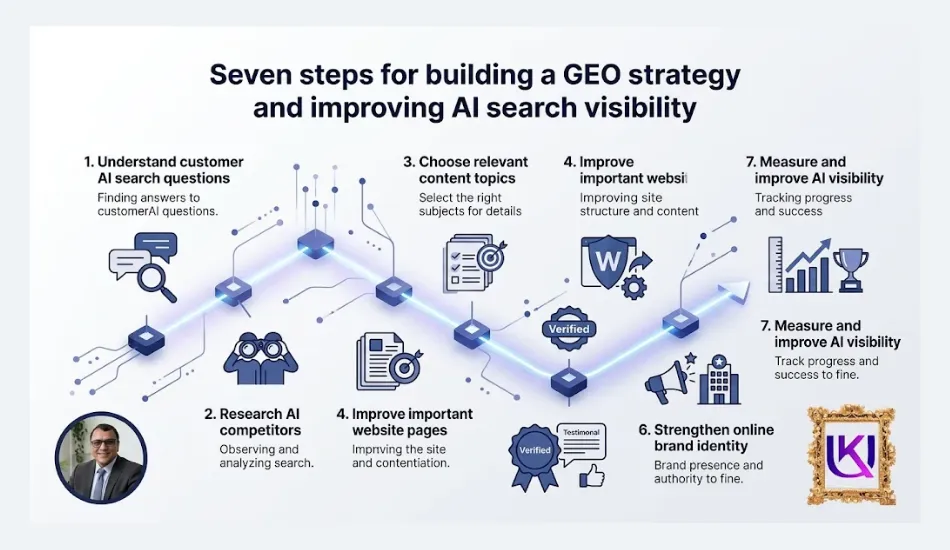
7 Step-by-Step Process: How to Build a GEO Strategy for Improved AI Search Visibility
A successful Generative Engine Optimization (GEO) strategy starts with a clear plan. You need to know what your customers ask, which information your website provides, and how AI search tools may find your brand.
Follow these seven steps to build a practical strategy for your business.
Step 1: Understand What Your Customers Ask AI Search Engines
Start by thinking about your customers’ problems. What do they want to know before they choose a product or service?
For example, if you run an SEO agency in the USA, your customers may ask:
- Which SEO agency is best for a small business?
- How much does local SEO cost?
- How can I get more customers from Google Maps?
- What should I check before hiring an SEO expert?
- Which SEO services does a new business need?
These questions help you understand what your content should cover.
You can collect ideas from customer emails, sales calls, website search data, Google Search Console, online forums, and keyword research tools.
Do not focus only on search volume. A question with low search volume may still come from a person who is ready to buy.
Step 2: Research Your Competitors in AI Search
Find out which brands and websites appear when people ask questions related to your services.
Test the same relevant questions in ChatGPT, Perplexity, and Google’s AI search features.
Record:
- Which brands appear in the answers?
- Which websites receive citations or links?
- What topics do those sources cover?
- What proof or examples do they provide?
- Which useful questions do their pages answer?
Look for gaps. Perhaps competing websites explain local SEO but do not show how to measure calls and leads. You can create a useful guide that answers this missing question.
Because AI answers can change between searches. One test is not enough to prove that a brand has stable visibility.
Step 3: Choose the Topics Your Brand Should Own
Do not publish content about every trending topic. Focus on subjects that connect directly to your products, services, and customer needs.
For an SEO agency, your main topics may include:
| Main topic | Supporting content ideas |
| Local SEO | Google Business Profile, local citations, local rankings |
| Technical SEO | Crawling, indexing, website speed, schema markup |
| Link Building | Backlink quality, link outreach, link risk |
| SEO Content | Search intent, content planning, topic coverage |
| GEO | AI search visibility, brand mentions, AI citations |
This structure helps you build deeper coverage around your main services.
Step 4: Improve Your Important Website Pages
Your service pages should explain exactly what you offer.
For each important page, answer these questions:
- What service do you provide?
- Who needs this service?
- Which problem does it solve?
- How does your process work?
- What makes your approach useful?
- What proof can you show?
For example, a local SEO service page should explain Google Business Profile (GBP) optimization, local keyword research, location pages, local citations, and performance tracking.
Use real examples when you have them. Do not add fake case studies, customer reviews, or results.
Step 5: Add Original Experience and Useful Evidence
AI search users need more than repeated advice. They need information that helps them make better decisions.
You can make your content more useful by adding:
- Real project examples.
- Before-and-after comparisons.
- Original research.
- Screenshots with proper context.
- Step-by-step processes.
- Expert explanations.
- Clear data sources.
For example, instead of writing only “Website speed is important for SEO,” explain how you found a slow-loading page, what caused the problem, and how you fixed it.
Only share results you can support with real evidence.
Step 6: Strengthen Your Brand’s Online Identity
Your website is important, but your brand information may also appear on other trusted platforms.
Make sure your business details are clear and consistent across relevant profiles and websites.
For a service business, this may include:
- Your official website.
- LinkedIn company or professional profile.
- Google Business Profile, if eligible.
- Relevant industry directories.
- Professional interviews and guest articles.
- Genuine customer reviews.
Focus on relevant sources. A mention from a trusted website in your industry is more useful than many unrelated brand mentions.
Step 7: Measure, Learn, and Improve
Generative Engine Optimization (GEO) is not a one-time task. You need to test your visibility and improve your content based on what you find.
Track these signals:
| What to measure | Why it matters |
| Brand mentions in AI answers | Shows whether your brand appears in relevant responses |
| AI citations and links | Shows whether AI answers reference your website |
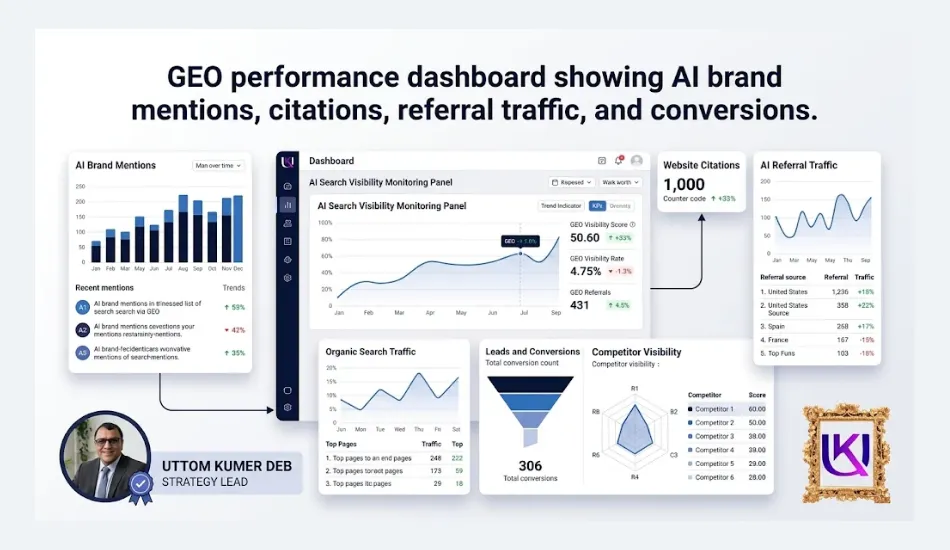
| AI referral visits | Shows whether users visit from AI platforms |
| Leads and conversions | Connects visibility with business results |
| Important page performance | Helps you find pages that need improvement |
Use Google Analytics 4, Google Search Console, and available AI visibility tools to collect useful data. Each tool measures different things, so do not treat one report as a complete picture of GEO performance.
Your next move: Choose one important service, research the questions customers ask about it, improve its main page, and publish supporting content. Then test whether your brand becomes more visible across AI search platforms over time.
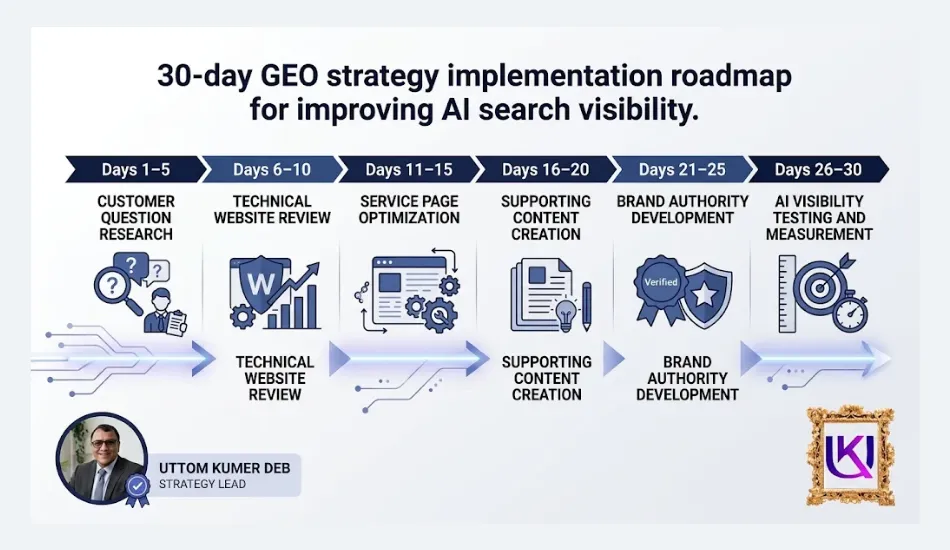
Your First 30-Day GEO Action Plan
| Time | What you should do | Expected output |
| Days 1–5 | Review your brand details and website access | Clear brand identity and technical issues list |
| Days 6–10 | Research customer questions | List of useful search prompts and content gaps |
| Days 11–17 | Improve key pages and publish helpful content | Better service pages and topic coverage |
| Days 18–23 | Review internal links, schema, and trusted mentions | Stronger site structure and clearer information |
| Days 24–30 | Test AI platforms and record results | First GEO visibility report |
This is a starting plan, not a promise of AI visibility within 30 days. Results depend on your website, content, competition, and the systems that select sources.
Your priority: Start with your most important service pages. Make your business information clear, answer real customer questions, and measure what changes. Build your GEO strategy step by step instead of trying to do everything at once.
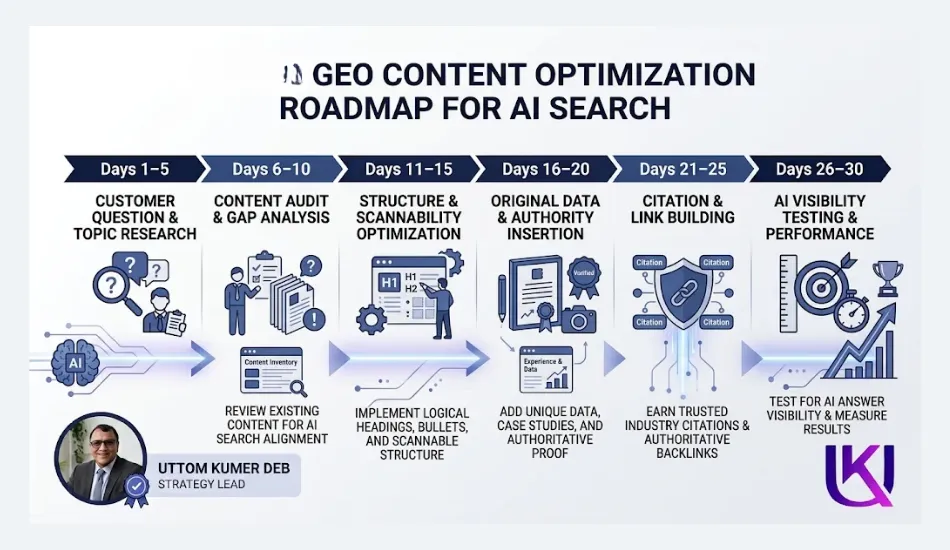
How to Optimize Your Content for AI Search
Creating useful content is only the first step. You also need to present information in a way that people and AI search systems can understand.
Your content should answer real questions, explain important details, and support its claims with reliable information.
Use these practical methods to improve your content for AI search.
1. Give a Direct Answer at the Beginning
Do not make readers search through long paragraphs to find the answer.
Start each important section with a clear explanation. Then add details, examples, and steps.
- Example question: What is local SEO?
- Weak answer: Local SEO is an important part of modern digital marketing. Many businesses use different methods to improve their online presence.
- Better answer: Local SEO helps your business appear in location-based searches on Google. It can help nearby customers find your services, business details, and location.
The second answer explains the topic directly. You can then discuss Google Business Profile, local keywords, reviews, and other related factors.
2. Use Clear Headings That Match Customer Questions
Your headings should tell readers what each section covers.
Instead of using a broad heading such as “Important Factors,” use a specific question:
- How Does Local SEO Help Small Businesses?
- What Makes a Website Easy for Search Engines to Crawl?
- How Can You Improve Your Google Business Profile?
- What Should You Check Before Hiring an SEO Agency?
Question-based headings make your content easier to scan. They also help you cover the questions connected to your main topic.
You do not need to turn every heading into a question. Use the format that explains the section best.
3. Explain Important Terms in Simple Language
Your readers may not understand every technical term.
When you use terms such as crawling, indexing, structured data, or entity SEO, explain what they mean.
For example:
- Crawling: The process search engines use to discover pages on your website.
- Indexing: The process of storing and organizing information about a page so it can appear in search results.
- Structured data: A standard format that helps search engines understand details about a page or business.
Clear explanations help beginners understand your content without losing important details.
4. Add Real Examples and First-Hand Experience
Generic advice is easy to repeat. Real examples make your content more useful.
Suppose you write about website speed. Do not only say that a fast website creates a better user experience.
Explain a real problem:
- A service page takes too long to load.
- Large images increase page weight.
- Too many scripts slow down the page.
- You compress images and remove unnecessary scripts.
- You test the page again to check the result.
If you have real project data, show it with dates, tools, and the steps you took. Explain what changed and what did not.
Never create fake project results to make an article look more trustworthy.
5. Support Claims With Reliable Sources
If you make a factual claim, show where the information comes from.
For example, when explaining Google’s AI search features, use relevant Google Search Central documentation. When discussing ChatGPT Search, check OpenAI’s official help and crawler documentation.
You can also use:
- Government and public data.
- Academic research.
- Industry reports with clear methods.
- Original surveys and experiments.
- Expert interviews.
Do not add links to increase the number of citations. Every source should support a specific point.
6. Use Lists, Tables, and Step-by-Step Instructions
Long paragraphs can make important information hard to find.
Use the right format for the information:
- Lists for key points or requirements.
- Tables for comparisons.
- Numbered steps for processes.
- Examples to explain practical situations.
- FAQs for useful questions that are not fully covered in the main text.
For example, if you compare SEO, AEO, and GEO, a table can help readers understand their different goals more quickly.
Keep tables simple. Do not add information that does not help the reader make a decision.
7. Keep Your Content Accurate and Updated
Old information can confuse readers and reduce trust.
Review your important pages regularly. Check whether:
- Statistics still match their original sources.
- Tools and platform features have changed.
- Links still work.
- Screenshots show the current interface.
- Examples remain relevant.
- Your service information is accurate.
Add an update date only when you have made a meaningful change. Changing the date without improving the content does not make it more useful.
8. Connect Related Pages With Internal Links
Internal links help readers move between related topics on your website.
For example, an article about Generative Engine Optimization (GEO) can link to your guides on:
- Technical SEO.
- Search intent.
- Schema markup.
- Link building.
- Content strategy.
- Local SEO.
Use clear anchor text so readers know what they will find after clicking.
Do not link every keyword to another page. Add links only when they provide useful context or help readers take the next step.
Key point: Good GEO content is not written only for AI tools. It should help real people understand a topic, solve a problem, and make a better decision. When your content is clear, accurate, useful, and easy to discover, it gives AI search systems a stronger source to consider.
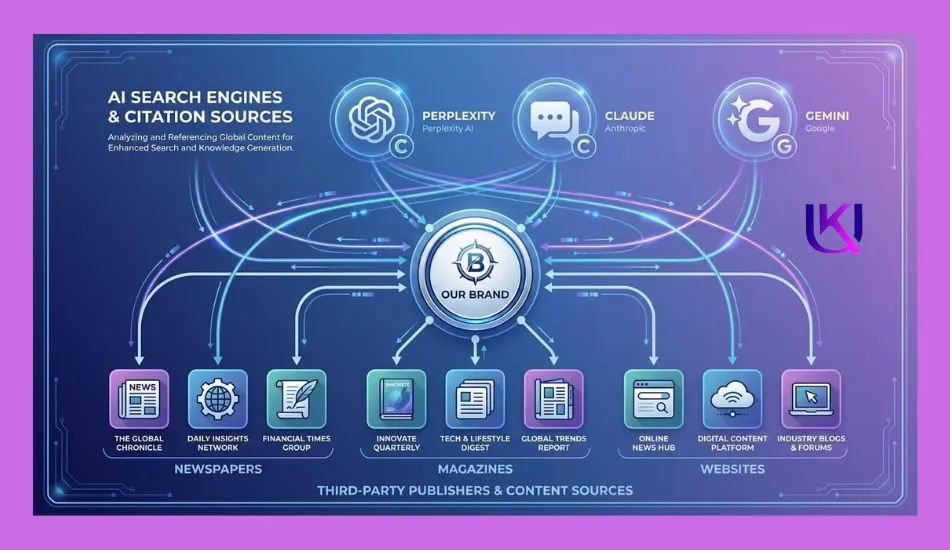
How to Build Brand Authority and Earn AI Citations
Publishing helpful articles is not enough to build a strong online brand. You also need to show that your business has real knowledge, clear services, and a trusted presence across relevant websites.
This matters because AI search tools may use information from different sources when preparing an answer. Your website is one source, but it is not the only one.
Here is how you can build stronger brand authority and improve your chances of being mentioned or cited.
1. Make Your Brand Information Consistent
Start by checking how your business appears online.
Your website, professional profiles, and business listings should explain the same core facts.
For example, if you run a digital marketing agency in the USA, make sure your online information clearly explains:
- Your official business name.
- Your main services.
- The customers you serve.
- Your service locations.
- Your website and contact details.
- Your professional experience.
If your website says you offer local SEO, but your business profiles describe you only as a general web design company, customers may find it harder to understand your main services.
Keep your brand description clear and accurate across relevant platforms.
2. Publish Case Studies That Show Real Work
A case study gives readers evidence of how you solve a problem.
Instead of writing only about what SEO (Search Engine Optimization) can do, explain what you did for a real project.
A useful SEO case study can include:
- The problem: What was the client’s website struggling with?
- The review: What issues did you find?
- The action: Which changes did you make?
- The result: What changed after the work?
- The evidence: Which reports or screenshots support the result?
For example, you could explain how you improved a local service website’s page structure, fixed indexing issues, and improved its local service content.
Use real project details and get permission before sharing private client information. Never invent traffic growth, rankings, or revenue results.
3. Earn Relevant Mentions From Trusted Websites
Your brand can appear on websites beyond your own domain.
For example, a US SEO agency may earn relevant mentions through:
- Industry publications.
- Expert interviews.
- Useful guest articles.
- Professional directories.
- Local business organizations.
- Relevant podcasts and events.
Focus on the value of the mention, not just the number of websites linking to you.
A detailed expert quote in a respected marketing publication may be more useful than dozens of links from unrelated websites.
Do not buy fake brand mentions or publish low-quality guest posts to create more online references.
4. Build Relationships With Industry Experts
People often trust information more when they can understand who is sharing it and why that person has useful experience.
You can build professional relationships by:
- Sharing useful insights on LinkedIn.
- Answering relevant industry questions.
- Taking part in expert discussions.
- Contributing original comments to industry articles.
- Working with other professionals on useful research.
For example, if you specialize in technical SEO, share a practical explanation of how you diagnose crawling and indexing problems.
Make your contribution useful. Do not turn every discussion into a sales pitch.
5. Use Backlinks to Support Your Online Authority
Backlinks remain an important part of SEO strategy. They can help search engines discover pages and understand how websites connect.
But you should not assume that every backlink creates an AI citation.
Focus on earning links from relevant websites that have real readers and publish useful information.
For example, a link from a trusted SEO publication to your technical SEO guide has a clearer topic connection than a link from an unrelated website.
Your link-building work should focus on:
- Relevant websites.
- Useful content worth referencing.
- Genuine editorial links.
- Real industry relationships.
- Natural links to the right pages.
Avoid link farms, automated link schemes, and paid links that pass ranking credit in violation of search engine policies.
6. Give Your Experts a Clear Identity
Show readers who is behind your content and business.
Add useful author and company information to your website. Explain the writer’s role, experience, and relevant work.
For example, an SEO article can include:
- The author’s name.
- A short professional biography.
- Relevant experience.
- Links to professional profiles.
- A reviewer name when expert review has taken place.
Do not add fake credentials or claim that an expert reviewed an article when no review has happened.
Your goal is to make your business and its people easy to understand.
7. Track Brand Mentions and AI Citations Separately
A brand mention and an (Artificial Intelligence) AI citation are not the same thing.
- Brand mention: An AI tool’s answer names your business or brand.
- AI citation: An AI answer links to or identifies a source used to support its answer.
Your business may be mentioned without a link. Your website may also receive a citation without your brand being recommended as a service provider.
Track both signals.
For example, test questions such as:
- Which SEO agencies help small businesses in the USA?
- Who offers technical SEO services for WordPress websites?
- What are reliable resources for learning local SEO?
Record whether your brand appears, which page is cited, and which other sources appear. Repeat the tests over time because AI answers can change.
Important: No backlink, guest post, author bio, or brand mention guarantees an AI citation. These actions help build a clearer and more credible online presence, but each platform chooses its sources through its own systems.
How to Build a GEO Strategy: Technical GEO Checklist
Technical GEO setup for your website. This explains content optimization, but it does not fully explain how AI search systems discover your website information.
1. Make Your Website Accessible to AI Search
Cover:
- Check whether important pages can be crawled.
- Review your robots.txt file.
- Understand AI search crawlers and their access requirements.
- Check website indexing in Google Search Console.
- Make important content available in readable HTML.
- Use accurate schema markup where relevant.
- Fix broken internal links and important page errors.
Explain that AI search crawlers and search engine crawlers have different roles. Do not suggest that allowing every AI crawler is necessary.
How to Test Your Brand Visibility in ChatGPT, Perplexity, and Google AI Search
Include a simple process:
- Select 10–15 questions related to your services.
- Test those questions on relevant AI platforms.
- Record whether your brand appears.
- Check which websites receive citations.
- Identify competitors appearing more often.
- Improve the pages related to missing answers.
- Repeat the tests using the same questions.
This gives readers something they can actually do.
Practical GEO Strategy Example: A Local SEO Agency in the USA
For example:
A local SEO agency wants to appear when US business owners ask AI tools:
- Which SEO agency helps small businesses?
- How much does local SEO cost in the USA?
- How can a local business improve Google Maps visibility?
Show how the agency:
- Creates helpful service pages.
- Publishes local SEO guides.
- Adds real case studies.
- Builds relevant industry mentions.
- Improves its technical SEO.
- Tests AI search visibility.
- Measures leads and referral traffic.
This example helps beginners understand the full process.

How to Build a GEO Strategy: Your First 30-Day Implementation Plan
| Timeline | Main activity |
| Days 1–5 | Research customer questions and AI competitors |
| Days 6–10 | Review website pages and technical access |
| Days 11–15 | Improve important service pages |
| Days 16–20 | Publish supporting content and original examples |
| Days 21–25 | Strengthen brand authority and relevant mentions |
| Days 26–30 | Test AI visibility and review performance |
Part -1 GEO Strategy Guide: What Is GEO and How Does AI Search Work?
Conclusion: Build Your GEO Strategy for Long-Term AI Search Visibility
Building a strong GEO strategy takes more than publishing content and adding keywords to your website. You need to help AI search tools understand what your business does, who you serve, and why people should trust your information.
Start with the seven steps in this guide. Research the questions your audience asks, create clear and useful content, strengthen your brand authority, improve your website structure, and track your visibility across AI search platforms.
Generative Engine Optimization (GEO) does not replace Traditional SEO. We both work together. Strong technical SEO, helpful content, trusted sources, and a clear brand identity give your business a better foundation for search visibility.
You also need to keep testing your strategy. AI search platforms change, and the way they select and present information can change too. Review your content, check your brand mentions, and update weak pages when needed.
So, start with one important service or product page. Improve its answers, add useful proof, and make your business information clear. Then measure whether your brand appears in relevant AI-generated answers over time.
Want to improve your brand’s visibility across Google and AI search?
UK Deb can help you build a practical GEO and SEO strategy that supports your business growth.
FAQs About How to Build a GEO Strategy: 7 Steps to Improve Your Brand’s AI Search Visibility.
1. What is a GEO strategy?
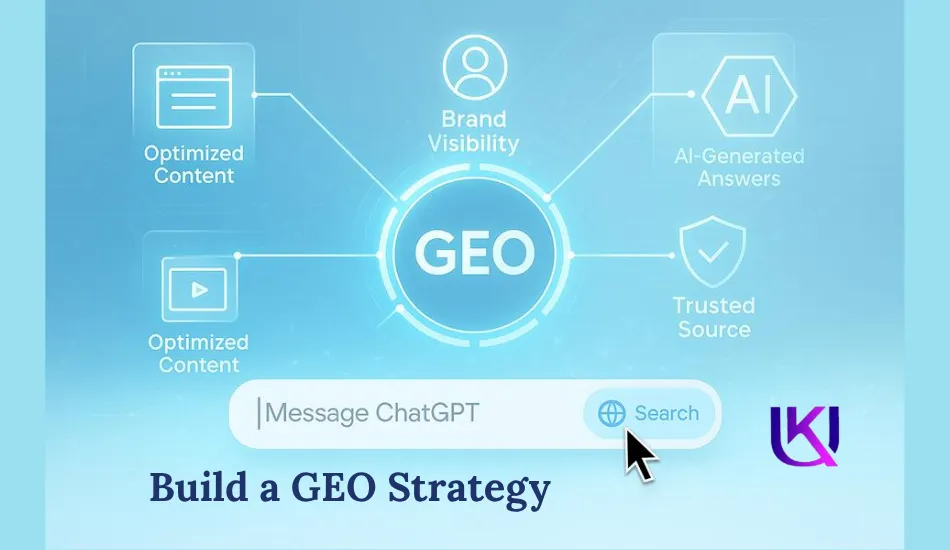
A (Generative Engine Optimization) GEO strategy is a plan to improve your brand’s visibility in AI-generated search answers. It focuses on creating helpful content, building brand authority, earning trusted mentions, and making your website information easy to understand.
2. How do you build a GEO strategy?
You can build a GEO strategy by following seven steps: Research the questions your customers ask AI. Analyze your competitors in AI search. Choose topics related to your business. Improve your important website pages. Add original experience and useful evidence. Strengthen your brand’s online identity. Measure your AI search visibility and improve your content.
3. How is GEO different from SEO?
SEO focuses on improving your website’s visibility in traditional search results. GEO focuses on helping your brand and content appear in AI-generated answers.
Both strategies support each other. Strong technical SEO, useful content, and trusted information can support your GEO efforts.
4. Which AI platforms should you target for GEO?
Start with the AI search engine platforms your target customers use. These may include: ChatGPT Search, Google AI Overviews, Google AI Mode, Perplexity, Microsoft Copilot. Claude, etc. You do not need to target every platform at once. Focus on the ones that matter most to your audience.
5. How do you make your website content easier for AI search tools to understand?
Write clear answers to common customer questions. Use descriptive headings, simple explanations, relevant examples, and reliable sources. You should also improve your website structure, internal links, and page accessibility so search systems can discover and understand your content.
6. Do backlinks help with Generative Engine Optimization?
Backlinks can support your overall SEO and online authority. Relevant links from trusted industry websites can also help people discover your brand. However, a backlink does not guarantee an AI mention or citation. Focus on earning genuine links from websites related to your industry.
7. How can you get your brand mentioned in ChatGPT answers?
Create useful content that answers questions related to your products and services. Build a clear online identity, publish original information, and earn relevant mentions from trusted sources. You can also test relevant questions in ChatGPT Search to see whether your brand or website appears. Remember, no method guarantees a brand mention.
8. How do you measure GEO performance?
Track several signals instead of relying on one metric: Brand mentions in AI answers. Links and citations to your website. Referral traffic from AI platforms. Website engagement. Leads and conversions. Performance of important website pages. Google Analytics 4, Google Search Console, and AI visibility tools can help you measure different parts of your performance.
9. How long does it take to see results from a GEO strategy?
There is no fixed timeline for GEO results. Your progress depends on your website’s current authority, content quality, competition, and the AI platforms you want to reach. Start by improving your most important pages. Then monitor brand mentions, citations, and referral traffic over time.
10. Does GEO replace traditional SEO?
No. GEO does not replace SEO. It adds another way to improve your brand’s search visibility. You still need technical SEO, useful content, proper indexing, internal links, and a strong website structure. These elements give your website a solid foundation for both traditional and AI-powered search.
11. Is GEO important for small businesses?
Yes. GEO can help small businesses build visibility when potential customers use AI tools to compare services, research products, or find solutions.
For example, a local plumbing company can publish helpful content about plumbing costs, common repair problems, and emergency services. This gives customers useful information when researching their options.
12. Can schema markup improve AI search visibility?
Schema markup helps search engines understand structured information about your website, products, services, and business.
It can improve content understanding, but adding schema markup doesn’t guarantee AI platforms will mention or cite your brand. Use accurate structured data that matches the visible content on your pages.