

AI content strategy has changed how you plan SEO content today. Many websites publish blog posts every week, but still struggle to rank in Google search results. The problem is not always bad writing.
In many cases, the real issue starts before the article is even written. Poor topic research, weak search intent matching, and missing semantic SEO signals often stop content from getting traffic.
This is where Artificial Intelligence (AI) tools can help more smartly. Ideally, asking AI to write full articles, you can use tools from Gimini, OpenAI, Grok, Ahrefs, Semrush, and Surfer SEO to find ranking opportunities, discover content gaps, organize NLP entities, and build topical authority before writing starts.
This process helps you create content that better matches user intent, improves semantic relevance, and supports stronger EEAT signals.
In this guide, you will see the exact workflow used to plan SEO content with AI support while still keeping human expertise at the center. You will find winning topics, group keywords into content clusters, study SERPs, and build a content plan designed around what real users actually search for.
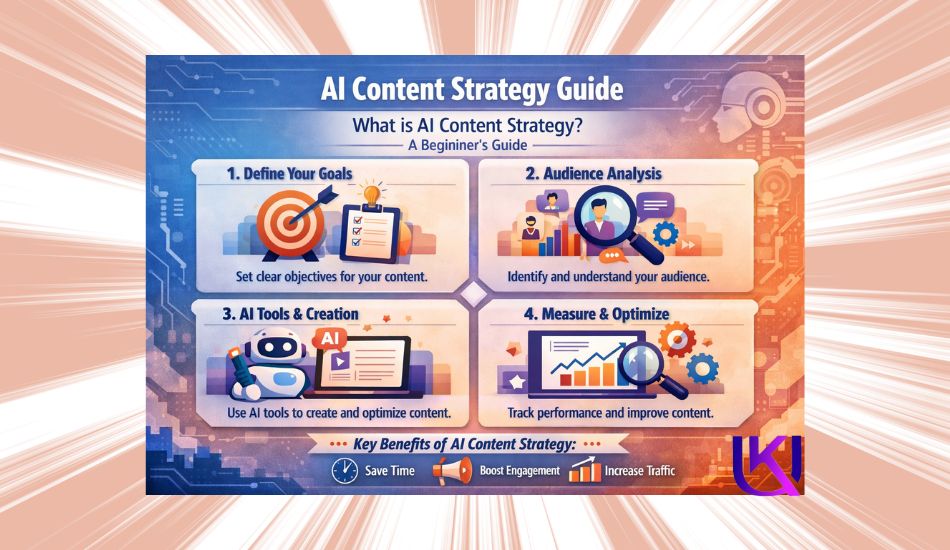
Beginner’s Guide: What Is AI Content Strategy Planning?
Content strategy planning means creating a smart plan for the content you publish online. Basically, when writing random blog posts, you build content based on what people are already searching for in Google.
A good content strategy helps you answer three simple questions:
- What does your audience want?
- Why are they searching for it?
- How can your content help them better than others?
This is the foundation of modern SEO.
Many beginners think content strategy only means choosing keywords. But real strategy goes much deeper. It includes search intent, topic research, semantic SEO, user problems, content structure, internal linking, and topical authority.
Most people use AI tools the wrong way.
They ask us to write their articles. They copy what it gives them. But they hit publish. Then they wonder why nothing ranks.
That is not an AI content strategy. That is just lazy writing with extra steps.
The truth is, AI does not write content for you. Not the kind that ranks. Not the kind that brings real traffic. But if you use it before you write to plan, to research, to spot gaps, it changes everything.
This is the exact workflow I use. No fluff. No theory. Just what works.
For example, if someone searches for an AI content strategy, they may want:
- AI workflow ideas
- SEO content planning tips
- Keyword research methods
- Topic cluster examples
- Better Google rankings
- EEAT-friendly content systems
If your article solves these problems clearly, your content becomes more useful for both users and search engines.

Why Content Planning Matters Before Writing?
Many websites fail because they start writing too fast.
They publish articles without:
- studying the SERP (Search Engine Result Page)
- Understanding user intent
- checking competition
- mapping NLP (Natural Language Processing) entities
- building topical relevance
This often creates thin content that never ranks.
A smart content strategy fixes this problem before writing even begins.
When you plan content correctly, you can:
- target better keywords
- organize related topics
- improve semantic relevance
- build stronger topical authority
- create a better user journey
- increase organic traffic over time
This is why SEO professionals use tools like Ahrefs, Semrush, Google Search Console, and Google Trends before creating content.
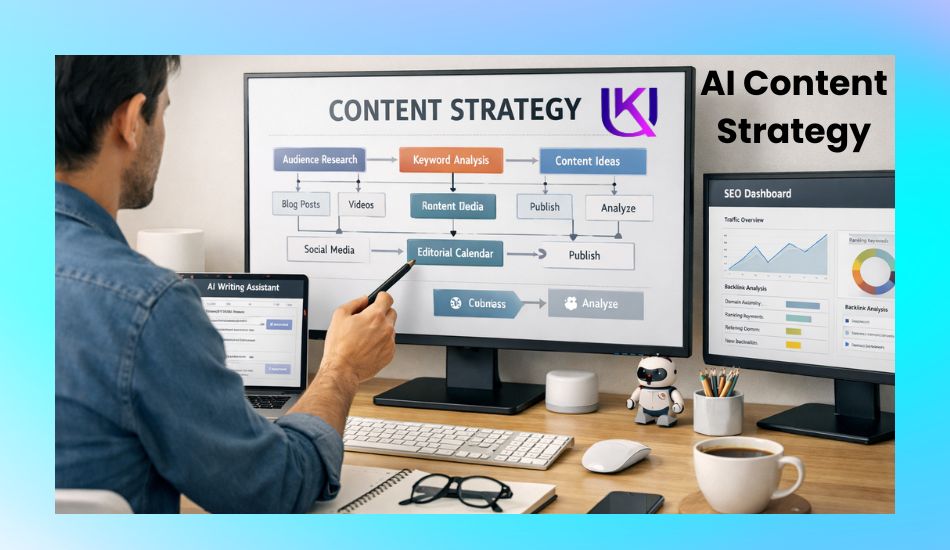
The Simple Goal of Content Strategy
The basic idea is very simple: to create the right content for the right person at the right time.
That means your content should match:
- the user’s search query
- their current problem
- their knowledge level
- their next step
For beginners, this usually starts with:
- Finding a topic people search for
- Understanding why they search for it
- Creating helpful content around that need
- Connecting niche-related articles together
- Updating content as search trends change
This process helps search engines understand your website better. Over time, it also helps you build trust, expertise, and topical authority in your niche.

How AI Improves Content Strategy Planning?
AI tools do not replace human creativity. But they can speed up research and planning.
For example, AI tools like Gimini, ChatGPT, or Claude can help you:
- Find topic ideas
- group keyword clusters
- Discover common questions
- Identify semantic keywords
- analyze search intent
- organize article structures
This helps you spend less time guessing and more time creating useful content people actually want to read.
When combined with human experience and EEAT principles, an AI content strategy becomes much stronger and more effective.
Why Most Content Plans Fail Before You Write a Word?
You pick a topic. You write a 2,000-word article. You wait. Nothing happens.
Sound familiar?
The problem usually is not the writing. The problem is the planning. You chose a topic no one is searching for. Or you chose one that is too competitive. Or you wrote about it the wrong way for what people actually want to find.
A smart AI content strategy fixes all of this before you type a single word of the actual article.
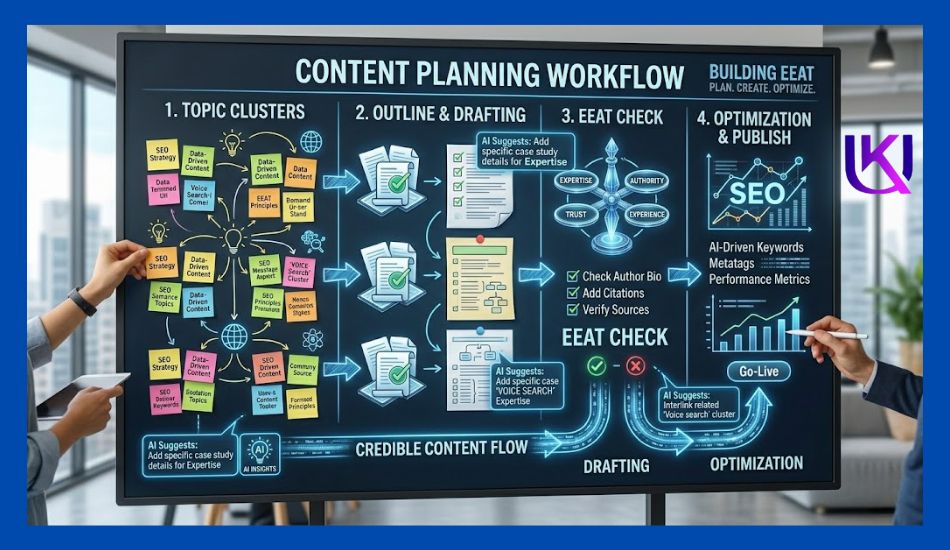
What Is the Step-by-Step AI Content Strategy Workflow?
AI content strategy works best when you use AI tools to improve planning, not replace human thinking. Before you write a single article, you can use tools and Google search results to study search intent, content gaps, and ranking keywords.
Many tools only help you build topical clusters, organize NLP entities, and create a smarter content workflow. This process helps you build topical authority, improve semantic relevance, and create content that matches what users actually want to find.
Step 1: Use AI to Find the Real Question Behind the Keyword
Start here. Always.
Type your main topic into an AI tool like Grok, ChatGPT, or Claude. But do not ask it to write anything. Ask it this instead:
“What are the most common questions people have about [your topic]? List 20 that show real pain points.”
You will get a list of questions you never thought of. Some will feel too basic. Some will feel too niche. That is perfect. Those are real human problems. Real human problems become real search queries.
Then take those questions to Google. Type a few into the search bar. Look at the “People Also Ask” section. Look at what shows up in the autocomplete. That tells you what people are actually typing.
AI gives you the ideas. Google tells you which ones have demand.
Step 2: Check What Already Ranks and Why
Before you plan any content, look at what Google already trusts on this topic.
Search your target keyword. Open the top 5 results. Read them. Not to copy. To understand what they covered. What structure did they use? What questions did they answer?
Now ask your AI tool:
“Here are the top-ranking articles on [keyword]. What topics or questions are they missing? What angle has not been covered yet?”
Paste in the titles and a brief summary of each article. The AI will help you spot gaps. Those gaps are your opportunity.
This is one of the most powerful parts of a real AI content strategy. You are not guessing what to write. You are finding the white space that competitors left open.

Step 3: Build Your Content Outline with AI, Not Your Draft
There is a big difference between an outline and a draft.
An outline is a plan. A draft is the execution. AI is great at plans. The execution still needs your voice, your experience, and your examples.
Ask your AI tool to help you build a content outline like this:
“Create an SEO content outline for the keyword [your keyword]. The target reader is [describe them]. The main intent is [informational/commercial/etc]. Include H2s, H3s, and key points to cover under each section.”
What you get back is a skeleton. Do not use it word-for-word. Change the headings. Add sections from your own experience. Remove things that do not fit your angle.
The outline helps you think in structure. Structure is what makes an article easy for Google to understand and easy for readers to follow.
Step 4: Use AI to Find Your Semantic Keywords
Google does not just look at your main keyword anymore. It looks at the whole topic. It wants to see related words, related ideas, and related entities that show you actually know what you are talking about.
This is called semantic SEO. And AI is very good at it.
Ask this:
“What semantic keywords, related entities, and LSI phrases should I include in an article about [your keyword]? Give me a list of 30.”
You will get words you should naturally weave into your content. Things like specific tools, concepts, people, brands, or processes tied to your topic. Using these words tells Google your article is thorough.
You are not stuffing keywords. You are covering the topic completely. That is what ranks.

Step 5: Match Your Content to the Right Search Intent
This step is where a lot of smart writers still get it wrong.
Search intent means: what does the person typing this keyword actually want?
Do they want a quick answer? A step-by-step guide? A comparison of tools? A definition? The type of content you create must match what they are looking for.
Here is how to check it with AI tools:
“What is the likely search intent behind the keyword [your keyword]? Should this be a how-to guide, a list post, a definition article, or something else? Why?”
Then compare the AI’s answer with what you already saw ranking on Google. If all the top results are how-to guides, write a how-to guide. If they are all listicles, that format is winning. Follow the pattern. Then make your version better.
Step 6: Spot Content Gaps in Your Whole Topic Cluster
One article is not a strategy. A topic cluster is.
A topic cluster means you have one strong pillar article on a broad topic. Then you have several smaller supporting articles that go deep on one part of that topic. They all link to each other. This tells Google you have deep knowledge of the subject.
Use AI to build this map:
“I want to build topical authority around [main topic]. What pillar article should I write? What are 10 supporting articles that would strengthen that pillar? Give me titles and target keywords for each.”
This one prompt can map out months of content. And every piece of content you publish under this cluster makes the others rank better, too.
This is how serious websites dominate search results in their niche. They do not write random articles. They build a web of related content that covers a whole subject from every angle.
Step 7: Prioritize What to Write First
You now have a list of topics. But you cannot write them all at once.
Use AI to help you prioritize. Ask it:
“Here is a list of article ideas in my content plan. Which ones should I write first based on low competition, high relevance to my main keyword, and ability to rank faster?”
Then cross-check with a keyword research tool like Ahrefs, Semrush, or even free tools like Ubersuggest. Look at keyword difficulty and monthly search volume. Target keywords with lower difficulty first, especially if your site is new or has low authority.
Quick wins give you traffic. That traffic builds trust. That trust makes harder keywords easier to rank later.
What AI Cannot Do: Be Honest About AI Content Strategy?
AI cannot replace your experience. It cannot share your story. It cannot add a real example from the time something went wrong on your project at 11 pm. It cannot have an opinion backed by years of doing the actual work.
Those things are what make content rank and stay ranked. Google’s helpful content system is built to find and reward real expertise. AI-generated walls of text with no real insight do not fool it.
Use AI as your research partner. Your outline builder. Your gap finder. Your keyword helper.
Then you do the writing. Your voice. Your examples. Your honest take.
That is a real AI content strategy. That is how you build something that lasts.

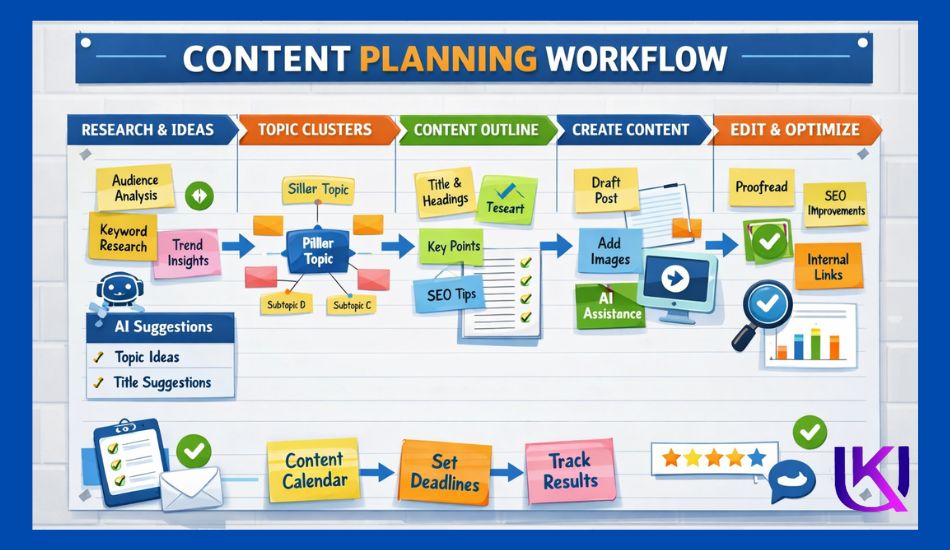
AI Content Strategy: A Quick Recap of the Workflow
Here is the whole system in one place:
- Ask AI for the real questions behind your keyword
- Check Google to confirm those questions have demand
- Study what already ranks and find the gaps
- Build your content outline with AI, then make it your own
- Pull semantic keywords and related entities from AI
- Match your content format to search intent
- Map out your full topic cluster with supporting articles
- Prioritize your writing schedule based on competition and opportunity
None of these steps requires AI to write for you. Every single one makes your writing sharper, your research faster, and your chances of ranking much higher.
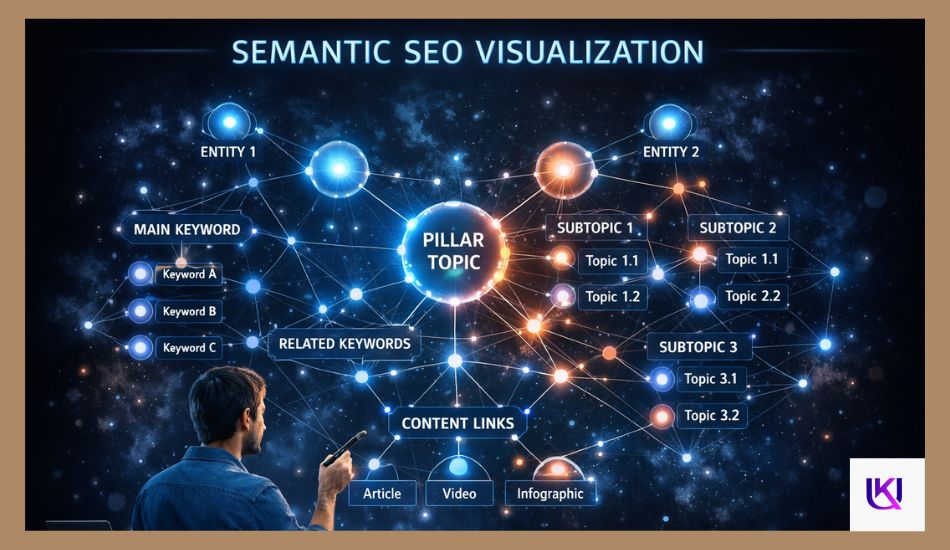
How Semantic SEO Changes AI Content Strategy?
Semantic SEO changes how you think about content from the very start. Instead of focusing only on keywords, you focus on meaning, context, and how topics connect with each other.
In simple words, you stop writing “keyword pages” and start building “topic systems” that help Google understand your content better.
1. Entity Optimization Talking in Real Concepts, Not Just Keywords
Entity optimization means using real-world concepts, people, tools, and topics in your content instead of repeating the same keyword again and again.
For example, if your topic is AI content strategy, you naturally include related entities like:
- AI tools
- SEO platforms
- content planning systems
- search intent
- semantic SEO
This helps search engines connect your content with real meaning, not just words.
Tools like Google Suggest, Ahrefs, and Semrush also support this kind of entity-based content research by showing related topics and keyword relationships.
2. Contextual Relevance: Every Sentence Must Stay Connected
Contextual relevance means every part of your content must stay connected to the main topic.
If your article is about AI content strategy, then every section should support:
- planning content
- finding topics
- Understanding search intent
- building SEO structure
You should not jump to unrelated ideas.
When your content stays tightly connected, search engines understand:
- What your page is about
- Who it is for
- And what problem does it solve
This improves your chances of ranking for multiple related queries, not just one keyword.
3. Topical Depth Covering the Full Topic Clearly
Topical depth means going deeper into one subject instead of writing shallow content on many topics.
For example, instead of only saying “use AI for SEO,” you explain:
- How to find topics with AI
- How to build keyword clusters
- And how to analyze SERP data
- How to structure content plans
- How to improve content quality
This is how you build topical authority.
Search engines reward websites that fully cover a subject, not ones that only scratch the surface.
Over time, deep content helps your site become a trusted source in your niche.
4. How Google Understands Your Content Today?
Modern search engines do not just read keywords. They try to understand meaning, relationships, and intent.
That means Google looks at:
- entities in your content
- topic relationships
- user intent matching
- content structure
- overall topical coverage
This is why Semantic SEO is so powerful.
If your content clearly explains a topic using related entities and strong structure, Google can easily understand:
“This page fully explains AI content strategy.”
And when Google understands your content better, your chances of ranking increase naturally.
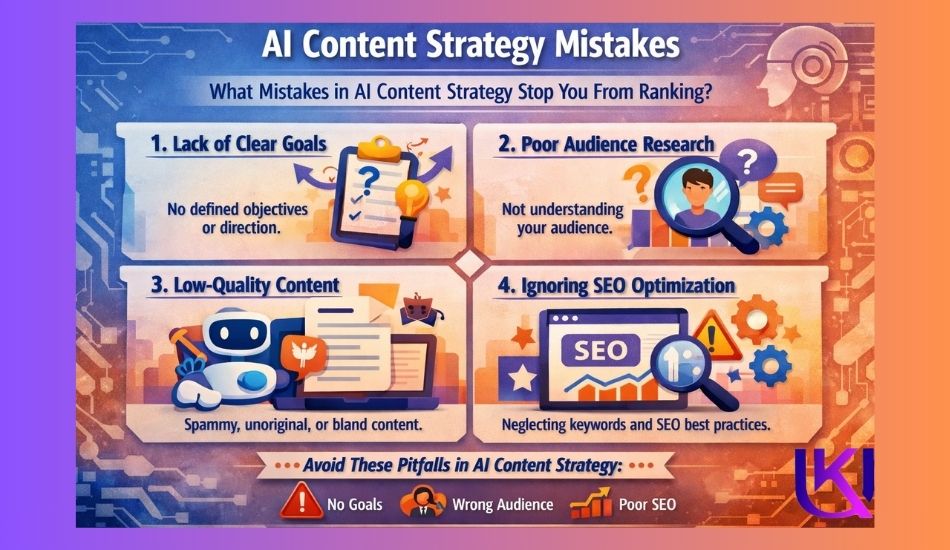
What Mistakes in AI Content Strategy Stop You From Ranking?
The biggest AI content mistakes to avoid. When you use AI for content planning, it becomes easy to move fast. But speed also creates mistakes. Many websites fail not because they use AI, but because they use it the wrong way.
Here are the biggest mistakes you avoid when building an AI content strategy for SEO.
1. Publishing Raw AI Content Without Editing
One of the biggest mistakes is publishing content directly from AI without human review.
Raw AI content often feels:
- too general
- too smooth but empty
- missing real experience
- weak in trust
Search engines like Google want real value, not just generated text. That is why human editing is always needed.
You should always:
- Add real insights
- improve examples
- fix weak explanations
- include practical experience
AI should support your writing, not replace your thinking.
2. Keyword Stuffing
Keyword stuffing means repeating the same keyword too many times in unnatural ways.
For example: “AI content strategy is good for AI content strategy SEO because AI content strategy helps AI content strategy…”
This does not help anymore.
Modern SEO focuses on meaning, not repetition. Instead of repeating keywords, you should use related entities like:
- content planning
- semantic SEO
- search intent
- topical authority
This helps your content stay natural and readable while still being optimized.
3. Writing Thin Articles
Thin content means pages that:
- have little information
- do not solve problems
- stay on the surface
- lack depth or structure
Even if AI writes it fast, it will not rank well.
To avoid this, every article should:
- explain the topic clearly
- cover subtopics deeply
- answer real user questions
- guide the reader step by step
High-quality content always wins over short AI-generated posts.

4. Ignoring EEAT Signals
EEAT stands for:
- Experience
- Expertise
- Authoritativeness
- Trust
If your content does not show EEAT, it becomes harder to rank in competitive topics.
Even with AI support, you must add:
- real examples
- personal workflow
- clear explanations
- trustworthy structure
Google evaluates content based on quality signals, not just keywords or AI usage.
5. Using Copied Content Structures
Another big mistake is copying the same blog structure everyone else uses.
For example: Intro → Benefits → Features → Conclusion (same everywhere).
This makes your content look predictable and weak.
Ideally, you should build:
- unique user journeys
- problem-to-solution flow
- intent-based structure
- deeper topic mapping
Tools like Ahrefs and Semrush can help you study competitors, but you should not copy them directly.
Your goal is not to look similar.
Your goal is to be more helpful and more complete.
Conclusion: Can AI Help Me Build a Winning SEO Content Strategy?
A strong AI content strategy is not about letting AI write everything. It is about using AI to think better, plan smarter, and choose the right topics before you write.
When you follow a clear system, you stop guessing what to publish. You start building content based on real search intent, real problems, and real user needs in Google.
The real power comes when you combine:
- AI tools for research and ideas
- Semantic SEO for meaning and structure
- EEAT for trust and quality
- Human experience for real value
Many tools can help you move faster, but your strategy decides if your content will actually rank or not.
If you focus only on writing speed, you lose quality. But if you focus on planning first, everything becomes easier: topics, structure, rankings, and long-term traffic.
So, SEO success is not about writing more content. It is about building the right content in the right order, for the right audience.
The writers who will win at SEO in the next few years are not the ones who let AI do their thinking. They are the ones who use AI to think better and then bring something human to the page that no tool can replicate.
Start your content plan with this system. Use AI where it is smart to use it. And write every word yourself.
That combination is hard to beat.