
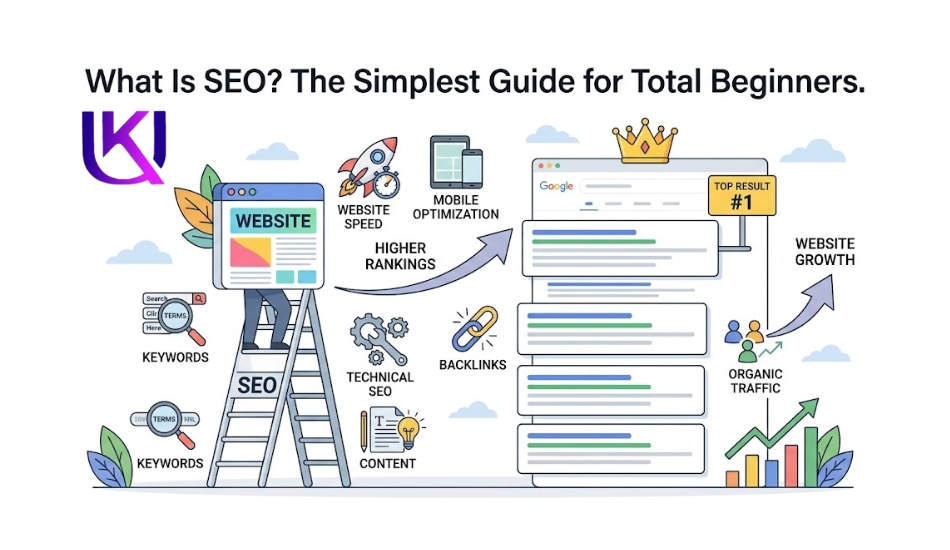
What is SEO Beginners Guide? is a question many people search for when they launch a website and wonder why nobody can find it on Google.
You may spend hours writing content, designing pages, and adding products, yet your website still gets little or no traffic. That can feel frustrating, especially when other websites seem to appear everywhere in Google Search.
The reason is simple. Search engines need help understanding your website. They must know what your content is about, who it helps, and why it deserves a place in search results. This is where Search Engine Optimization (SEO) comes in.
SEO is the process of improving your website so that it becomes easier for search engines to crawl, understand, and rank. It helps match your content with the keywords and search intent people use every day.
Good SEO also improves content quality, page speed, mobile-friendly design, user experience, website security, and overall trust. When combined with strong backlinks and helpful information, these improvements can increase your website’s visibility, search engine rankings, and organic traffic over time.
In this beginner-friendly guide, you will learn how SEO works, why Google ranks some pages higher than others, and the simple steps you can take to help your website reach the right audience.
However, you will understand the core ideas behind on-page SEO, technical SEO, and off-page SEO, even if you are starting from zero.
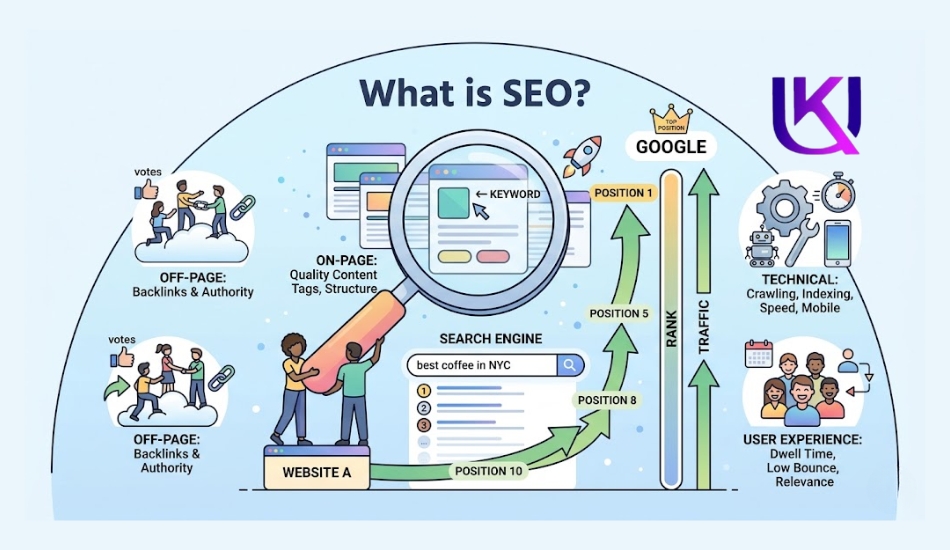
What Is SEO in Simple Words?
You type something into Google and other search engines. You hit enter. A list of websites shows up. You click the first one.
Did you ever stop and think why that website showed up first?
That is SEO at work.
SEO stands for Search Engine Optimization. It is the process of making your website easy for Google to find, read, and trust.
When Google trusts your website, it moves your pages higher in search results.
Higher means more people see you. More people seeing you means more visitors. More visitors mean more business.
And the best part? You do not pay Google for this. It is free traffic.
This guide will walk you through exactly how SEO works. No confusing words. No technical jargon. Just a clear picture from start to finish.
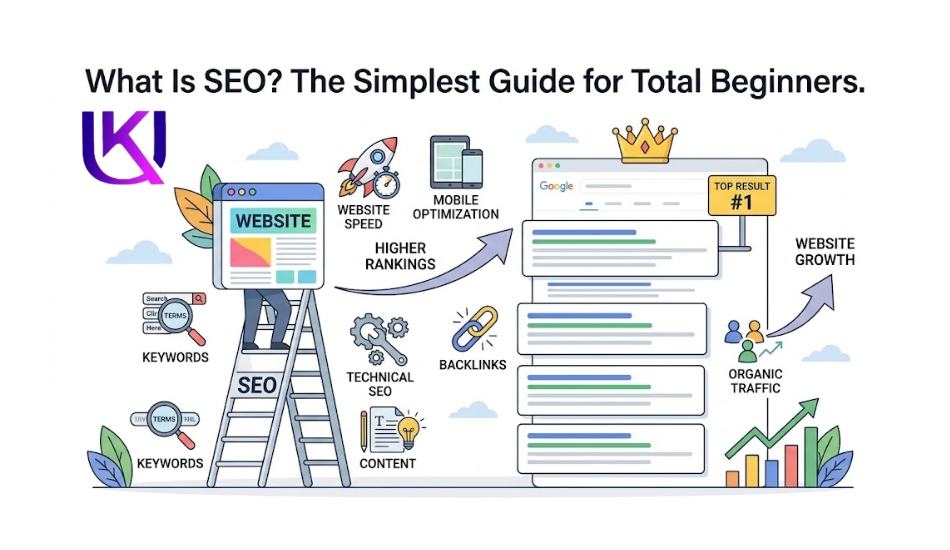
Why Does SEO Even Matter?
Here is something worth knowing.
Over 90% of online experiences start with a search engine. When someone needs a product, a service, or an answer, they Google it first. They do not type your website address directly. They just search.
Now here is the thing. If your website does not show up on the first page of Google, most people will never find you.
Studies show that the first five results on Google get around 67% of all clicks. Results on page two? Almost zero people scroll there.
So SEO is not optional. It is how people find you online.
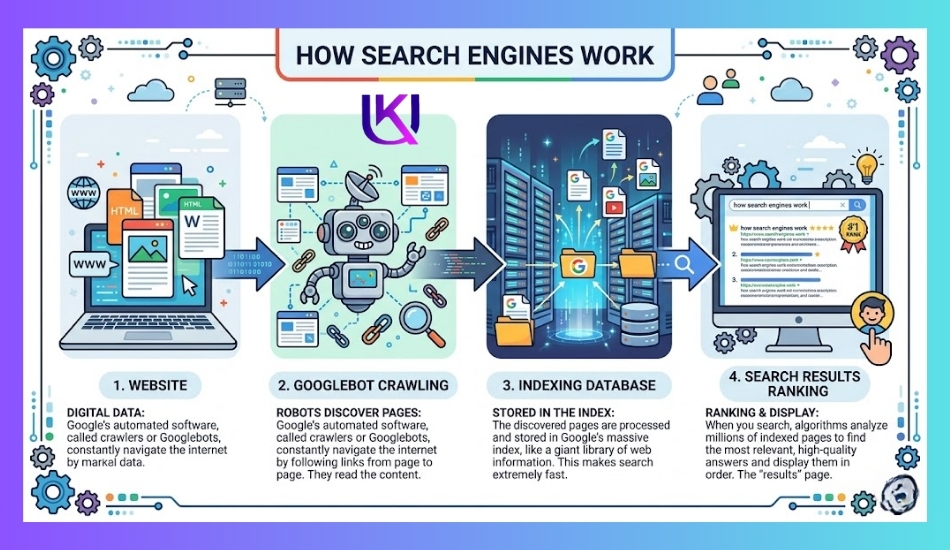
How Search Engines Like Google Actually Work?
Many beginners think Google instantly knows about every website on the internet. That is not how it works.
Before your page can appear in search results, Google must discover it, understand it, and decide where it belongs. This process happens in three main steps: crawling, indexing, and ranking.
Understanding these steps helps you see why some pages appear on the first page of Google while others stay hidden.
1. Crawling: How Google Finds Your Website
The first step is called crawling.
Google uses automated programs called “Googlebot” to travel across the internet and discover new pages. These bots follow links from one page to another, just like a person clicking through websites.
If your website has clear navigation, working links, and an XML sitemap, Google can find your pages more easily.
However, if pages are blocked, broken, or hidden deep inside your website, Google may never discover them.
Think of crawling as Google walking through a giant library and looking for new books to read.
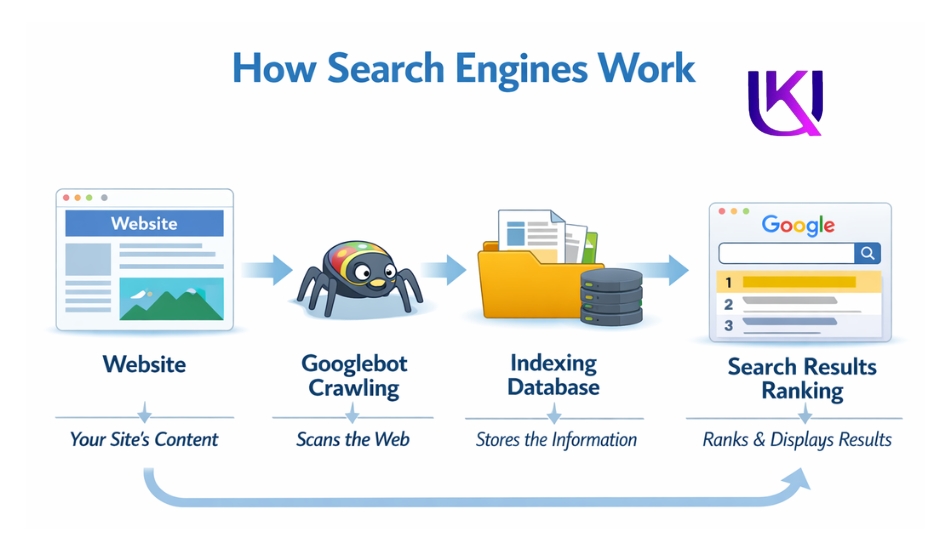
2. Indexing: How Google Stores Information
Once Google finds a page, it tries to understand what the page is about.
This step is called indexing.
Google analyzes your content, headings, images, keywords, internal links, and overall topic. It then stores that information in its massive search index.
You can think of the index as Google’s giant digital library.
If a page is not indexed, it cannot appear in search results, no matter how good the content is.
This is why creating clear content, using descriptive headings, and making your pages easy to understand is so important.
3. Ranking: How Google Chooses Search Results
After a page is indexed, Google decides where it should appear in search results.
This process is called ranking.
When someone types a search query into Google, thousands or even millions of pages may be relevant. Google’s job is to find the pages that best answer the searcher’s question.
To do this, Google compares pages using hundreds of ranking signals.
The pages that provide the most helpful, trustworthy, and relevant information usually appear higher in search results.
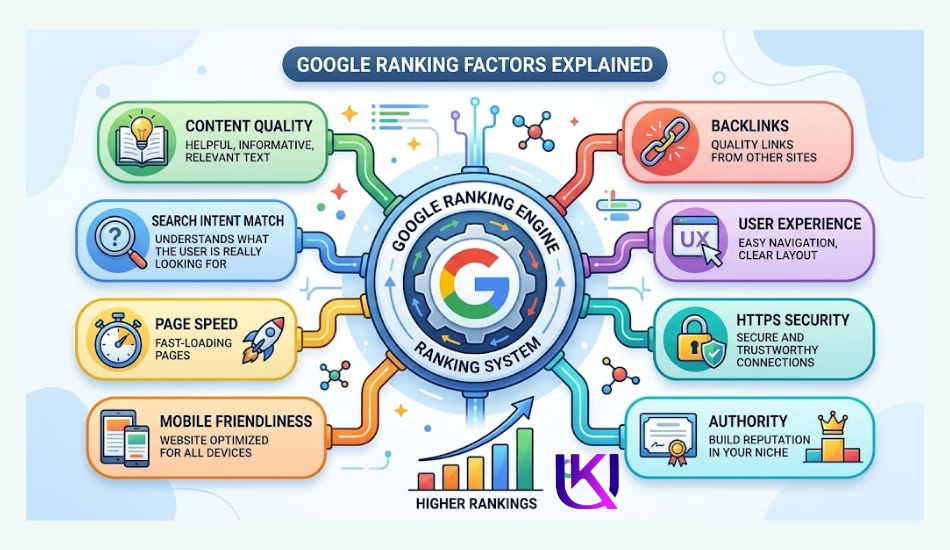
How Google Decides Which Page Appears First?
Google’s main goal is simple: give users the best answer as quickly as possible.
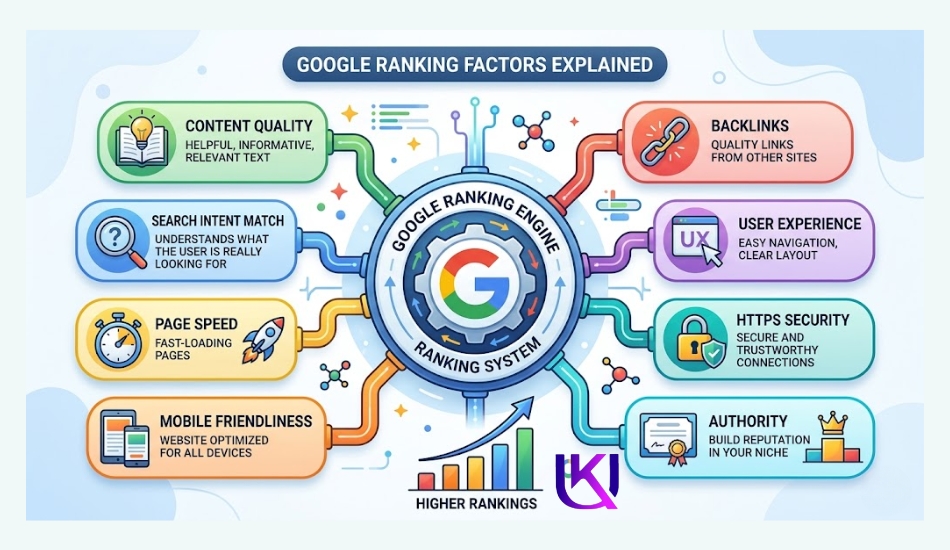
When deciding which page deserves a higher position, Google looks at factors such as:
- Search intent match
- Content quality
- Keyword relevance
- Page experience
- Website authority
- Backlinks from trusted websites
- Mobile-friendly design
- Page speed
- HTTPS security
- User engagement signals
For example, if someone searches for “how to start SEO,” Google wants to show a page that clearly explains SEO, answers common questions, loads quickly, works well on mobile devices, and comes from a trustworthy source.
This is why modern SEO is not about tricks or shortcuts. It is about creating helpful content, improving user experience, and making it easy for search engines to understand your website.
The better Google understands your page and the more value it provides to users, the better chance it has of ranking higher and attracting organic traffic.
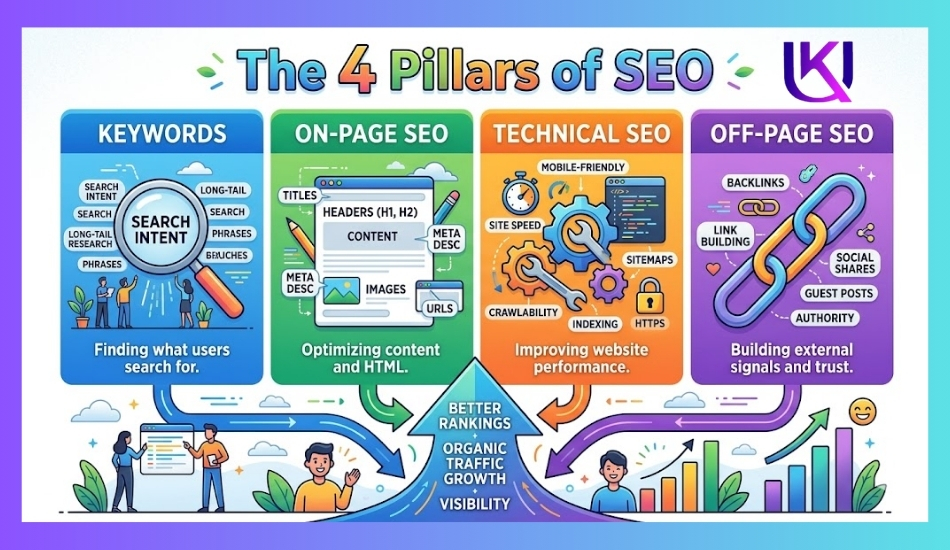
Simple Explained: The Four Pillars of SEO Standing
Think of SEO like building a house. You need four things to make it work well.
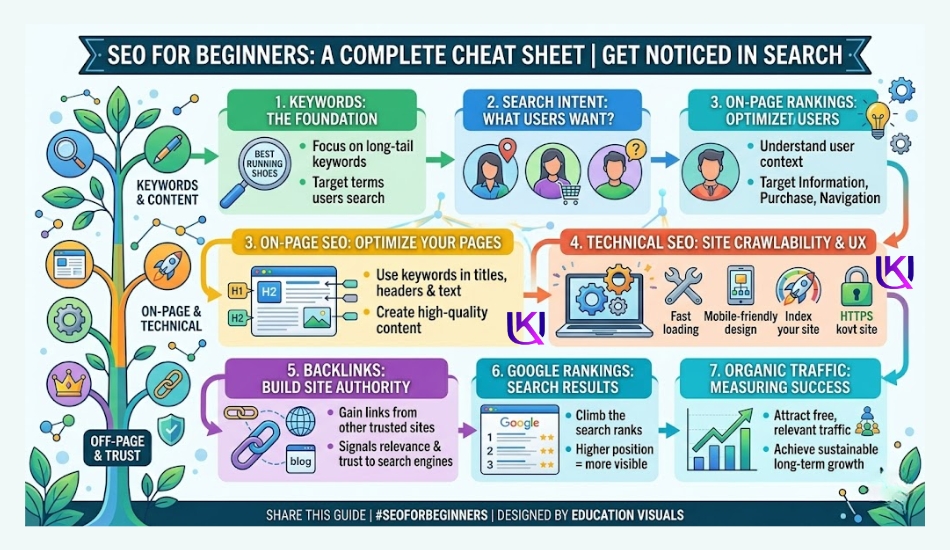
1. Keywords: The Language of Search
Every time someone searches on Google, they type words. Those words are called keywords.
Your job is to figure out which words your audience uses. Then, you use those same words on your website.
Search Intent is the most important part of keywords. It means asking why someone is searching this?
If someone types “buy running shoes,” they want to purchase something. If they type “how to train for a marathon,” they want information.
These are two very different goals. You need to match your content to the right intent. Otherwise, even if you rank high, the wrong people visit your page.
Long-tail keywords are your best friend when you are just starting. These are longer, more specific phrases. Instead of “running shoes,” a long-tail keyword would be “best vegan leather running shoes for women.”
Why does this matter? Shorter keywords have huge competition. Thousands of big websites fight for them. Long-tail keywords have less competition. A small or new website can rank for them much more easily.
Where should you use your keywords?
- In your page title
- In your URL (the web address)
- In your main heading (H1)
- Naturally throughout your content
Do not stuff keywords everywhere. Google is smart enough to notice that. Write naturally. Keywords should flow the way real people talk.
2. On-Page SEO: What Your Visitors See
A. Title Tags and Meta Descriptions are the first things people see on Google before they even visit your site. The title is the blue clickable headline. The meta description is the short text below it. Both should tell people clearly what your page is about. And both should make them want to click.
B. Readability matters more than most beginners realize. Nobody wants to read a giant wall of text. Break your content into short paragraphs. Use subheadings (H2, H3) to organize sections. Use bullet points to list steps or features. When your page is easy to skim, people stay longer. When people stay longer, Google notices and ranks you higher.
C. Image Optimization has two parts. First, compress your images. Large images slow down your page. A slow page sends visitors away. Google also penalizes slow pages. Second, add alt text to every image. Alt text is a short description of what the image shows.
Search engines cannot see images. But they can read alt text. This helps Google understand your page, and it also helps visually impaired users.
3. Technical SEO: The Engine Under the Hood
Technical SEO is the behind-the-scenes stuff. Your visitors do not see it. But Google definitely does.
Think of it this way. You can write amazing content. But if your website is broken, slow, or confusing to search engines, none of that content will rank.
A. Page Speed is critical. Google has said publicly that speed is a ranking factor. If your page takes more than three seconds to load, a large chunk of visitors will leave before reading a single word. Compress your images. Clean up your code. Use a fast hosting provider. Even shaving one second off your load time can make a meaningful difference in rankings.
B. Mobile-Friendly Design is no longer optional. More than half of all Google searches now happen on a phone. If your site looks broken or hard to navigate on a small screen, visitors bounce immediately. Google uses mobile-first indexing, meaning it looks at your mobile version first when deciding rankings.
C. HTTPS and SSL mean your website is secure. You know the little padlock icon in your browser? That appears when a site has SSL. Without your site, it shows as “Not Secure.” This scares visitors away. It also signals to Google that your site cannot be trusted. Get HTTPS. It is a basic requirement today.
D. Crawlability is about making sure Google’s bots can actually visit and read every page on your site. Broken links, poor site structure, and missing sitemap files can block search engines from indexing your content properly. If Google cannot read your page, your page will not rank.
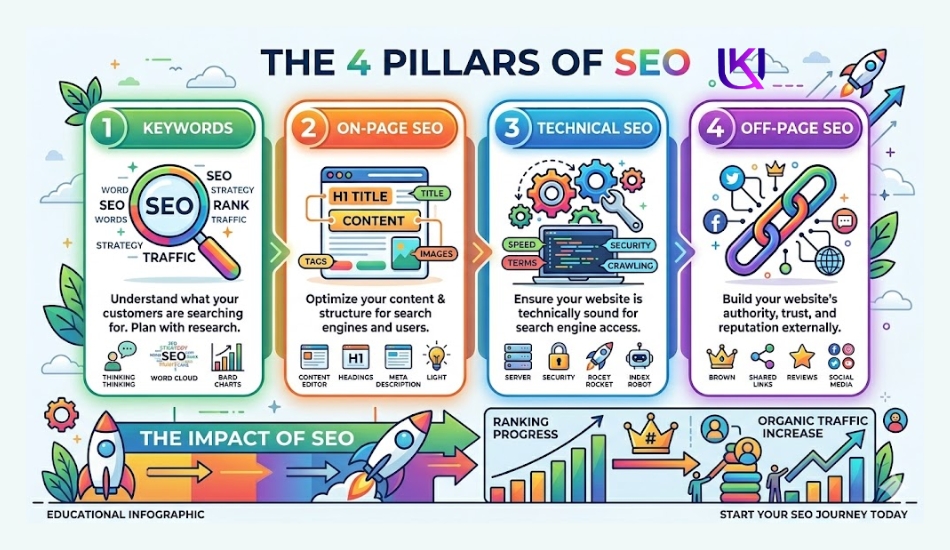
4. Off-Page SEO: What the Rest of the Internet Thinks of You
On-page and technical SEO are things you control directly. Off-page SEO is about how others see your website.
The most important off-page signal is backlinks.
A backlink is when another website links to your content. Think of it as a vote. When a trusted website links to you, it tells Google this content is worth reading. The more high-quality backlinks you have, the more authority Google gives your site.
But here is the keyword: quality. One link from a well-known, respected website is worth more than 100 links from random or spammy sites. The best way to earn good backlinks is to create content that genuinely helps people. Original research, detailed guides, and useful tools attract links naturally.
5. Local SEO: Physical Location Business Boost
Local SEO is a specific branch of off-page SEO for businesses with a physical location. If you run a shop, a clinic, a restaurant, or any local service, you need a Google Business Profile (GBP). This is a free listing on Google. It shows your business name, address, hours, phone number, and reviews. It is how you appear in local searches like “coffee shop near me” or “dentist in Chicago.”
A complete and updated Google Business Profile dramatically improves your visibility in local search results and on Google Maps.
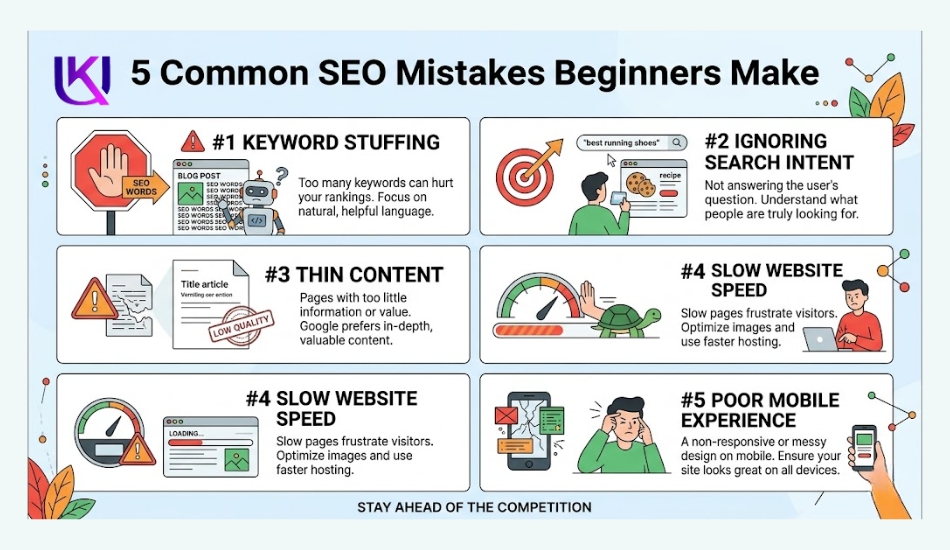
6 Most Common SEO Mistakes Beginners Make Down
Learning SEO is exciting, but many beginners make simple mistakes that can stop their websites from growing.
The good news is that most SEO mistakes are easy to fix once you know what to look for.
If your website is not getting the traffic you expected, one of these common issues may be the reason.
1. Keyword Stuffing
Many beginners believe that repeating the same keyword over and over will help a page rank higher.
Years ago, some websites used this trick. Today, it can hurt your SEO.
Keyword stuffing makes content difficult to read and creates a poor user experience. Search engines are now smart enough to understand topics, related terms, and natural language.
Instead of forcing keywords into every sentence, focus on writing helpful content that answers the reader’s question.
Use your main keyword naturally in important places such as:
- Page title
- Main heading
- URL
- Introduction
- Relevant subheadings
Then write naturally for your audience.
2. Ignoring Search Intent
One of the biggest SEO mistakes is targeting a keyword without understanding why people are searching for it.
This is called search intent.
For example, someone searching “what is SEO” wants an explanation. Someone searching “SEO services near me” may be looking to hire an expert.
If your content does not match what users expect to find, Google is less likely to rank it highly.
Before creating content, ask yourself:
- What question is the user trying to answer?
- What problem are they trying to solve?
- What type of content are they expecting?
The closer your content matches search intent, the better your chances of ranking.
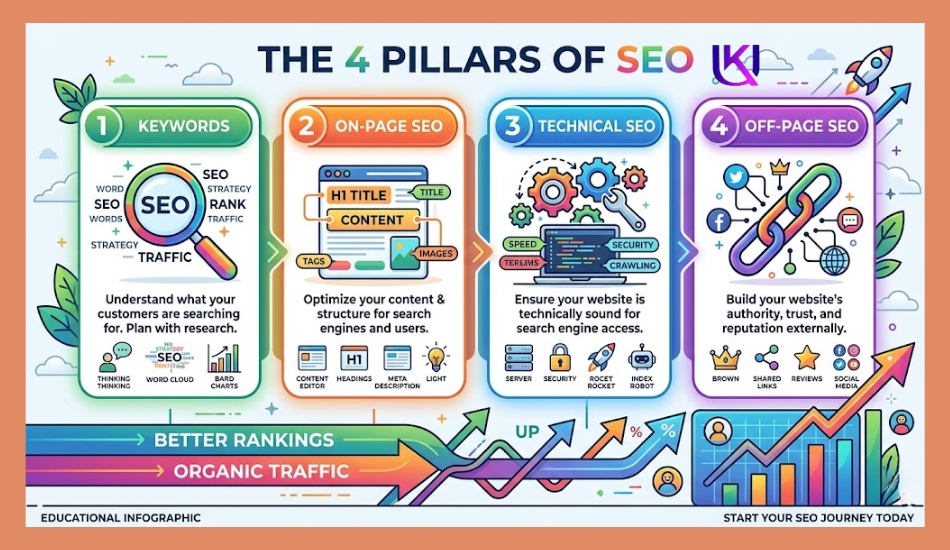
3. Publishing Thin Content
Thin content is content that provides very little value.
It may be too short, too generic, outdated, or missing important information that users need.
Many beginners publish pages with only a few paragraphs and expect them to rank. Unfortunately, search engines prefer content that fully answers the user’s question.
Good content should:
- Solve a real problem
- Answer common questions
- Explain topics clearly
- Include useful examples
- Cover important details
You do not need to write thousands of words. You simply need to provide enough information to help the reader.
4. Slow Websites
Website speed plays an important role in both SEO and user experience (UX).
People do not like waiting for slow pages to load. If a website takes too long, visitors often leave before reading anything.
Search engines also use page speed as a ranking factor.
Common causes of slow websites include:
- Large image files
- Poor web hosting
- Too many plugins
- Unnecessary code
- Large scripts
A faster website helps users stay longer and improves the chances of ranking well in search results.
5. Poor Mobile Experience
Today, most Google searches happen on smartphones and tablets.
If your website looks great on a desktop computer but is difficult to use on mobile devices, you may lose visitors and rankings.
Common mobile problems include:
- Tiny text that is hard to read
- Buttons that are difficult to tap
- Content that does not fit the screen
- Slow loading pages
- Poor navigation
A mobile-friendly website makes it easier for visitors to find information, interact with your content, and stay engaged.
6. Focus on Helping Users First
Most SEO mistakes happen when people try to optimize for search engines instead of helping real users.
Google’s goal is to provide the best answers for searchers. When your content is useful, easy to read, fast, and designed around user needs, many SEO improvements happen naturally.
If you avoid keyword stuffing, understand search intent, create valuable content, improve page speed, and optimize for mobile users, you will already be ahead of many beginner websites.
How Does SEO Work Together?
Here is a simple way to picture Keywords, On-Page, Technical, and Off-Page.
- Imagine you open a new bookstore. You carefully organize your shelves so customers can find what they need (on-page SEO).
- You fix the broken entrance door and make sure the lights work (technical SEO).
- You tell people what kind of books you carry using the same words they use (keywords).
- And you ask happy customers to recommend your shop to their friends (off-page SEO).
All four things work together. Missing any one of them limits your results.
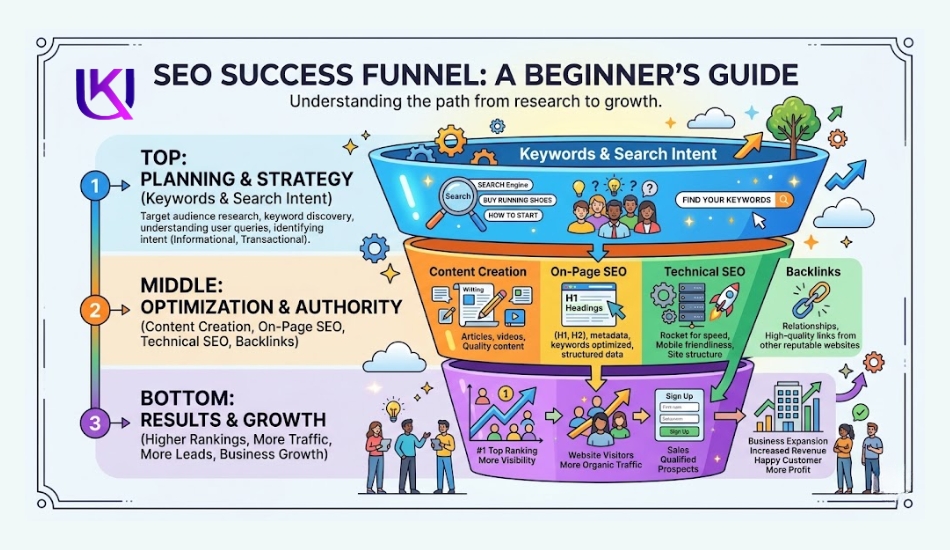
How SEO Helps Your Website Grow?
Many people think SEO is only about getting higher rankings on Google. While rankings are important, SEO does much more than that.
Good SEO helps your website become easier to find, easier to use, and more trustworthy. It helps you connect with people who are already searching for what you offer.
Let’s look at the biggest ways SEO helps your website grow.
1. Better Rankings
One of the main goals of SEO is to improve your position in search engine results.
When you optimize your content with the right keywords, match search intent, improve page quality, and fix technical issues, search engines can better understand your website.
As a result, your pages have a better chance of appearing higher in Google Search.
Higher rankings matter because most users click results near the top of the page. If your content is buried on page two or three, many people may never find it.
2. More Visibility
Even if someone does not click your website right away, appearing in search results helps people see your brand.
The more often your pages appear for relevant searches, the more familiar your website becomes.
SEO increases your online visibility by helping your content show up when people search for answers, products, services, or solutions related to your topic.
Over time, this visibility can help you reach a larger audience without paying for advertising.
3. More Organic Traffic
Organic traffic refers to visitors who find your website through unpaid search results.
Unlike paid ads, organic traffic can continue coming to your website long after content is published.
When your pages rank for valuable keywords and answer user questions clearly, search engines are more likely to send visitors to your site.
This means more potential readers, customers, subscribers, or leads without spending money on every click.
4. Better User Experience
SEO is not only for search engines. It is also for people.
A well-optimized website loads quickly, works smoothly on mobile devices, has clear navigation, and provides useful content.
Visitors can find information faster and enjoy a better browsing experience.
When users stay longer, explore more pages, and easily find what they need, both visitors and search engines see your website more positively.
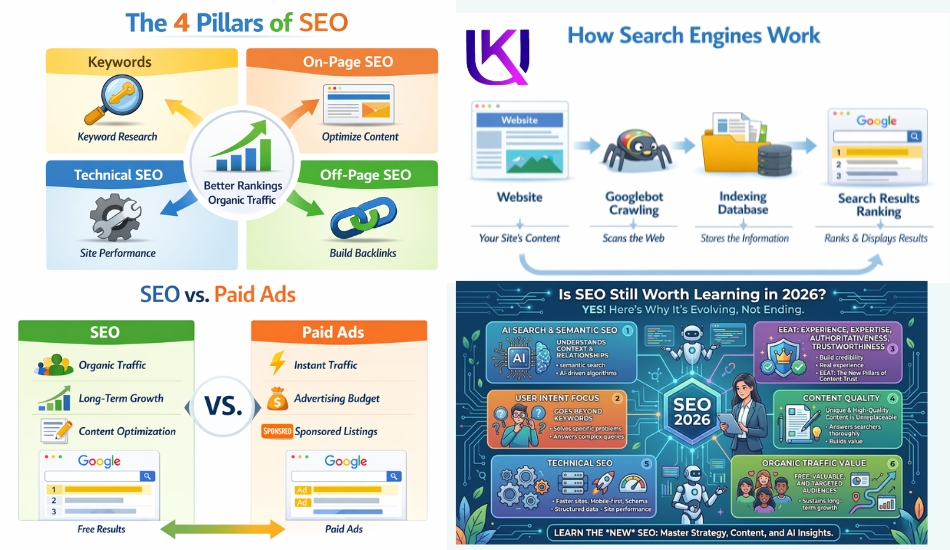
5. Increased Trust
Trust is one of the most valuable benefits of SEO.
People naturally trust websites that appear near the top of search results. Strong content, secure HTTPS connections, quality backlinks, positive user experiences, and clear information all help build credibility.
Google also looks for signals of expertise, experience, authority, and trustworthiness when evaluating content.
As your website earns trust from both users and search engines, it becomes easier to attract visitors and compete in your industry.
6. SEO Creates Long-Term Growth
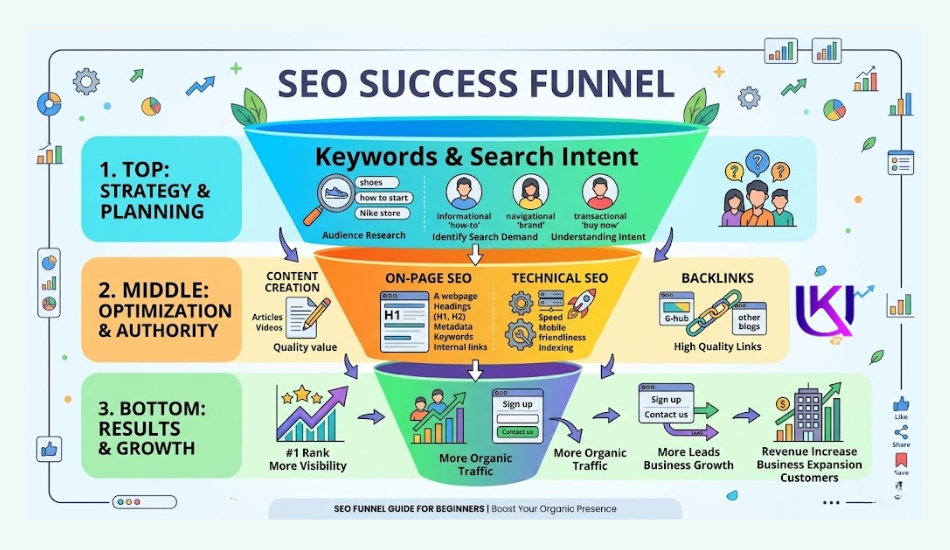
The real power of SEO is that all these benefits work together.
Better rankings lead to more visibility. More visibility brings more organic traffic. Better user experience keeps visitors engaged. Increased trust encourages people to return and recommend your website.
Instead of relying only on ads, SEO helps create a steady foundation for long-term online growth. The work you do today can continue bringing results for months or even years in the future.
How Long Does SEO Take to Work?
This is a fair question. And the honest answer is SEO takes time.
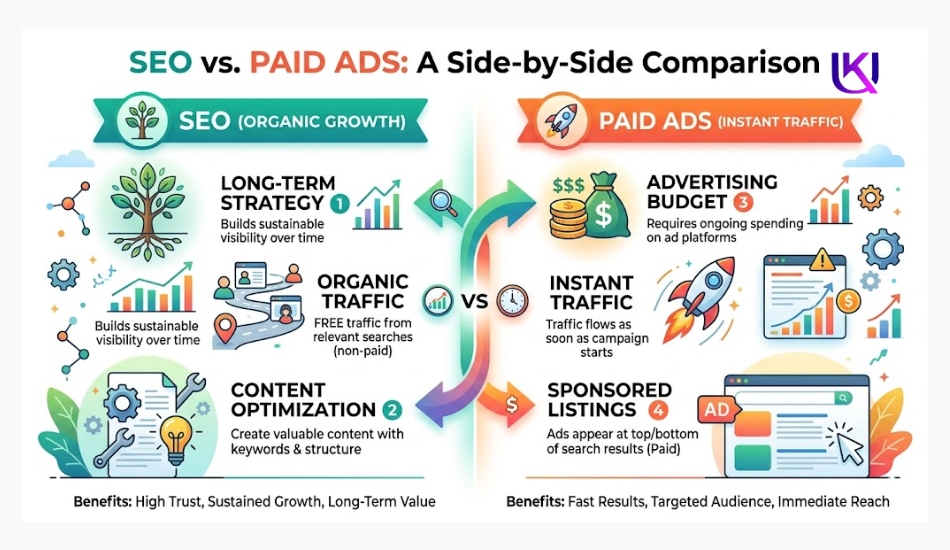
Unlike paid ads that bring visitors the moment you pay, SEO builds slowly. For a new website, you might start seeing results in three to six months. For more competitive keywords, it can take a year or more.
But here is why it is worth it. Once you rank, the traffic is free. It keeps coming without you paying for every click. A well-ranked page can bring thousands of visitors every month at zero cost.
SEO is not a quick win. It is a long-term investment.
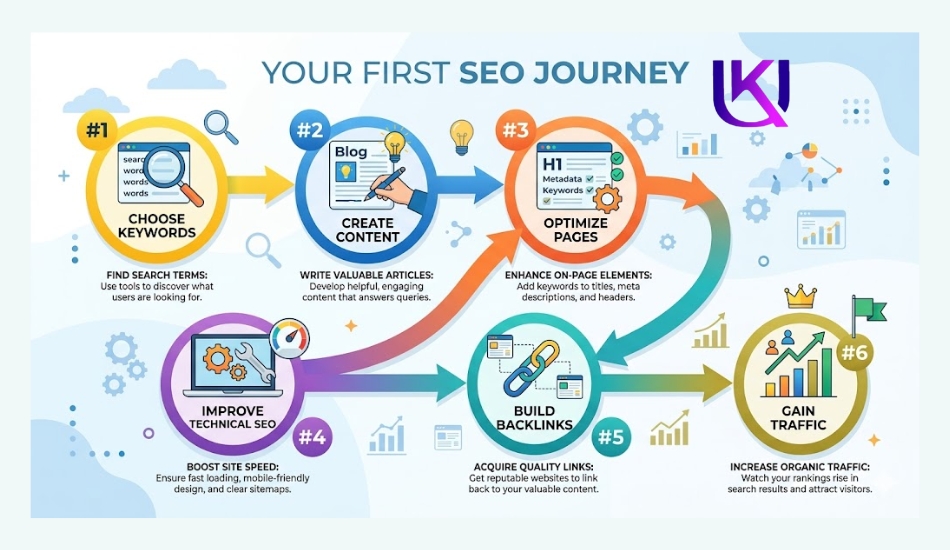
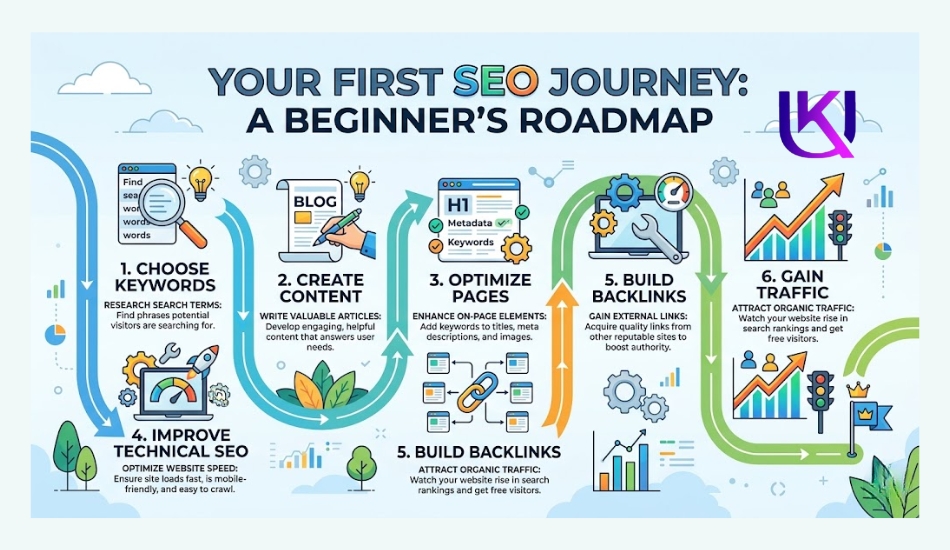
What Should You Do First as a Beginner?
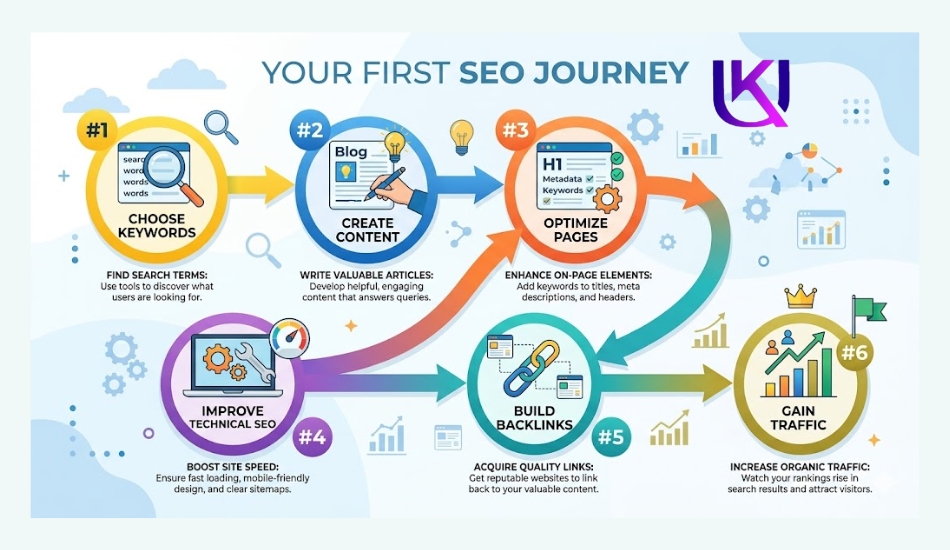
If you are brand new to SEO, do not try to do everything at once. Start here:
- Step 1: Pick one long-tail keyword for your most important page. Choose something specific and relevant to what you offer.
- Step 2: Write genuinely helpful content around that keyword. Answer the question your audience is actually asking.
- Step 3: Make sure your site loads fast and works on mobile. These two technical basics have the biggest impact on beginners.
- Step 4: Set up your Google Business Profile if you have a physical location.
- Step 5: Be patient. Track your progress with free tools like Google Search Console. Watch your rankings grow over weeks and months.
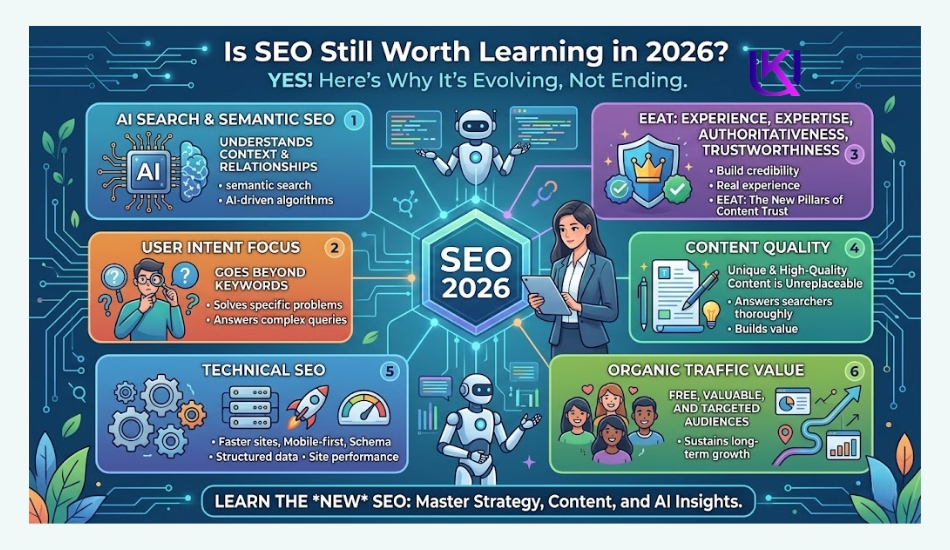
Is SEO Still Worth Learning in 2026?
If you have been reading about AI tools, AI search engines, and constant Google updates, you may wonder if SEO is still worth learning.
The short answer is yes.
SEO has changed, but it has not disappeared. In fact, understanding SEO is becoming even more valuable because search engines are getting better at finding helpful, trustworthy content.
The websites that focus on helping users are still the ones most likely to succeed.
1. AI Search and Google Updates Are Changing SEO
Search is evolving faster than ever.
Google now uses advanced artificial intelligence to better understand language, context, topics, and user intent. AI-powered search experiences can provide direct answers, summaries, and recommendations within search results.
At the same time, Google continues releasing algorithm updates that reward high-quality content and reduce the visibility of low-value pages.
This means old SEO tactics such as keyword stuffing, thin content, and ranking tricks are becoming less effective.
Instead, search engines are focusing on:
- Helpful content
- Real expertise
- User experience
- Topic relevance
- Trustworthy information
- Strong website performance
The goal has not changed. Google still wants to give users the best possible answer.
2. Why SEO Remains Important
Even with AI-generated answers and new search features, people still need websites.
Users search for products, services, tutorials, reviews, guides, comparisons, and expert opinions every day. Search engines must still decide which sources deserve attention.
SEO helps your website become a trusted source.
When you create useful content, understand search intent, improve technical SEO, and build authority, you increase your chances of appearing in search results where your audience is already looking.
SEO also offers benefits that many other marketing channels cannot match:
- Long-term organic traffic
- Increased brand visibility
- Better user experience
- Higher trust and credibility
- Lower customer acquisition costs over time
Unlike paid advertising, a well-optimized page can continue attracting visitors months or even years after it is published.
3. Future Opportunities for Beginners
Many beginners think they are too late to learn SEO.
The reality is that new opportunities appear every year.
As AI creates more content online, high-quality websites that demonstrate experience, expertise, authority, and trust become even more valuable. Businesses, bloggers, creators, and local companies still need people who understand how search works.
Some of the biggest opportunities in 2026 include:
- Creating helpful niche content
- Optimizing websites for AI-powered search
- Improving technical SEO
- Building topical authority
- Local SEO for small businesses
- Content strategy and semantic SEO
- User experience optimization
You do not need to compete with the biggest websites on the internet. Many successful websites grow by focusing on specific topics and helping a clearly defined audience.
4. The Best Time to Learn SEO Is Now
SEO is no longer about gaming search engines. It is about understanding users and providing the information they need.
If you learn how search intent works, create valuable content, improve your website’s technical foundation, and build trust over time, SEO can become one of the most powerful skills you develop.
Search technology will continue to evolve, but the need for helpful, accurate, and trustworthy information is unlikely to disappear. That is why SEO remains a valuable skill for website owners, bloggers, businesses, marketers, and beginners entering the digital world in 2026 and beyond.
The Bottom Line: Is SEO Really Important for New Websites in 2026?
SEO is not magic. It is not a trick. It is the practice of making your website genuinely useful to your visitors and to search engines.
The most important SEO rule is simple.
Do not write for search engines first. Write for people first.
When your content truly helps readers solve their problems, search engines naturally reward your website with better rankings.
If you stay focused on usefulness, clarity, and real value, your SEO results will grow naturally over time.
When you get it right, Google rewards you with free, consistent traffic. That traffic builds your audience, your leads, and your revenue over time.
You now understand the four pillars. Keywords help you speak your audience’s language. On-page SEO makes your content readable and clear. Technical SEO makes sure search engines can access and understand your site. Off-page SEO builds your credibility in Google’s eyes.
Start with one step today. Every improvement adds up. And over time, those improvements compound into real, lasting growth.
Published for beginners exploring SEO for the first time. No prior experience required.
Most helpful article: What Is SEO and How Does It Really Work in 2026?
FAQs: What Is the Easiest Way to Understand SEO for Beginners?
1. What is SEO in simple words?
SEO (search engine optimization) means improving your website so it can appear in Google search results. It helps people find your content when they search for related topics.
2. How long does SEO take to show results?
SEO is not instant. Most websites start seeing real results in 3 to 6 months. It depends on content quality, competition, and how well your site is optimized.
3. Do I need to know coding for SEO?
No. You do not need coding skills to start SEO. Basic SEO, like keywords, content writing, and page optimization, can be done without technical knowledge.
4. What is the most important part of SEO?
All parts matter, but content and user intent are the most important. If your content does not help users, other SEO efforts will not work well.
5. Can I do SEO for free?
Yes. You can do SEO without paying money by creating good content, using free tools like Google Search Console, and improving your website step by step.
6. Is SEO still important in 2026?
Yes. Even with AI search, SEO is still important because Google and other search engines still need high-quality content to show users.
7. What is the difference between SEO and paid ads?
SEO brings free organic traffic over time. Paid ads bring instant traffic but stop when you stop paying.
8. Why is my website not ranking on Google?
Common reasons include weak content, poor keyword targeting, slow website speed, or not matching search intent.
9. Can beginners learn SEO easily?
Yes. SEO can be learned step by step. Start with keywords, then learn content writing, and slowly improve technical and off-page SEO.