
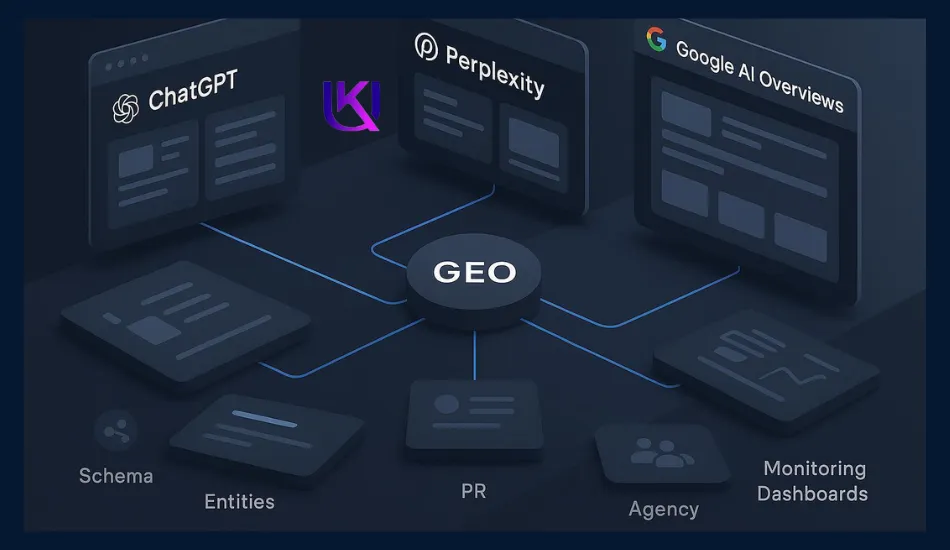
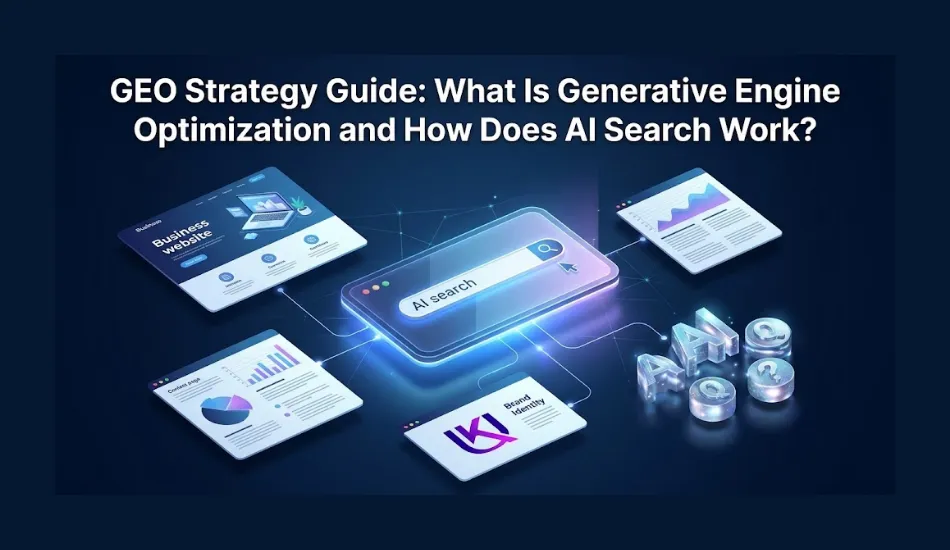
A GEO strategy helps your business improve its visibility in AI-powered search tools such as ChatGPT, Perplexity, and Google’s AI search features.
Search is changing. Your customers no longer use Google alone to find products, services, and business advice. Many now ask AI tools direct questions and use their answers to compare businesses or make decisions.
This creates a new challenge for your business. Your website may rank in Google, but does your brand appear when someone asks an AI tool for recommendations?
Generative Engine Optimization (GEO) focuses on making your website and brand information easier for AI search systems to discover, understand, and reference. It relies on useful content, clear business details, relevant sources, and a strong online presence.
But GEO does not replace traditional SEO. Your website still needs sound technical SEO, helpful content, relevant pages, and a clear site structure. These basics help search systems access and understand your information.
In this guide, you will learn:
- What Generative Engine Optimization (GEO) means.
- How GEO differs from SEO and AEO.
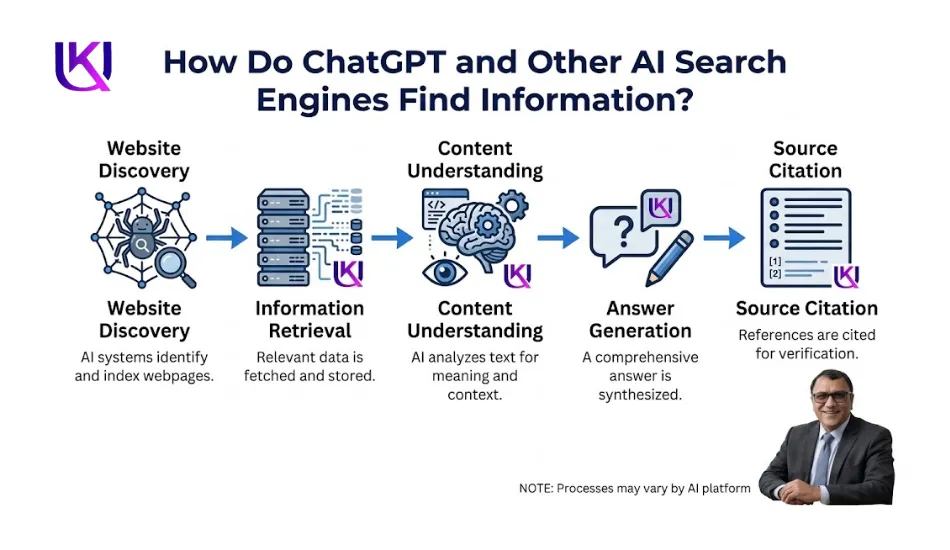
- How ChatGPT and other AI search engines find information.
- Why your business needs to understand AI search visibility.
- How changes in AI-powered search affect your online presence.
Whether you run a small business, manage a marketing team, or work in SEO, this guide will help you understand GEO and prepare your website for AI-powered search.

GEO Definition: What Is Generative Engine Optimization?
Generative Engine Optimization (GEO) is the process of improving your website, content, and online brand information so AI-powered search tools can find, understand, and use your information when generating answers.
In simple words, GEO helps your business become easier to discover in tools such as ChatGPT, Perplexity, and Google’s AI search features.
For example, when someone asks ChatGPT, “Which SEO agency can help my small business in Texas?”, the system may search for useful information and show relevant sources.
Your GEO goal is to make your business information clear, useful, and trustworthy enough to be considered for relevant AI-generated answers.
However, GEO does not guarantee that AI tools will mention your brand or cite your website. It helps you improve the quality, clarity, and discoverability of the information they may use.
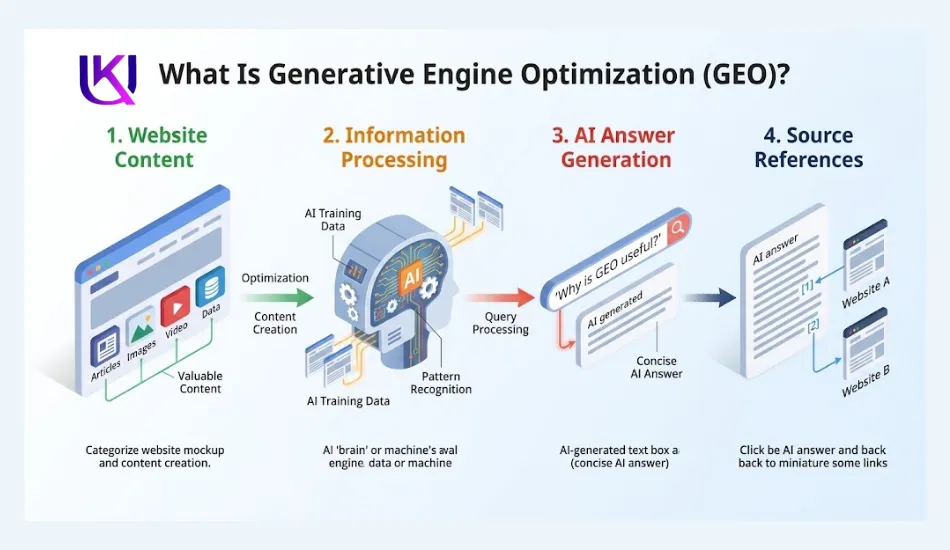
What Is Generative Engine Optimization (GEO)?
Generative Engine Optimization (GEO) is the process of improving your website and brand so AI-powered search systems can discover, understand, and reference your information in their answers.
Traditional SEO focuses on helping your website appear in search engine results. GEO also focuses on making your brand a useful and reliable source when people ask questions through AI tools such as ChatGPT, Perplexity, and Google’s AI search features.
For example, imagine you own a digital marketing agency in Texas. A potential customer asks ChatGPT:
“Which digital marketing agency can help a small business improve local search rankings in Texas?”
The AI tool may look for relevant information from different sources before creating an answer. These sources may include business websites, service pages, expert articles, and other online information.
If your website clearly explains your services, shares useful experience, and provides reliable information, your brand may become a relevant source for that answer. However, appearing in an AI answer is not guaranteed.
GEO is not about adding more keywords or writing content only for AI. It is about building a clear online presence that helps AI systems understand what your business does, who you serve, and why your information is useful.
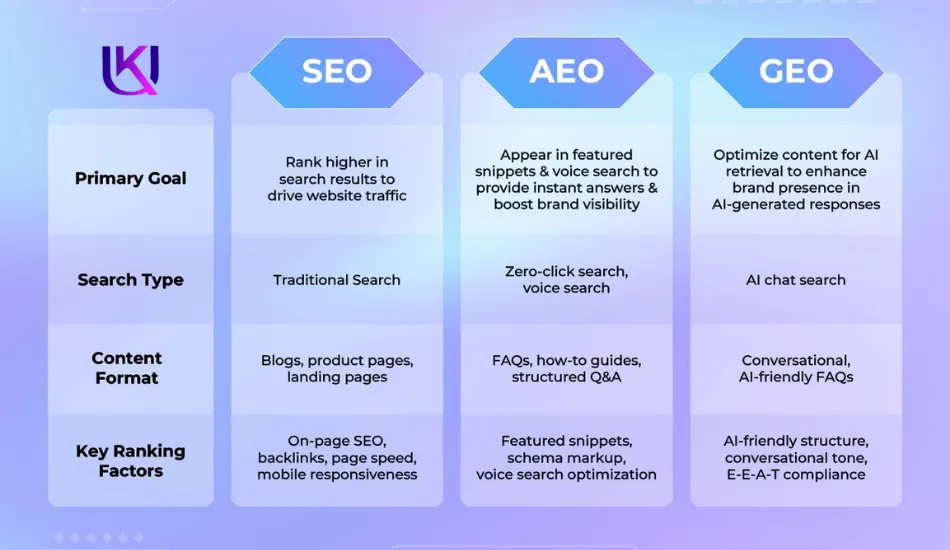
SEO vs SEO vs AEO: What’s the Difference?
SEO, AEO, and GEO all help people find information online. However, each one focuses on a different part of the search experience.
If you want your business to appear in traditional Google results, answer direct questions, and gain visibility in AI-generated responses, you need to understand how these three strategies work together.
Let’s look at the differences.
1. What Is SEO (Search Engine Optimization)?
SEO helps your website appear in search engine results when people look for information, products, or services.
For example, imagine you run an SEO agency in New York. Someone searches:
“Best SEO services for small businesses in New York.”
Your goal is to help your service page appear in relevant Google search results.
SEO (Search Engine Optimization) focuses on:
- Keyword and search intent research.
- Technical SEO and website performance.
- Helpful and relevant content.
- Internal linking and site structure.
- Relevant backlinks and brand authority.
- Search engine crawling and indexing.
SEO gives your website a strong foundation for organic search visibility.
2. What Is AEO?
AEO (Answer Engine Optimization) focuses on making your content easy to use when search systems provide direct answers to questions.
For example, someone asks Google:
“What is local SEO for a small business?”
Your content should provide a clear and useful answer without making readers search through several paragraphs.
AEO (Answer Engine Optimization) focuses on:
- Answering specific questions.
- Using clear question-based headings.
- Adding useful definitions.
- Creating helpful FAQs.
- Providing accurate facts and examples.
- Using relevant structured data where appropriate.
AEO helps your content serve people who want quick, direct answers.
3. What Is GEO (Generative Engine Optimization)?
GEO focuses on improving your brand’s visibility in AI-generated answers.
For example, a business owner asks ChatGPT, Gemini, or other AI search:
“Which SEO agencies can help my small business get more local customers in the USA?”
An AI system may use information from different websites and sources to prepare its response.
Your GEO strategy should help AI systems understand your brand, services, expertise, and published information.
GEO focuses on:
- Clear brand identity and entity information.
- Useful, well-supported content.
- Relevant brand mentions across the web.
- Original research and practical experience.
- Topic coverage and related entities.
- Visibility in AI-generated answers and citations.
However, no GEO technique can guarantee that an AI system will mention your business.
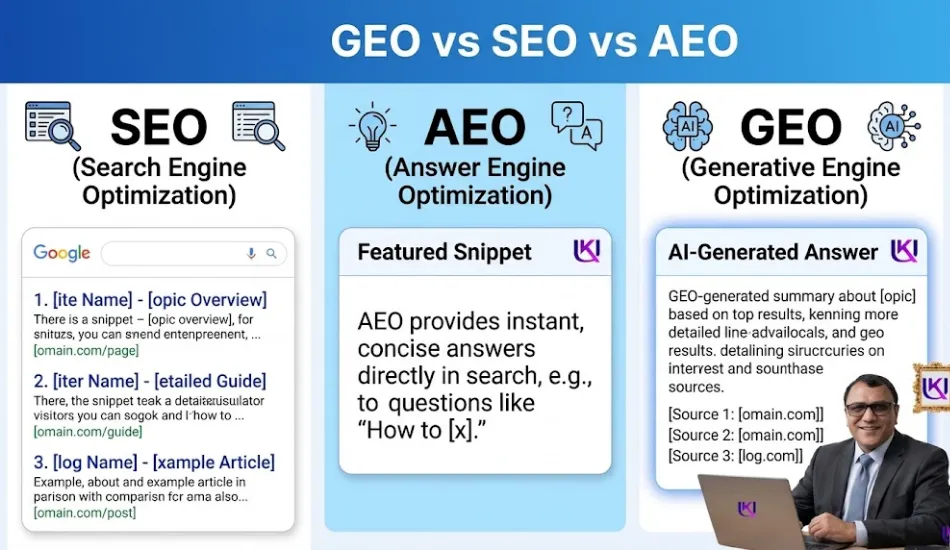
SEO vs AEO vs GEO: Key Differences
| Comparison | SEO | AEO | GEO |
| Main goal | Search visibility | Direct answers | AI answer visibility |
| Main focus | Website and pages | Questions and answers | Brand and information |
| Search experience | Search results | Answer-focused results | Generative AI responses |
| Content approach | Relevant and useful content | Clear answers | Useful, supported information |
| Important signals | Relevance, links, technical access | Answer clarity and relevance | Retrieval, relevance and source quality |
| Measurement | Rankings, clicks, impressions | Answer visibility | AI mentions and citations |
| Examples | Google Search | Featured snippets | ChatGPT and Perplexity |
Note: These are practical distinctions, not separate official ranking systems. The three areas overlap, and different platforms use different methods.
Can SEO, AEO, and GEO Work Together?
Yes. In fact, combining them gives you a more complete search strategy.
Consider a US-based plumbing company that wants more local customers.
You can use all three approaches:
SEO: Improve Google Search Visibility
Create a service page targeting “emergency plumber in Austin, TX.” Improve its local relevance, technical setup, and internal links.
AEO: Answer Customer Questions
Add useful answers about emergency plumbing costs, common pipe problems, and when to call a plumber.
GEO: Build AI Search Visibility
Publish accurate service information, show real customer experience, earn relevant local mentions, and maintain consistent business details across trusted sources.
When these activities work together, your business can build visibility across different search experiences.
Which Strategy Should You Focus on First?
If you are a small business owner, start with SEO fundamentals. Make sure your website can be crawled, your pages answer customer needs, and your business information is accurate.
Then improve your content for direct answers and build your brand’s presence across relevant sources.
You do not need three separate websites or three unrelated content strategies.
The practical approach is simple:
- Use SEO to build your search foundation.
- Use AEO to answer customer questions.
- Use GEO to improve your visibility in AI-generated answers.
This approach helps you serve people first while making your business information easier for search and AI systems to understand.
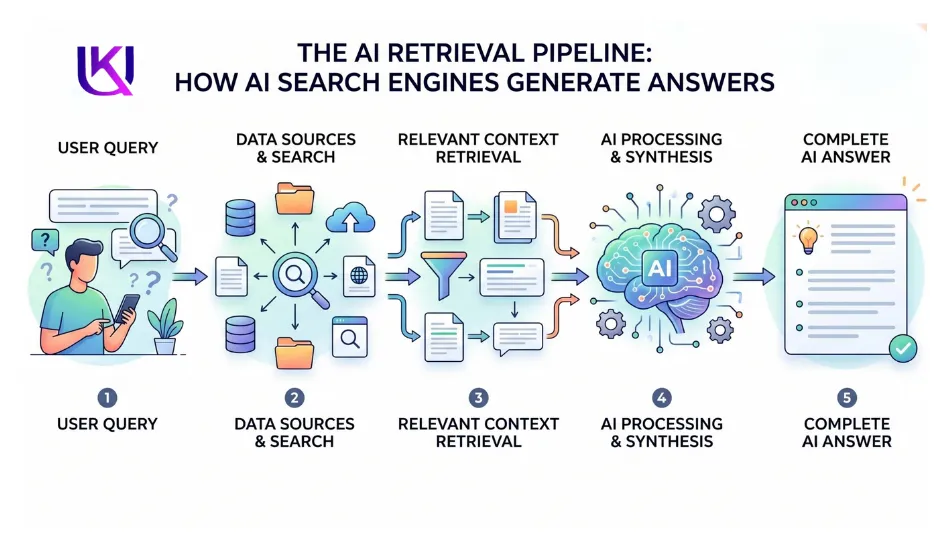
How Does GEO Work?
Different AI search platforms use different systems. Some retrieve information from web search results, while others may use their own indexes, connected sources, or previously learned information.
A common process looks like this:
- Discover: An AI-powered system finds relevant information from accessible sources.
- Retrieve: It selects information that may help answer the user’s question.
- Understand: It processes the information and identifies useful facts and context.
- Generate: It creates an answer based on the information available to it.
- Reference: Depending on the platform, it may show links or citations to supporting sources.
This is a simplified explanation, not a fixed process used by every AI platform.
Why Does GEO Matter for Your Business?
Your potential customers may now use AI tools to compare services, research products, and find expert advice before making a decision.
If your brand has a clear identity and useful information across trusted sources, you have more opportunities to become part of these discovery journeys.
For your business, this means focusing on three things:
- Make your brand easy to identify.
- Publish useful content that answers real customer questions.
- Build a reliable online presence through your website and relevant external sources.
The goal is not simply to appear in an AI answer. You want customers to understand your expertise and have a good reason to visit your website.
Important 2026 Update: Google Introduces New GEO Visibility Reports
Google has made an important change for website owners in 2026.
On June 3, 2026, Google announced new Generative AI Performance Reports in Google Search Console. According to Google’s August 31, 2026 update, these reports and controls have rolled out worldwide.
The new reporting system gives website owners more insight into how their pages appear in Google’s generative AI search features.
You can now review:
| Report data | What it tells you |
| Impressions | How often your website links appear in supported AI features |
| Pages | Which website URLs appear |
| Countries | Where those impressions come from |
| Devices | Which devices users are using |
| Dates | How visibility changes over time |
Google also introduced a Search generative AI control in Search Console. Website owners can manage whether their website’s links and content are included in supported Google AI search features.
How to use this update for your GEO strategy:
- Open your Google Search Console account.
- Select your verified website property.
- Find the Generative AI performance report.
- Review impressions and pages.
- Compare visibility by country and date.
- Check the Search generative AI control to confirm your inclusion setting.
Important distinction
These reports measure visibility in Google’s supported AI search features, such as AI Overviews and AI Mode. They do not measure your brand mentions or citations in ChatGPT or Perplexity.
For those platforms, you need separate AI visibility tracking and manual prompt testing.
Beginner’s learning guide: What Is SEO and How Does It Really Work in 2026?
FAQs: How can a business improve visibility in GEO Strategy?
1. What Is a GEO Strategy in Digital Marketing?
A GEO strategy is a plan to improve how AI-powered search systems discover, understand, and reference your brand’s information. It focuses on useful content, clear business details, reliable sources, and strong online visibility.
2. What Is Generative Engine Optimization (GEO)?
Generative Engine Optimization (GEO) is the process of improving your website and brand information so AI search systems can find and use it when creating answers. These systems include ChatGPT, Perplexity, and Google’s AI search features.
3. How Is GEO Different From Traditional SEO?
Traditional SEO helps your website appear in search engine results. GEO focuses on making your content and brand easier for AI-powered search systems to understand and reference in generated answers. Both need useful content, clear information, and strong technical foundations.
4. How Do ChatGPT and Other AI Search Engines Find Websites?
AI search platforms use different methods to find information. Some search the web, retrieve relevant pages, and use selected sources to create answers. Your website’s accessibility, content quality, and relevance can help these systems understand your information.
5. Why Is GEO Important for Businesses in 2026?
More people are using AI-powered tools to research products, compare services, and find answers. A GEO strategy helps your business prepare for this change and build visibility beyond traditional search results.
6. Does GEO Replace SEO?
No. GEO does not replace SEO. Search engines and AI systems still depend on accessible, useful, and relevant web content. Strong SEO practices give your GEO work a solid foundation.
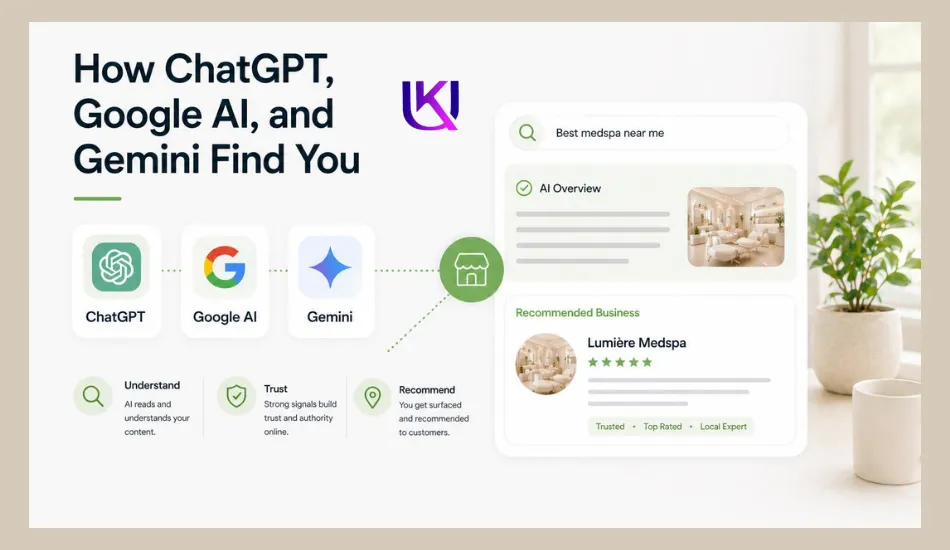
7. How Can You Improve Your Brand’s Visibility in ChatGPT?
Start by making your website easy to access. Publish clear answers to customer questions, explain your services, share real business experience, and keep your brand information consistent. You can also test relevant questions in ChatGPT to see whether your brand appears. However, no method can guarantee a mention or citation.
8. Do You Need Special Schema Markup for GEO?
No special GEO schema is required. You can use relevant structured data, such as Organization, LocalBusiness, Article, and Product schema, when it correctly describes your page. Schema helps search systems understand information, but it does not guarantee AI citations.
9. Can a Small Business Benefit From GEO?
Yes. A small business can start with clear service pages, useful local content, customer questions, real reviews, and accurate business information. You do not need a large marketing budget to build a strong foundation.
10. Is GEO the Same as AEO?
No. AEO (Answer Engine Optimization) focuses on making content useful for direct answers. GEO focuses on visibility within AI-generated responses. Their goals overlap, but they are not exactly the same.
Final Thoughts: Build Your GEO Foundation Before AI Search Grows Further
AI search is changing how people discover businesses, compare services, and find answers. Your brand needs to be ready for this shift.
A strong GEO strategy starts with the basics. Make your website easy to access. Publish useful content. Answer real customer questions. Keep your business information clear and consistent. Show your experience through real examples and trusted sources.
However, GEO does not replace SEO. Both work together to help people and search systems understand your website.
You do not need to change everything at once. Start by checking your important pages, improving weak content, and testing how AI tools respond to questions about your industry.
Your next step: Learn how to build a GEO strategy with practical steps, content improvements, and brand visibility techniques in Part 2 of this guide.
Continue reading: How to Build a GEO Strategy: 7 Steps to Improve Your Brand’s AI Search Visibility.
Sources: