

What is an SEO audit? If your website is not getting visitors from Google Search, loading slowly, or struggling to appear in search rankings, an SEO audit helps you find out why.
You built a website. You published content. You waited.
But Google still isn’t sending you traffic.
You don’t know what’s wrong. The site looks fine to you. But something is clearly broken under the hood.
That’s exactly where an SEO audit comes in.
Think of it as a complete health check for your website. It looks at important areas such as technical SEO, on-page SEO, website performance, user experience, mobile friendliness, internal linking, XML sitemaps, crawl errors, broken links, and indexing problems.
An SEO audit also uses tools like Google Search Console and Google Analytics to uncover hidden SEO issues that may be hurting your organic traffic.
In 2026, when Google pays close attention to website health, Core Web Vitals, and overall user experience, running an SEO audit is often the first step toward improving visibility, attracting more visitors, and helping your website perform better in search results.

What Is an SEO Audit?
An SEO audit is a full check-up of your website.
It shows you what’s working, what’s broken, and what’s holding your site back from ranking on Google.
Think of it like a doctor’s visit, but for your website.
When you go to a doctor, they check your blood pressure, your heart, and your lungs. They don’t just guess what’s wrong. They run tests. They look at data. Then they tell you exactly what needs fixing.
An SEO audit does the same thing.
It looks at your whole website, the structure, the pages, the speed, the links, the content, and finds every problem that’s stopping Google from ranking you higher.
During an SEO audit, you examine important areas such as:
- Technical SEO
- On-page SEO
- Website performance
- Mobile friendliness
- Internal linking
- XML sitemap health
- Crawl errors
- Broken links
- Indexing issues
- Core Web Vitals
- Content quality
The goal is simple. You want to make it easier for Google to crawl, understand, and rank your pages.
For example, your website may have helpful content, but if pages are not indexed properly, load slowly, or contain broken links, Google may struggle to rank them. An SEO audit helps uncover these hidden problems before they cause bigger traffic losses.
Most website owners use tools such as Google Search Console and Google Analytics during an audit. These tools provide valuable data about website health, search performance, user behavior, and potential SEO issues.
In 2026, SEO audits are more important than ever. Search engine optimization (SEO) is no longer just about keywords. Google also looks at page experience, website speed, content quality, and how easily users can find the information they need.

What Does an SEO Audit Actually Look At?
A real SEO audit doesn’t just skim the surface.
A regular SEO audit helps ensure your website meets these expectations and stays competitive in search results.
Simply put, an SEO audit gives you a clear roadmap for improving your website so you can attract more visitors, increase organic traffic, and create a better experience for your audience.

15 Different Types of Basic to Advanced SEO Audits Explained
Not all SEO audits focus on the same areas. Some audits look for technical problems, while others examine content, backlinks, or user experience.
Understanding the different types of SEO audits can help you identify the right issues and prioritize improvements.
It digs deep into every part of your site. Here’s what it checks:

1. Technical SEO
This is the behind-the-scenes stuff.
Your website has a structure. Google needs to read that structure to understand your site. If something is broken in the structure, Google gets confused.
Technical SEO checks things like:
- Can Google find and read your pages?
- Are your pages loading fast enough?
- Do you have broken links leading nowhere?
- Is your site secure with HTTPS?
If your technical setup is messy, everything else falls apart, no matter how good your content is.
2. Crawl Errors
Google uses something called a crawler. It’s like a robot that visits your site and reads all your pages.
But sometimes, the crawler runs into problems.
Maybe a page doesn’t exist anymore. Maybe a link is broken. Maybe a page is blocked by mistake.
A crawl error means Google tried to visit your page and couldn’t.
An SEO audit finds every single one of those errors. Then you fix them. And Google can finally reach your pages.
3. Indexing Problems
Even if Google finds your page, it still has to decide whether to show it in search results.
That decision is called indexing.
Sometimes, pages don’t get indexed. That means they’re completely invisible in Google search. No one will ever find them no matter how good the content is.
An SEO audit checks which pages are indexed and which ones are hidden. Then you find out why and fix it.

4. On-Page SEO
On-page SEO is everything on the page itself.
This includes:
- Your title tag (the blue link people see in Google)
- Your meta description (the short text below the title)
- Your headings (H1, H2, H3)
- How you use your target keywords
- Whether your content actually answers the question someone searched for
If your on-page SEO is weak, Google doesn’t understand what your page is about and won’t rank it.
An SEO audit checks every page and tells you what’s missing, what’s wrong, and what to fix.
5. Content Audit
A content audit evaluates the quality and usefulness of your website content.
It helps identify:
- Outdated articles
- Thin content
- Duplicate content
- Missing topics
- Keyword gaps
- Low-performing pages
A content audit ensures your website continues to provide valuable information that matches what users are searching for.

6. Website Speed and Performance
Nobody waits for a slow website.
If your site takes 5 seconds to load, most people leave before they ever see your content. Google knows this. And slow sites get ranked lower because of it.
An SEO audit checks your page speed, how fast your site loads on both desktop and mobile.
It also looks at things like image sizes, unnecessary code, and server response times. All of these slow your site down without you knowing.

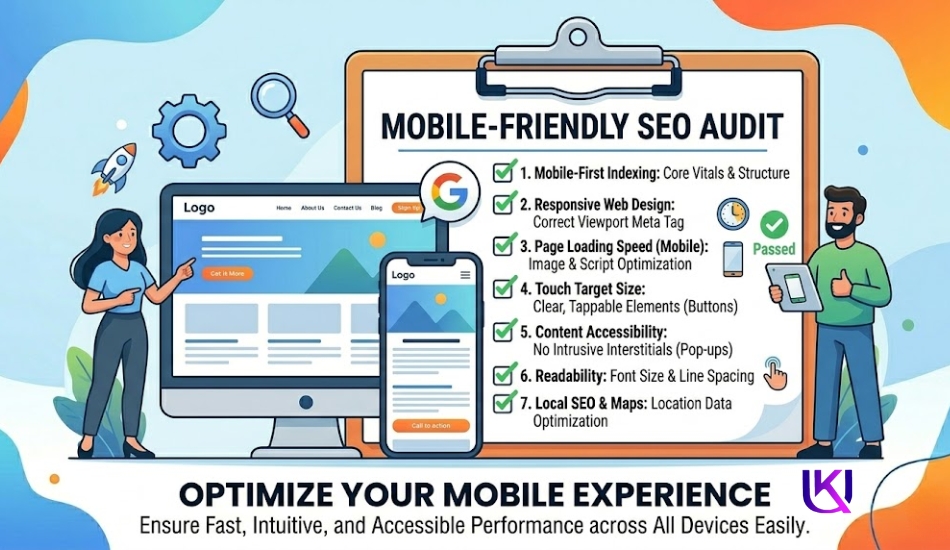
7. Mobile Friendliness
More than 60% of searches in the US happen on a phone.
Google ranks the mobile version of your site first. This is called mobile-first indexing.
If your site looks bad on a phone, with tiny text, broken buttons, and weird layouts, you will rank lower. Period.
An SEO audit checks how your site looks and works on mobile. It finds every place where the experience breaks down.
8. Internal Linking
Internal links are links inside your website that connect one page to another.
They do two things:
- They help visitors find more content on your site
- They help Google understand which pages are most important
If your internal links are missing or broken, Google can’t map out your site. Important pages don’t get the attention they deserve.
An SEO audit looks at your full internal linking structure and tells you where the gaps are.
9. XML Sitemaps
An XML sitemap is like a map of your website.
It tells Google: “Here are all my pages. Please check them.”
If your sitemap is missing, outdated, or broken, Google might miss some of your most important pages.
An SEO audit checks your sitemap and makes sure it’s correct, updated, and submitted to Google properly.
10. Broken Links
Broken links are links that go nowhere.
You click, and you get an error page.
They hurt your user experience. They waste Google’s crawl budget. And they make your site look old and poorly maintained.
An SEO audit finds every broken link across your entire site so you can fix or remove them.
11. User Experience (UX)
Google cares a lot about how people feel when they visit your site.
Do they find what they’re looking for quickly? Do they stay on the page? Do they leave right away?
User experience (UX) signals like bounce rate, time on page, and click-through rate all affect your rankings.
An SEO audit looks at how easy your site is to use. It finds places where people get confused, frustrated, or stuck.
12. Backlink Audit
Backlinks remain an important ranking factor. A backlink audit reviews the websites linking to your pages.
This audit helps you find:
- High-quality backlinks
- Toxic backlinks
- Spam links
- Lost backlinks
- Link-building opportunities
Strong backlinks can improve authority, while harmful links may negatively affect search performance.

13. Local SEO Audit
If your business serves a specific city or region, a local SEO audit is essential.
This audit checks:
- Google Business Profile optimization
- Local citations
- NAP consistency (Name, Address, Phone Number)
- Local keyword targeting
- Customer reviews
- Local search visibility
It helps your business appear in local search results and map listings.
Here is my real example: UK Deb Professional SEO Service and Business Consultancy.
14. Competitor SEO Audit
A competitor SEO audit compares your website against those of competitors that rank for the same keywords.
It helps uncover:
- Content opportunities
- Keyword gaps
- Backlink opportunities
- Technical advantages
- Ranking strengths and weaknesses
This type of audit shows what successful competitors are doing and where you can improve.
15. Which SEO Audit Do You Need?
For most beginners, a complete SEO audit combines all of these areas. Technical SEO, on-page optimization, content quality, backlinks, and user experience work together to influence rankings.
Instead of focusing on a single issue, a full SEO audit gives you a clear picture of your website’s overall health and a roadmap to improve organic traffic and search visibility.

Why Does This All Matter in 2026?
SEO has changed a lot.
Google’s algorithm in 2026 is smarter than ever. It uses AI (Artificial Intelligence) to understand your content, your website structure, and how real people interact with your pages.
You can’t trick it with old tactics anymore.
You need a clean, fast, well-structured website with really helpful content. And you need to know exactly where your site is falling short.
That’s what an SEO audit tells you.
Without it, you’re guessing. And guessing wastes time, money, and effort.

Do You Really Need an SEO Audit?
Here’s a simple way to find out.
Ask yourself these questions:
- Is your site getting less traffic than it used to?
- Did your rankings drop after a Google update?
- Are you publishing content but not seeing results?
- Did you recently redesign your site or move to a new domain?
- Is this a brand new website?
If you answered yes to any of these, you need an SEO audit.
Even if things seem fine, a regular audit catches problems early. Small issues that seem harmless today can become serious ranking killers six months from now.
What Happens After an SEO Audit?
An audit doesn’t just hand you a list of problems.
A good SEO audit gives you a clear action plan.
It tells you:
- What’s broken and why it matters
- Which fixes will make the biggest difference
- What to prioritize first
- How to track improvement over time
You get a roadmap. Not just a report.

How Does an SEO Audit Help Improve Rankings?
Many website owners think rankings drop because Google changed its algorithm. Sometimes that is true. But often, hidden SEO issues are the real reason pages stop performing well.
An SEO audit helps you find and fix those problems before they cause even bigger traffic losses.

1. Finds Technical Problems That Hold Pages Back
Google needs to crawl and index your pages before they can rank. If search engines cannot access your content, your rankings may suffer.
An SEO audit can uncover:
- Crawl errors
- Indexing problems
- Broken links
- Slow-loading pages
- Mobile usability issues
- XML sitemap errors
Fixing these issues makes it easier for Google to discover and understand your website.
2. Improves User Experience
Google wants to rank websites that provide a good experience for visitors.
An SEO audit checks important user experience factors such as:
- Page speed
- Mobile friendliness
- Navigation
- Readability
- Core Web Vitals
When users can find information quickly and easily, they tend to stay longer on your site. This sends positive signals to search engines.
3. Helps Optimize Content
Even great content can struggle if it is not properly optimized.
An SEO audit reviews:
- Title tags
- Meta descriptions
- Heading structure
- Keyword targeting
- Internal links
- Content quality
This helps ensure each page matches search intent and gives users the answers they are looking for.
4. Identifies Weak or Outdated Content
Search results change over time. Content that ranked well a few years ago may no longer meet user expectations.
A content-focused SEO audit can help you find:
- Outdated information
- Thin pages
- Duplicate content
- Missing topics
- Pages with declining traffic
Updating these pages often leads to better visibility and stronger rankings.
5. Strengthens Internal Linking
Internal links help visitors and search engines move through your website.
An SEO audit shows where:
- Important pages have too few links
- Orphan pages exist
- Link opportunities are missing
A stronger internal linking structure helps distribute authority across your website and improves content discovery.
6. Improves Website Authority
Backlink audits reveal which websites link to you and whether those links help or hurt your SEO.
By removing harmful links and building high-quality backlinks, you can strengthen your website’s authority and trustworthiness over time.
7. Creates a Clear SEO Action Plan
One of the biggest benefits of an SEO audit is clarity.
Instead of guessing why traffic is falling or rankings are stuck, you get a list of specific issues to fix. This allows you to focus on changes that can make the biggest impact.
The Real Benefit of an SEO Audit
An SEO audit does not magically increase rankings overnight. What it does is uncover the obstacles preventing your website from reaching its potential.
When you fix technical issues, improve content, strengthen internal links, and create a better user experience, Google can better understand your website. Over time, this often leads to higher rankings, more organic traffic, and stronger long-term search visibility.
Simply put, an SEO audit helps your website become easier for both users and search engines to trust, navigate, and rank.
How Often Should You Do an SEO Audit?
For most websites, once every 6 to 12 months is a good starting point.
But if your site is large, gets a lot of traffic, or you update content often, every 3 to 6 months is better.
Also, do an audit whenever:
- Google releases a major core update
- Your traffic drops suddenly
- You make big changes to your site
What Does an SEO Audit Cost?
This varies a lot.
Free tools like Google Search Console and Screaming Frog can give you some data on your own.
But a professional SEO audit done by a real expert costs anywhere from $500 to $5,000+, depending on the size of your site and the depth of the audit.
For small businesses and beginners, even a basic audit can reveal quick wins that lead to real traffic growth.
The Bottom Line: What Is an SEO Audit and Why Does Your Website Need It in 2026?
Your website might have dozens of hidden problems right now.
Slow pages. Broken links. Missing metadata. Indexing errors. Mobile issues.
None of these are visible when you’re just looking at your site. But Google sees all of them.
An SEO audit pulls back the curtain.
It shows you exactly what’s wrong and gives you the roadmap to fix it.
In 2026, you don’t have to guess why your site isn’t ranking. An SEO audit gives you real answers, backed by real data.
And real answers lead to real results.
Need help with your SEO audit? Connect with an expert who can dig into your data and give you a real plan, not just a report.
Get more related articles: How to Do a Full SEO Audit on Your Own Website in One Hour?

FAQs: What Is an SEO Audit and What Problems Does It Solve for Beginners?
1. What is an SEO audit in simple words?
An SEO audit is a detailed check-up of your website. It finds every problem that stops your site from ranking higher on Google and tells you how to fix them.
2. How long does an SEO audit take?
A basic audit takes a few hours. A deep, professional audit for a larger site can take several days to complete.
3. Can I do an SEO audit myself?
Yes, you can use free tools like Google Search Console(GSC), Ahrefs Webmaster Tools, or Screaming Frog to check some basics. But a professional audit goes much deeper and gives you more accurate insights.
4. What’s the most important part of an SEO audit?
Technical SEO is usually the starting point because if Google can’t crawl and index your site properly, nothing else matters.
5. Will an SEO audit help my small business?
Absolutely. Small business websites often have the most to gain from an audit because small problems are easier and cheaper to fix early.